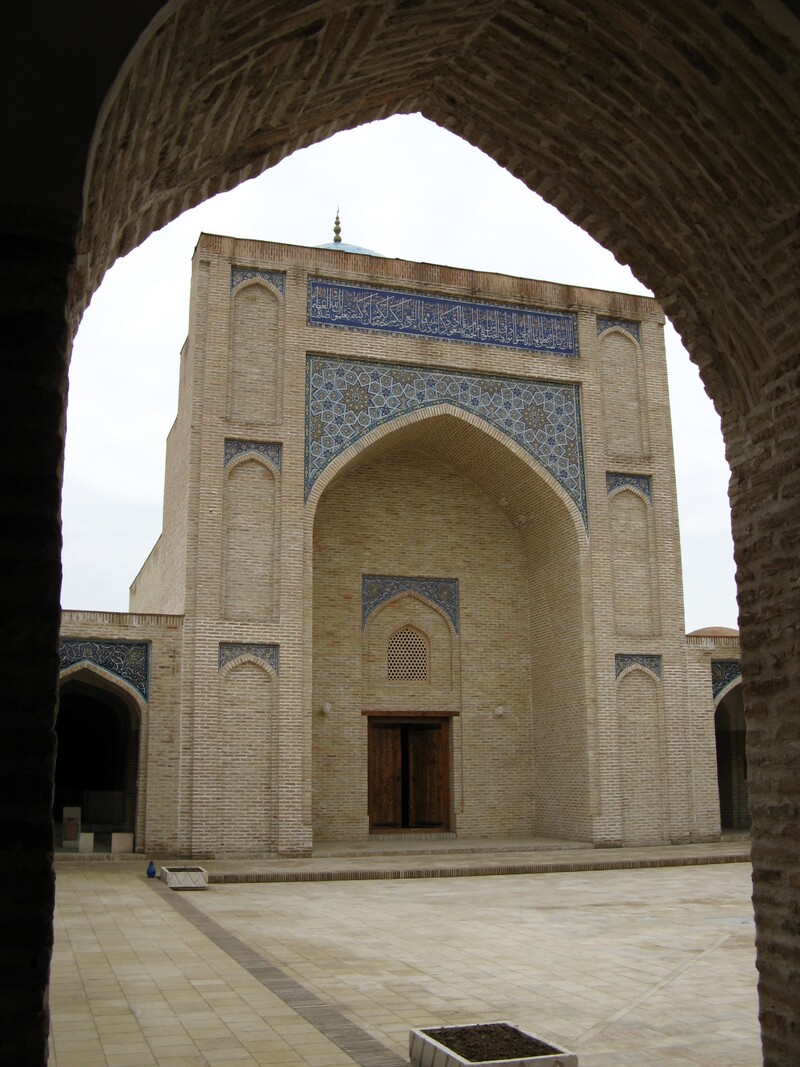
Getting Around Qarshi
Qarshi is the capital of the Qashqadaryo Region in southern Uzbekistan and a district-level city in its own right. It sits in the centre of a fertile oasis, and its historic core — the area around the Eski Bazaar, the Odina Mosque, the Kok Gumbaz Mosque and the cluster of madrassas — is compact enough that a visitor's day-to-day movements are mostly about covering short hops rather than long commutes. The practical guidance below covers what transport exists, how the pieces connect, and how to reach the city from its airport.
Arriving by Air
Qarshi is served by Qarshi Airport (IATA code KSQ). Uzbekistan Airways operates flights here from Tashkent, Navoi, Moscow-Domodedovo and Saint Petersburg. If you are flying in from abroad, the most likely routings are via Tashkent or one of the Russian cities served.
Because the airport is the city's own, it functions as your point of entry into Qarshi rather than as a distant hub. The practical options once you land are the same ones you will use around town:
- Taxi or ride-hailing — the simplest way to cover the final leg into the centre, especially if you are carrying luggage or arriving at night.
- Arranged pickup — if your hotel or guesthouse offers a transfer, take it; it removes any need to negotiate on arrival.
- Local buses — the cheapest option if you are travelling light and already know your destination, though you will need to confirm the route with your driver or a local.
Note that Qarshi has no metro or tram system, so there is no rail-based airport link to plan around. The city's rail connection is its mainline railway station, which serves longer-distance travel rather than an airport shuttle.
Rail
Qarshi has a railway station, which is the anchor for travel into and out of the city by train. For a visitor, the railway is primarily a way of arriving in or leaving Qarshi — connecting the city to the wider Uzbek network — rather than a means of getting around within it. There is no suburban or metro-style rail service for local trips, and no tram network.
If you plan to use the train, treat the station as a point-to-point gateway: arrange a taxi or a bus from the station to your accommodation on arrival, and build in time for that transfer.
Buses and Public Transport
Buses are the main form of public transport in Qarshi and the natural choice for budget-conscious travel around the city. They are the workhorse of local movement, connecting the centre with outlying districts and the surrounding area.
- Where to catch them — bus stops are distributed across the city; ask at your accommodation which stop is nearest and which route serves your destination.
- Paying — fares on local buses are typically paid on board. Carry small-denomination cash in local currency, as exact change makes the process smoother.
- Using them as a visitor — routes are not designed around tourist itineraries, so confirm the direction with the driver or a fellow passenger before boarding. This is normal practice and locals are generally helpful about it.
Beyond buses, shared taxis fill much of the gap in local transport, particularly for trips that buses do not serve directly.
Taxis and Ride-Hailing
Taxis are the most flexible way to get around Qarshi and the option most visitors fall back on. They are useful for short cross-town trips, for reaching the railway station or airport, and for the kind of door-to-door journeys that buses cannot easily provide.
- Street taxis — widely available. Agree on the fare before you set off, since metered operation is not guaranteed.
- Ride-hailing apps — app-based services are the most convenient way to book a car without negotiating, and they remove the language barrier from the transaction. Have your destination written down or pinned on a map to show the driver.
- Shared taxis — a common and inexpensive local practice, particularly for routes between towns and for filling gaps in bus coverage. They depart when the car fills, so they suit travellers who are not on a tight schedule.
For a visitor with limited time, taxis and ride-hailing are the most efficient way to link Qarshi's scattered sights — the Odina Mosque and Eski Bazaar area, the madrassa square, the Kok Gumbaz Mosque and the World War II Memorial are not all in one tight cluster, so a car between them saves considerable time.
Walking
Qarshi's central sights reward walking. The Odina Mosque sits on the southeast side of the Eski Bazaar, and the three madrassas — Kalizbek, Bakmir and Khodjaev Abdul Aziz — all stand on the same square, which makes that group easy to cover on foot in a single visit. The Kok Gumbaz Mosque, Qarshi's Friday Mosque and the largest such mosque in the region, is another walkable anchor in the historic core.
Two practical notes for walkers:
- Access to monuments — the madrassas no longer serve a religious function and are in need of restoration, but tourists can enter if they ask the guardian. The Odina Mosque now houses Qarshi's Regional Museum, so it is a straightforward visit. At the World War II Memorial, it is possible to access the upper levels on request.
- Climate — Qarshi has a cold semi-arid climate, which means hot, dry summers and cold winters. Plan longer walks for the cooler parts of the day, and carry water in summer.
Walking is best treated as the way to explore the historic core rather than as a way to cross the entire city; for longer hops, combine walking with a taxi or bus.
Putting It Together
A practical pattern for a visitor looks like this: fly into Qarshi Airport and take a taxi or arranged transfer to your accommodation; use walking to explore the Eski Bazaar, Odina Mosque, madrassa square and Kok Gumbaz Mosque; use taxis or ride-hailing for sights further out, such as the World War II Memorial; and use buses if you want the cheapest way to move around and are comfortable confirming routes as you go. For onward travel, the railway station handles longer-distance train journeys, with a taxi or bus covering the transfer at either end.