Getting Around Shagamu: A Visitor's Guide
Shagamu (also called Ishagamu or Orisagamu-Ewa) is a conurbation of thirteen towns in southwestern Ogun State, sitting along the Ibu River and Eruwuru Stream between Lagos and Ibadan. It is the capital of the Remo Kingdom, and the Akarigbo's palace is in the town of Offin. The city is spread across a number of distinct areas — among them Offin, Makun, Makun Station, Sabo, Isote, Epe, Ijagba, Ogijo, Simawa and the GRA — so plan on using local transport rather than walking between neighbourhoods. Remo, a dialect of Yoruba, is the language you'll hear most, though English is widely understood in markets, hotels and transport hubs.
How Visitors Get Around
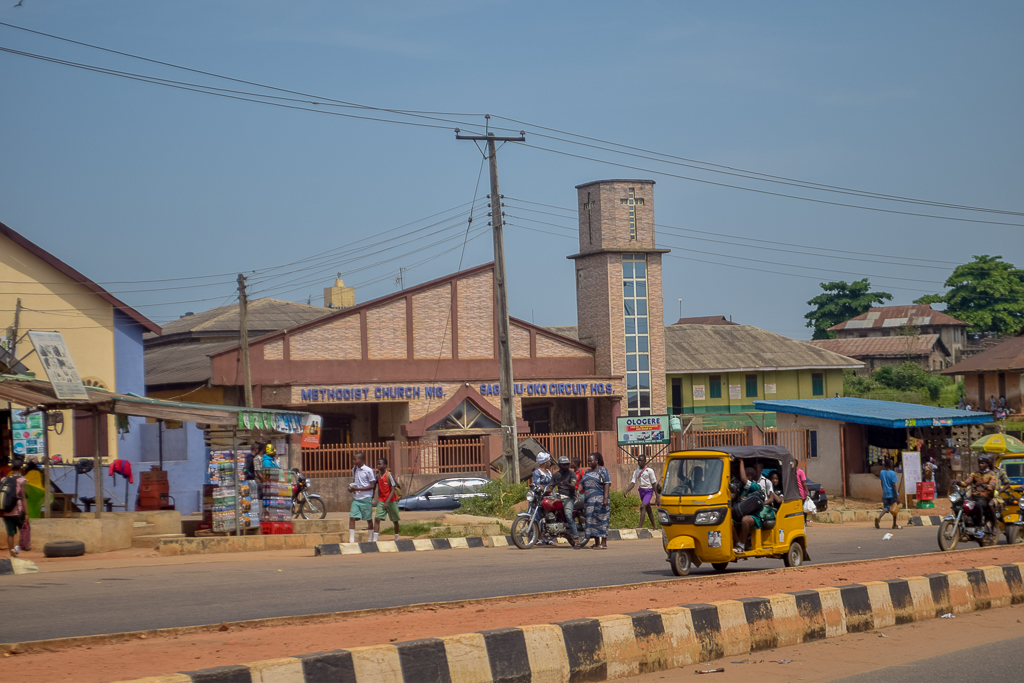
Shagamu has no metro, tram or light-rail system, and no commuter rail network serving the city itself. Getting around is done almost entirely by road, using a mix of shared taxis, minibuses, tricycles and motorcycles. These are informal, plentiful and inexpensive, and they cover the city thoroughly — the trade-off is that there is no single ticketing system, no published timetable and no fixed stops. You flag down whatever is passing and pay the driver directly.
Because fares are low and paid in cash, keep a supply of small naira notes on you. Exact change is not always available, and haggling is not usually part of the deal — the fare is the fare.
Buses and Other Public Transport
Shagamu's public transport is dominated by minibuses rather than large buses. Minibuses are scattered around the city and township, plying "every nook and cranny," so they are the most useful mode for reaching almost any part of town. Some drivers can be erratic, so hold on and keep your bearings. Fares are in the region of ₦50–100.
For longer journeys, different transport companies offer daily bus services from almost all major cities around the country, which is how most visitors arrive. If you're continuing onward to Lagos or Ibadan, ask at the motor park which companies run that route and when the next departure is.
Taxis and Ride-Hailing
Taxis are abundant in Shagamu and are hailed down by the roadside. They operate as shared taxis: the driver typically takes four passengers, three in the back and one in front. Fares range from ₦50–100. If you want the vehicle to yourself, you'll generally need to negotiate with the driver, since the default arrangement is to fill the car.
Tricycles (locally known as keke) are also everywhere, driven by "happy-go-lucky" operators who move people around the city, again at fares of roughly ₦50–100. They're a good middle option — more sheltered than a motorcycle, more nimble than a shared taxi.
Motorcycles are available if you want speed to move around the city, for a token fare. They are the quickest way through congestion, but also the least protected; use your judgement, especially after dark or in rain.
The source material does not describe app-based ride-hailing operating in Shagamu, so plan on hailing vehicles on the street or arranging a driver through your hotel rather than relying on a smartphone app.
Walkability
Walking works well within a single neighbourhood — around your hotel, the market, or a cluster of shops and eateries — but Shagamu is a conurbation of thirteen towns rather than a compact grid, and the areas of interest are spread out. For anything beyond a short stroll, take a taxi, minibus, tricycle or motorcycle. The climate reinforces this: the rainy season is generally rainy and humid, with average temperatures often in the high 20s or low 30s Celsius, while the dry season from January to April is sunnier with less rainfall. Either way, you'll want to limit long walks in the middle of the day.
Getting There From the Airport
Shagamu does not have a civilian airport, so you cannot fly directly into the city. The practical options are to fly into Murtala Muhammed International Airport in Lagos, or into Ibadan Airport, and continue overland from there. Shagamu's position between Lagos and Ibadan is precisely what has driven its growth, so both routes are well established.
From either airport, the onward leg is by road. Long-distance bus companies run daily services from major cities around the country, and shared taxis and minibuses cover the final stretch into town once you arrive. Arrange your onward transport in advance where you can — through your hotel, or by asking at the motor park — and confirm the fare before you set off, since prices for intercity runs are negotiated rather than fixed.
Practical Tips
- Carry small naira notes: local fares are low and paid in cash, and change can be scarce.
- Expect shared vehicles by default — taxis take four passengers, so a "private" ride means negotiating.
- Minibuses reach the widest range of places; tricycles and motorcycles are best for short, quick hops.
- There is no metro, tram or city rail network, and no unified transit pass — you pay each driver as you go.
- Plan around the seasons: the rainy season is humid and wet, the dry season (January to April) sunnier and drier.
- Fly into Lagos or Ibadan, then continue by road; Shagamu has no civilian airport of its own.