Getting Around Sinuiju: What Visitors Need to Know
Sinuiju sits directly across the Yalu (Amnok) River from Dandong, China, and is North Korea's main overland border entry and exit point. For a visitor, the single most important thing to understand about getting around is that independent travel is not permitted. Foreign visitors must be accompanied by an official guide at all times, and travel within the country is only allowed as part of an approved tour. In practice, this means your "transport network" is largely arranged for you — but it still helps to know what exists and how the pieces connect.
How Tourists Actually Move Around
For foreigners, movement around Sinuiju is guide-controlled. Public transport use is not permitted for visitors, so you will not be buying a ticket and hopping on a local bus or tram on your own. Instead, your itinerary vehicle plan is your transport: a border bus or car from Dandong, a local tour vehicle in Sinuiju, the train via Sinuiju Youth Station, or an arranged road transfer.
Because of this, the practical questions to settle before you travel are administrative rather than navigational. Ask your operator:
- How you will cross the border — by train, vehicle, or bus.
- Whether your guide stays with you through the border process.
- What luggage inspection at Sinuiju involves.
- Whether onward arrangements in Dandong are included.
- That all transport costs are stated in writing.
On costs generally, note that charges for taxis, hire vehicles, guides, tolls, and permits can be high and arbitrary, so written confirmation matters.
Rail
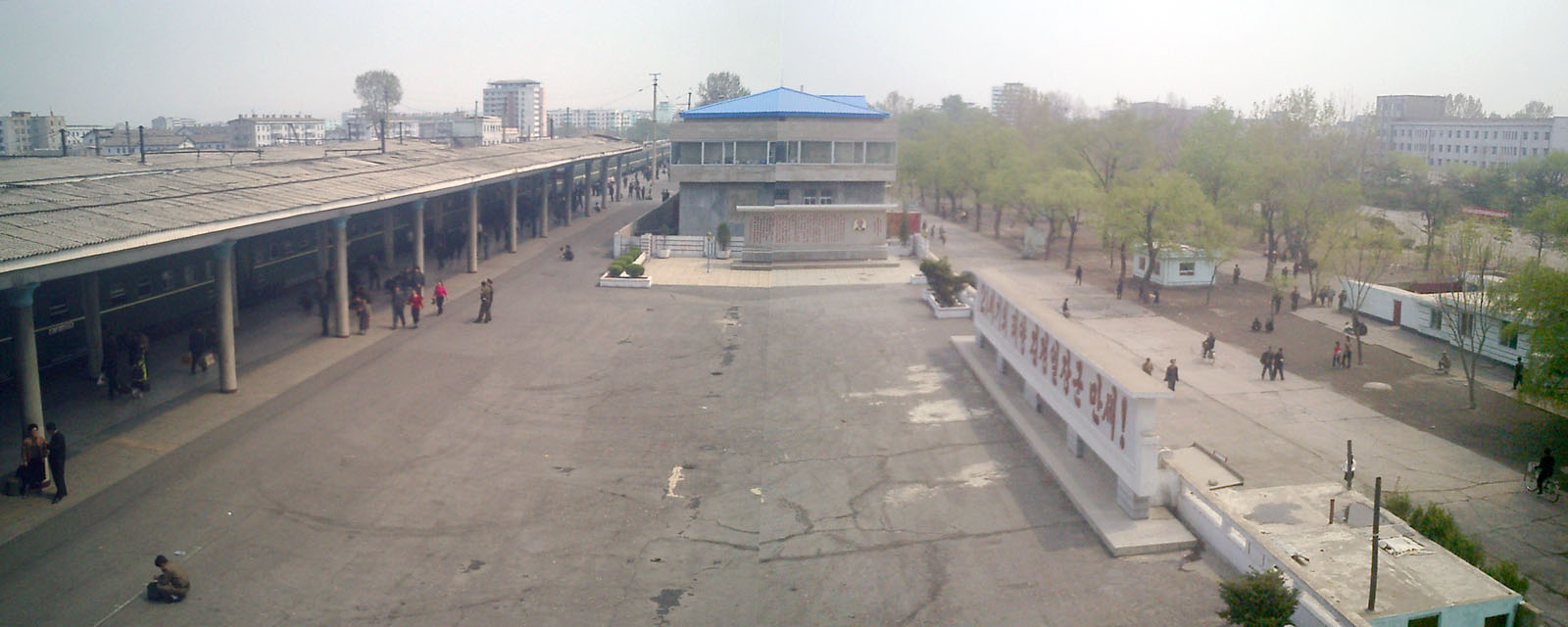
Sinuiju Youth Station (also rendered as Sinuiju Chongnyon Station) is the key rail hub. It is an important stop between Pyongyang and Beijing, and it is the northern terminus of the Korean State Railway's Pyongui Line from Pyongyang. The district is also served by several other stations on the Pyongui line, plus the Tokhyon and Paengma lines, and the city's factories are served by the Kangan Line.
The station connects to China via the Sino-Korean Friendship Bridge, which carries both rail and road across the river to Dandong. That bridge is the crossing point — pedestrians are not allowed, so you cross by train or vehicle only.
The Dandong–Pyongyang train resumed daily service, and the long stop at Sinuiju for DPRK border guard carriage inspection and immigration is a normal part of the journey; how long it takes depends on inspection efficiency. The scheduled Sinuiju–Pyongyang sector is roughly four hours by timetable but often runs longer, so build in buffer time for onward connections. Reference fares exist for the Dandong–Sinuiju sector in soft and hard sleeper classes, with child fares lower — but most visitors encounter this as part of a tour package that bundles train, guides, fees, meals, vehicles, accommodation, and permits at a higher overall price.
Metro and Trams
Sinuiju does not have a metro or tram network. The city's urban transit is a trolleybus line running from the city centre to the railway station, reopened with new trolleybuses derived from the Pyongyang Chollima-321 model. A second line that once ran from Sinuiju Chongnyon Station to the Ragwon Machine Complex closed years ago when the highway was reconstructed with a shifted alignment.
Note that this trolleybus line is local public transport, and public transport use is not permitted for foreign visitors — so treat it as context for understanding the city rather than as a mode you will ride.
Buses and Other Public Transport
There is no public bus network a visitor can use independently. The "bus station" that matters practically is your itinerary's vehicle plan: the Dandong border bus or car, the local Sinuiju tour vehicle, or an arranged road transfer. Tour operators typically provide road transportation as part of the programme.
Taxis and Ride-Hailing
There is no reliable public taxi tariff for foreign visitors, and ride-hailing is not a realistic option. Taxi and hire-vehicle charges can be high and arbitrary, which is another reason to have your operator state all transport costs in writing before you commit. In practice, you will not be flagging down a taxi in Sinuiju; your guide and vehicle are arranged in advance.
Walkability
Walking is possible within the specific sites your tour visits, but it is not a way to explore the city freely. You are accompanied by an official guide at all times, and photography and device handling are subject to guide instructions. The realistic walking experience is a guided walk around a defined set of stops rather than independent wandering.
A typical day trip from Dandong takes in the main city square, a revolutionary museum, the cosmetics factory, a folk park, an art gallery, and a kindergarten. The main city square, bounded by the museum and the railway station, is the sightseeing base for the city centre, along with the station area and restaurant stops. Because the square, museum, and station sit together, this central cluster is the most walkable part of a visit.
Getting From the Airport Into the City
Sinuiju has a small airport with a single turf runway, and Air Koryo operates passenger and cargo flights from Pyongyang. However, this is not the practical air gateway for most visitors. The airport across the border in Dandong has a more reliable schedule and more accessible connections.
The main flight gateway for DPRK itineraries is Pyongyang Sunan International Airport, which is not in Sinuiju. Flight-based Sinuiju itineraries normally arrive in Pyongyang, join an approved tour, and then travel to Sinuiju by rail or arranged road transfer. There is no independent airport taxi or bus option — you do not land and make your own way into the city.
Crossing the Border and Reaching the City
The Sino-Korean Friendship Bridge connects Dandong to Sinuiju and carries both rail and road. The bridge crossing itself takes only minutes; the real time cost is immigration, customs, the guide handoff, and inspection. A typical day-trip sequence runs: local partners take you to the customs house, you exit China, drive across the bridge, complete DPRK customs, and meet your local guide.
Entry by foot over the bridge is theoretically possible but mostly limited to Chinese citizens with appropriate visas. The older Yalu River Broken Bridge — the original Dandong–Sinuiju link, bombed during the Korean War — now ends in the river; it is a landmark visible from the Dandong waterfront, not a crossing.
There is also a way to get close to North Korea without passing border controls: excursion boats from Dandong are sometimes permitted to approach within a few metres of the Sinuiju coastline, as long as nobody lands.
Choosing Your Base
- Dandong: the best base for short Sinuiju day trips, with a rail station, riverfront, bridge access, and China-side hotels. The train station is a short walk from the Yalu River and the Friendship Bridge.
- Sinuiju city centre: the sightseeing base for the central square, railway station area, museum, art gallery, kindergarten, and restaurant stops.
- Dongrim: the base for overnight extensions — confirm drive time, road conditions, and the next morning's destination, since roads on rural programmes can be bumpy.
- Pyongyang: the base when Sinuiju is part of an exit route, such as flying into Pyongyang and leaving via Pyongyang–Dandong by train.
One naming caution: a "Sinuiju hotel" may actually mean Dongrim or another operator-selected accommodation outside the city centre, so confirm exactly where you will sleep.
Practical Notes for the Journey
- Keep documents, visa paperwork, tour confirmation, phone, camera, medicine, and declared electronics accessible for inspection.
- Follow guide instructions on photography and device handling.
- Expect the Sinuiju border stop to take time, and do not schedule tight onward connections.
- Remember that regular U.S. passports cannot be used for travel to, in, or through North Korea unless specially validated, and that travel is only permitted on official tours.