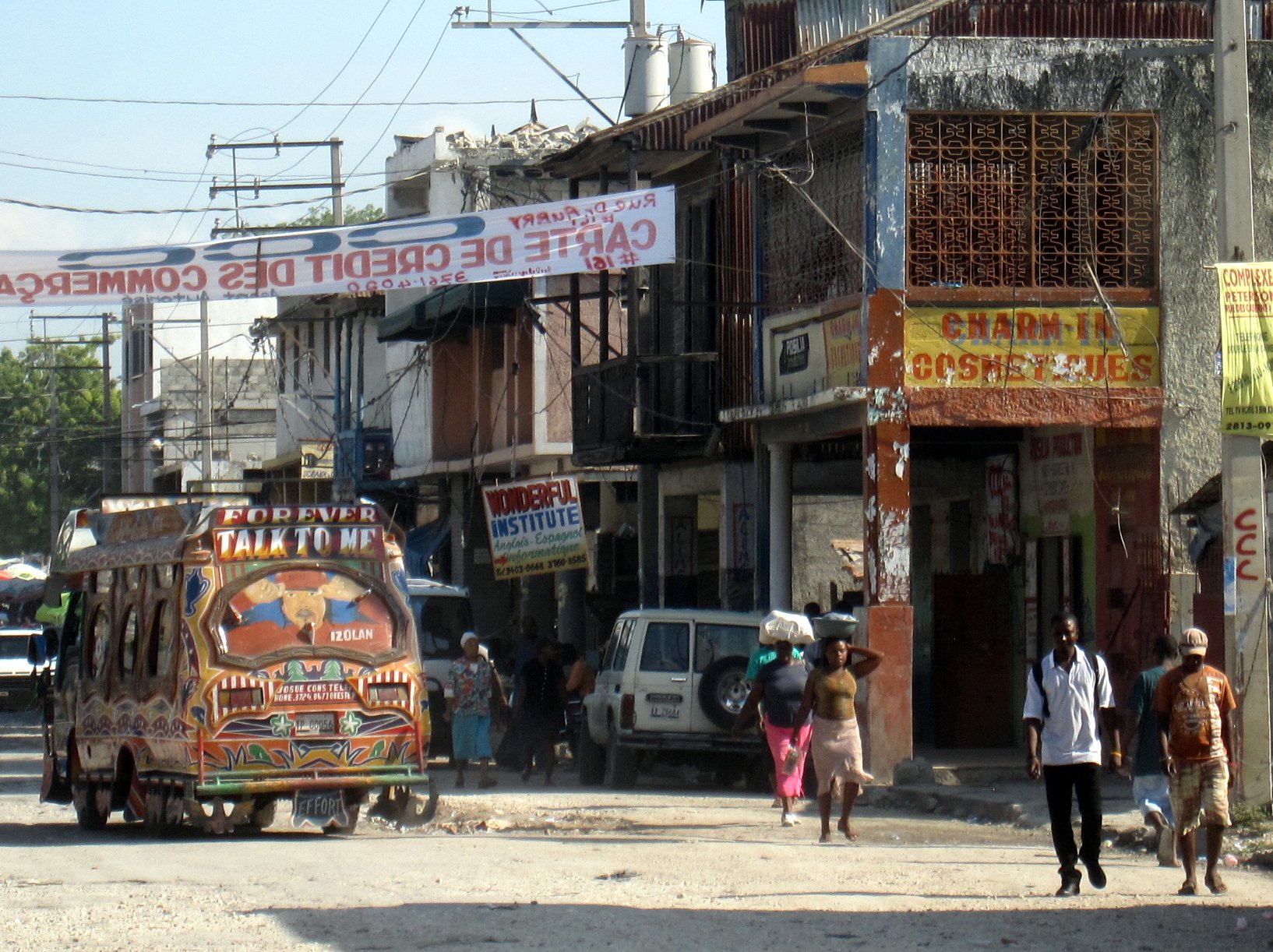
Getting Around Port-au-Prince
Port-au-Prince is a sprawling capital whose layout resembles an amphitheater: commercial districts sit near the water, while residential neighborhoods climb the hills above the bay. The metropolitan area extends well beyond the city proper, taking in communes such as Delmas, Cité Soleil, Tabarre, Carrefour, and Pétion-Ville. That geography matters for getting around, because a trip that looks short on a map can involve climbing hills, crossing congested districts, or changing vehicles. Since 2020 the city has been paralyzed by extensive gang violence, with kidnappings, massacres, and gang rapes reported as common occurrences, so visitors should treat transport choices as safety decisions as much as practical ones, keep journeys to daylight where possible, and arrange movement through trusted local contacts.
Rail, Metro and Tram
There is no rail, metro, or tram network to use in Port-au-Prince. Getting around relies entirely on road-based transport: tap-taps, buses, taxis, and private cars.
Tap-taps and Public Transport
Tap-taps are the mainstay of local public transport. They run along prescribed routes throughout the city, so the practical approach is to find the route serving your destination rather than expecting a single vehicle to take you anywhere. Fares are low, but crossing the city often means using multiple routes, and each leg is charged separately. Payment is made on board in cash, so keep small notes and coins handy.
For longer overland connections, bus companies link Port-au-Prince with Santo Domingo in the Dominican Republic, arriving at their own stations in Tabarre and Pétion-Ville. If you arrive from Santo Domingo after dark, Pétion-Ville is the safer area to head for, and it is recommended that you arrange a local pick-up by a trusted local contact for the ride from the bus station to your accommodations. A cheaper alternative is the Dominican minibus known as a guagua, which runs from Santo Domingo toward the border town of Jimani; from there you continue by local transport, including crowded tap-taps and buses, toward Port-au-Prince via Croix-des-Bouquets. Try to arrive in Port-au-Prince before dark.
Taxis and Ride-Hailing
Street taxis are widely available and are best used only during daylight. After dark, prices rise substantially and the risk of being mugged increases markedly. Downtown street taxis can be recognized by a red ribbon hanging from the rear-view mirror. Expect to negotiate the fare, and confirm it before you set off.
Several taxi options have positive reports for safety and reliability, giving visitors and locals more choices for getting around both day and night:
- Premium Rapid – a taxi service with an app downloadable from the iTunes and Google Play stores.
- Al's Taxis – based in the Thomassin area and serving the whole of Port-au-Prince; reachable only by phone.
- Nick's Taxis – a small fleet of yellow cars, still operating but looking dated and tired.
Walking
Walking is not a practical way to cover the city as a visitor. The amphitheater layout means steep hillside neighborhoods above the commercial waterfront, and the distances between districts are considerable. Combined with the security situation, walking should be limited to short, purposeful trips in areas you know, ideally in daylight and with local guidance.
Getting from the Airport into the City
Toussaint Louverture International Airport sits on Boulevard Toussaint Louverture in Tabarre, northeast of central Port-au-Prince and north of Pétion-Ville. It is the city's main gateway, served by major airlines including Air Caraïbes, Air Transat, Air France, American Airlines, and JetBlue. Sunrise Airways, the national airline based in Port-au-Prince, operates domestic and international flights; its domestic flights use the separate Guy Malary Terminal east of the main terminal on Boulevard Toussaint Louverture, so check with the airline about where to check in and depart.
By road, the airport is reached from Boulevard des Industries, north of town, which provides the most direct route toward the terminal from Route Nationale 1 via a roundabout; from the roundabout, continue on Boulevard Toussaint Louverture to the main terminal. Route Nationale 1 itself runs through downtown as the main north-south thoroughfare, and Route de Delmas connects the RN-1/RN-2 junction in Port-au-Prince toward Pétion-Ville and onward to the south coast.
For the ride into the city, the practical options are a pre-arranged pickup through a trusted local contact, one of the established taxi services with a good safety reputation, or a street taxi during daylight. Given that street taxi prices rise substantially after dark and the risk of being mugged increases, arriving in daylight and having your transfer arranged in advance is the most sensible approach.