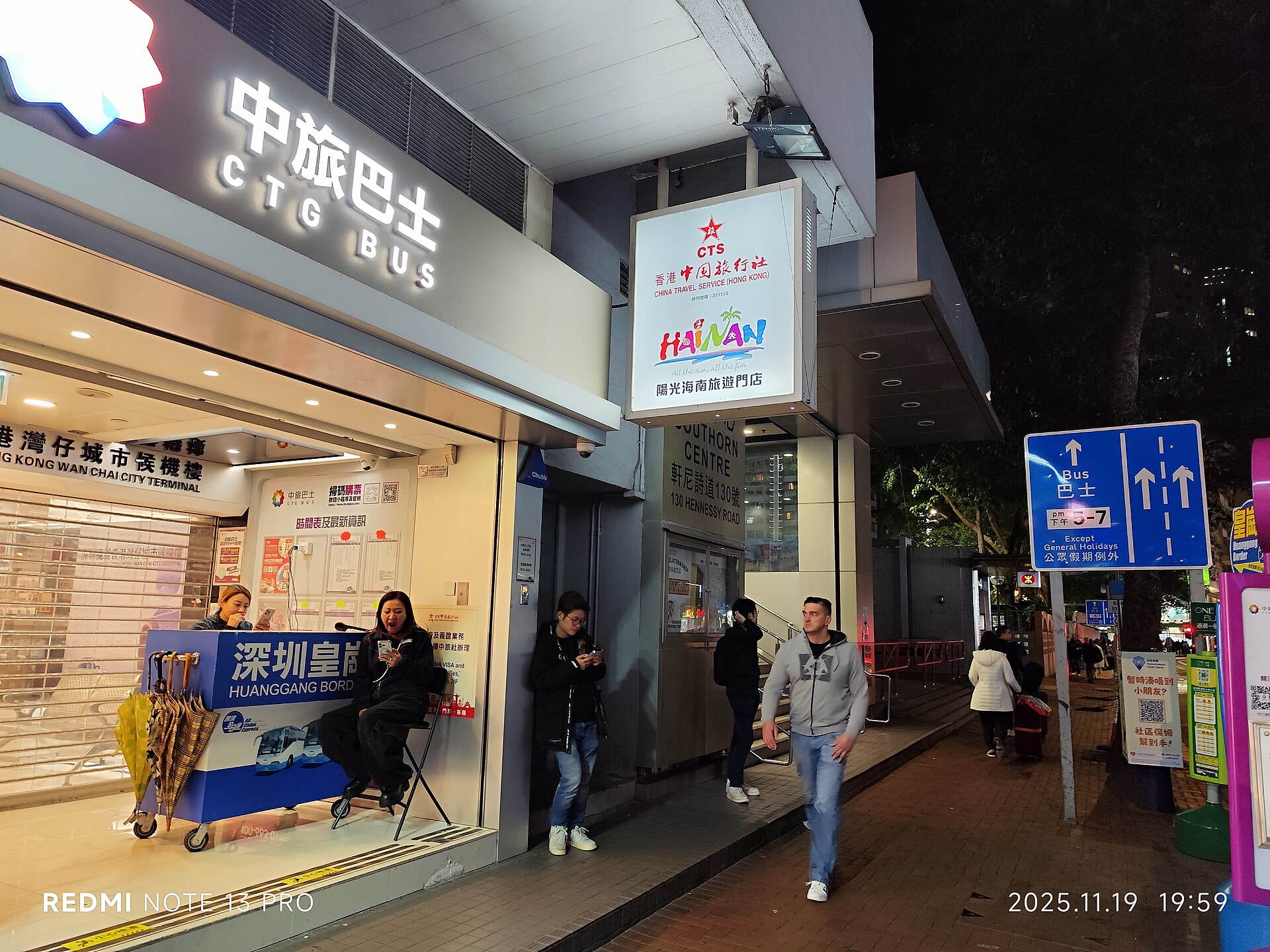
Getting Your Bearings in Wan Chai
Wan Chai sits on the northern shore of Hong Kong Island, bounded by Canal Road to the east, Arsenal Street to the west, and Bowen Road to the south. The strip north of Gloucester Road is known as Wan Chai North, where you'll find office towers, parks, hotels and the Hong Kong Convention and Exhibition Centre. The district is one of the busiest commercial areas in Hong Kong and is densely built up, so it rewards a visitor who understands the transport options before arriving.
How Tourists Get Around the City
Hong Kong's public transport is fast, relatively cheap and reliable, and it keeps running even during typhoons. Almost all MTR stations have step-free access, and those that don't are equipped with stair lifts and platform ramps, with staff on hand to assist. Because the MTR corporation develops land above its stations, major interchanges tend to sit inside malls and high-rises that also serve as bus and light rail interchanges — useful to know when you're navigating underground and emerge somewhere unexpected.
One practical caveat for anyone with mobility needs: pavements can be narrow and uneven, and some Hong Kong Island streets are actually long staircases. Raised walkways with lifts help you avoid the worst of it.
The MTR: Your Backbone
The Mass Transit Railway is the simplest way to move around. The Island Line runs along the north coast of Hong Kong Island, passing through Central, Admiralty, Wan Chai and Causeway Bay on its way east. If you're coming from Kowloon, the Tsuen Wan Line stops at Admiralty, where transferring to the Island Line is straightforward. You can also cross the harbour on the Tseung Kwan O Line or the East Rail Line.
Trams: Slow, Scenic, Cheap
The tram — locally nicknamed the "ding ding" — runs the length of Hong Kong Island from Kennedy Town in the west to Shau Kei Wan in the east, trundling right through Wan Chai. It's a great way to see this part of town without much effort or expense. It is neither fast nor especially comfortable, and it has no air conditioning — only fans and open windows — so it can be unpleasant on a hot day or on Sundays, when it gets very crowded. The tram is also cramped, with steep steps on and off, and is not wheelchair accessible. Do check that the tram you board is heading toward your destination rather than deviating off course.
Buses and Minibuses
Many buses run from Central eastwards through Wan Chai and beyond, and cross-harbour buses connect the area to Kowloon. Once you've got the hang of the bus system, journeys can actually be more comfortable than the metro — you avoid running around stations and can get a seat in a clean, air-conditioned environment.
Four main operators run the bus network: KMB (the largest, serving Kowloon and the New Territories), Citybus (Hong Kong Island and cross-harbour routes), Long Win (airport, Tung Chung and Disneyland), and New Lantau Bus (Lantau). Most are double-decker buses with low floors, wheelchair ramps and designated wheelchair areas. Note that airport buses are not wheelchair accessible — use the Airport Express instead.
Minibuses come in two flavours: green ones run fixed routes and timetables and can be flagged down at official stops, while red ones are owner-operated with driver-chosen routes and stop on request. Minibuses are among the cheapest ways to travel but are not wheelchair accessible. On some newer buses you press a button to request a stop; otherwise, call out "ba si jaam mm goi" — "bus stop, please."
Taxis and Ride-Hailing
Taxis are cheap enough if you want to get around in comfort — a ride from Hong Kong Station to Causeway Bay runs around HK$30 depending on traffic. There are three types: red taxis serve urban areas and are the most expensive, green taxis cover the New Territories, and blue taxis are confined to Lantau. Fares are displayed on the dashboard, and tipping is not expected. Drivers prefer cash, though some accept Octopus or contactless payment. If you're arriving at the airport, note that there are separate queue sections for each taxi type.
The taxi trade has historically operated under a fixed number of licences, but the government has recently allowed new app-based operators with citywide operating freedom, and newer vehicles have improved wheelchair access.
Paying for Transport: Octopus and Beyond
The Octopus card is the single most useful thing in your pocket. It's a stored-value card usable on most public transport as well as in shops, convenience stores, vending machines and some venues. Contactless credit and debit cards are increasingly accepted too, and Octopus is also available via its app, Apple Pay and Google Wallet. Concessionary fares — including for wheelchair users — are applied automatically on the MTR, buses, ferries (including the Star Ferry) and the Light Rail when you tap the relevant Octopus.
Ferries and the Waterfront
Wan Chai Pier is served by the Star Ferry from Hung Hom and Tsim Sha Tsui in Kowloon — a classic, inexpensive harbour crossing. The Star Ferry runs departures every few minutes from early morning to late night. North Point, a short hop east, also has a pier with frequent services to Hung Hom, Kwun Tong and Kowloon City, and there's a ferry pier at Sai Wan Ho as well. Ferries generally are wheelchair accessible, though some piers have steep ramps depending on the tide, so assistance may be needed.
Walking Around Wan Chai
Wan Chai is a light walk from Central and from Hong Kong's main transport hubs — except during the summer heat, when you'll be grateful for the MTR. The district is densely populated and compact, with landmarks such as the Hong Kong Convention and Exhibition Centre, Central Plaza and the Hopewell Centre all within the area. Wan Chai North, with its office towers, parks, hotels and exhibition centre, is a particularly walkable pocket near the waterfront. Just watch for narrow, uneven pavements and the occasional street that turns out to be a long staircase.
Getting In from the Airport
The Airport Express is the dedicated rail link into the city, with step-free access, dedicated wheelchair spaces and a ramp available on request from platform staff. It's the recommended option for anyone with mobility needs, since airport buses are not wheelchair accessible. Long Win operates the airport bus routes for those who prefer to travel by road, and taxis queue at the airport in separate lanes by type — red for urban Hong Kong Island, where Wan Chai is located.
Quick Practical Summary
- Best all-round option: the MTR Island Line, which runs straight through Wan Chai along the north shore of Hong Kong Island.
- Best for sightseeing: the tram — flat fare, no air conditioning, not wheelchair accessible, and crowded on Sundays.
- Best for comfort: buses, including cross-harbour routes to Kowloon, once you've learned the routes.
- Cheapest: minibuses, though they aren't wheelchair accessible.
- Most convenient door-to-door: taxis — cheap by international standards, cash preferred.
- Essential purchase: an Octopus card, which works across transport, shops and vending machines.
- From the airport: take the Airport Express for step-free, accessible travel into the city.