Getting Around Paris 19 Buttes-Chaumont
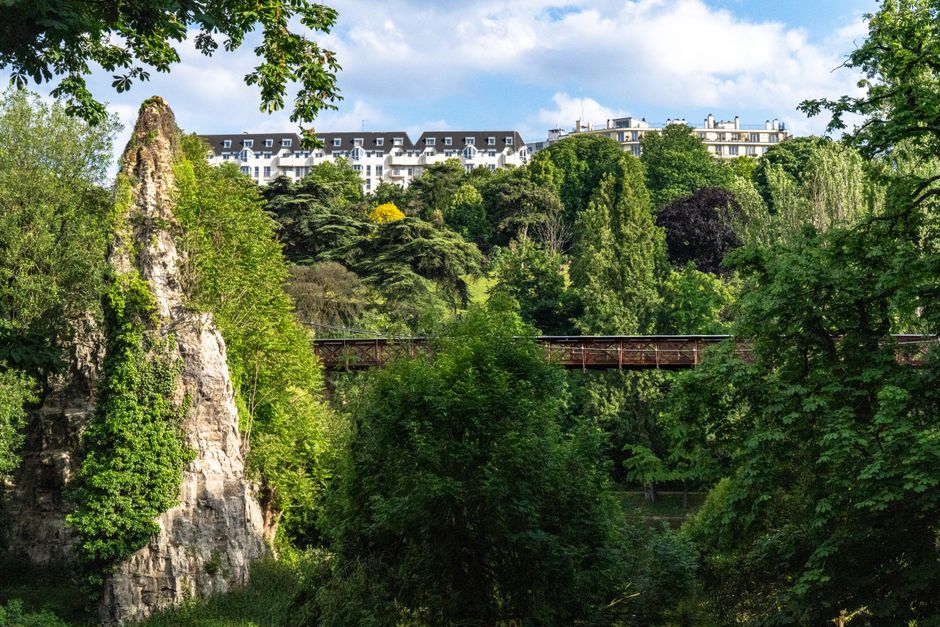
The 19th arrondissement sits in the northeast of Paris, and its best-known green space, Parc des Buttes-Chaumont, is well served by public transport. The park itself is a large public garden with an artificial lake, a cliff-top belvedere, and the Temple de la Sibylle, a miniature Roman temple on the Belvedere island. Whatever brings you to the area, you'll find that Paris rewards visitors who use the city's dense network of trains, metros, trams, and buses rather than trying to drive.
How Tourists Move Around the City
Paris is a compact, walkable city with one of the densest public transport networks in the world. Most visitors combine three modes: the metro for short hops across the city, the RER and Transilien rail lines for longer journeys and airport connections, and their own two feet for exploring individual neighbourhoods. Buses fill in the gaps and are especially useful when you want to see the city above ground rather than underground.
The whole system is integrated, so a single ticket or pass can usually cover metro, bus, tram, and RER journeys within the city. That integration is what makes Paris easy to navigate without a car.
Rail, Metro, and Tram Network
The metro is the backbone of city travel. Stations are close together, trains run frequently from early morning until after midnight, and lines crisscross the city so that most destinations require at most one change. For the Buttes-Chaumont area specifically, the nearest metro station is Buttes Chaumont on Line 7B, roughly a short walk from the park. Laumière on Line 5 is another convenient option, a slightly longer walk away. Lines 11, 5, and 7B all serve the surrounding area.
Service starts early and runs late: the first metro on Line 7B arrives around 5:33 AM, and the last runs around 1:11 AM. If you're out late, check the time of the final train on your line, as last departures vary.
The RER is the fast regional rail network that complements the metro. It's the quickest way to cover longer distances, including connections to the airports, and it links central Paris with the suburbs and beyond. Trams operate mainly on the edges of the city rather than through the historic centre, but they're a comfortable, above-ground option where they run.
Buses and Other Public Transport
Buses are a practical alternative to the metro, particularly for reaching the Buttes-Chaumont area. Several lines serve the park: 26, 48, 60, 75, and 71. Useful stops near the park include Jean Menans – Buttes Chaumont, the closest stop at about a five-minute walk; Armand Carrel – Mairie du 19ème, also around five minutes; and Alouettes, about a six-minute walk.
Bus routes fan out across the city and into the suburbs. Line 75 heads toward Porte de Pantin, line 48 toward Romainville – Vassou, line 60 toward Gambetta – Japon, and line 71 toward Bibliothèque François Mitterrand. Buses start early and run late: the first bus on line 48 is around 5:45 AM, and the last bus on line 71 is around 1:13 AM.
Buying tickets is straightforward. Single tickets and multi-ride packs are available from machines at metro and RER stations, from bus drivers in some cases, and via reloadable travel cards. Day passes and multi-day passes are worth considering if you plan to travel frequently, since they cover metro, bus, tram, and RER journeys within the relevant zones. Tickets are validated on entry; keep your ticket with you until you exit, as inspectors do check.
Taxis and Ride-Hailing
Taxis are metered and can be hailed in the street, found at official ranks, or booked by phone. Ride-hailing apps offer an alternative and are widely used in Paris. Both are most useful late at night when metro and bus service has ended, when you're carrying luggage, or when you're travelling to a destination poorly served by public transport. Expect higher fares during peak hours and at night. For the Buttes-Chaumont area, a taxi or ride-hail can drop you close to the park entrances, which is convenient if you're arriving with bags or travelling as a group.
Walkability
Walking is one of the best ways to experience Paris, and the 19th arrondissement is no exception. The park itself has an extensive internal network of roads and paths, so once you arrive you can spend a long time exploring on foot. The surrounding neighbourhood is also walkable, with landmarks such as Place Armand Carrel, the Mairie du 19e arrondissement, Église Saint-Serge, and Rosa Bonheur within reach.
Distances between metro or bus stops and the park are short: the nearest metro station is about a seven-minute walk, and the closest bus stop about five minutes. Comfortable shoes are essential, as Paris streets and park paths are often uneven.
Getting from the Airport into the City
Paris's main airports are connected to the city by rail and road. The RER regional rail network provides a direct link from the airports into central Paris, and it's generally the fastest and most economical option. Trains run frequently throughout the day and into the evening.
Alternatively, you can take a taxi or ride-hailing service from the airport directly to your accommodation. This is more expensive but convenient, especially if you have heavy luggage or arrive late at night. Airport buses also run between the terminals and various points in the city, offering a middle-ground option.
Once you're in the city, the same tickets and passes that cover the metro and buses generally cover your onward journey, so you can connect from the airport rail station to the metro and continue to the Buttes-Chaumont area without buying a separate ticket. From central Paris, take Line 7B to Buttes Chaumont station or Line 5 to Laumière, or catch one of the buses serving the park.
Practical Tips
- Buy a reloadable travel card or a day pass if you plan more than a couple of journeys; it simplifies travel across metro, bus, tram, and RER.
- Keep your ticket until you leave the system; inspections are common.
- Check the time of the last metro or bus on your line if you're out late, as final departures vary by line.
- Use the metro for speed and the bus for sightseeing above ground.
- For the park, aim for Buttes Chaumont (Line 7B) or Laumière (Line 5), or the Jean Menans – Buttes Chaumont bus stop.
- Walk when you can; the 19th arrondissement and the park itself are best explored on foot.