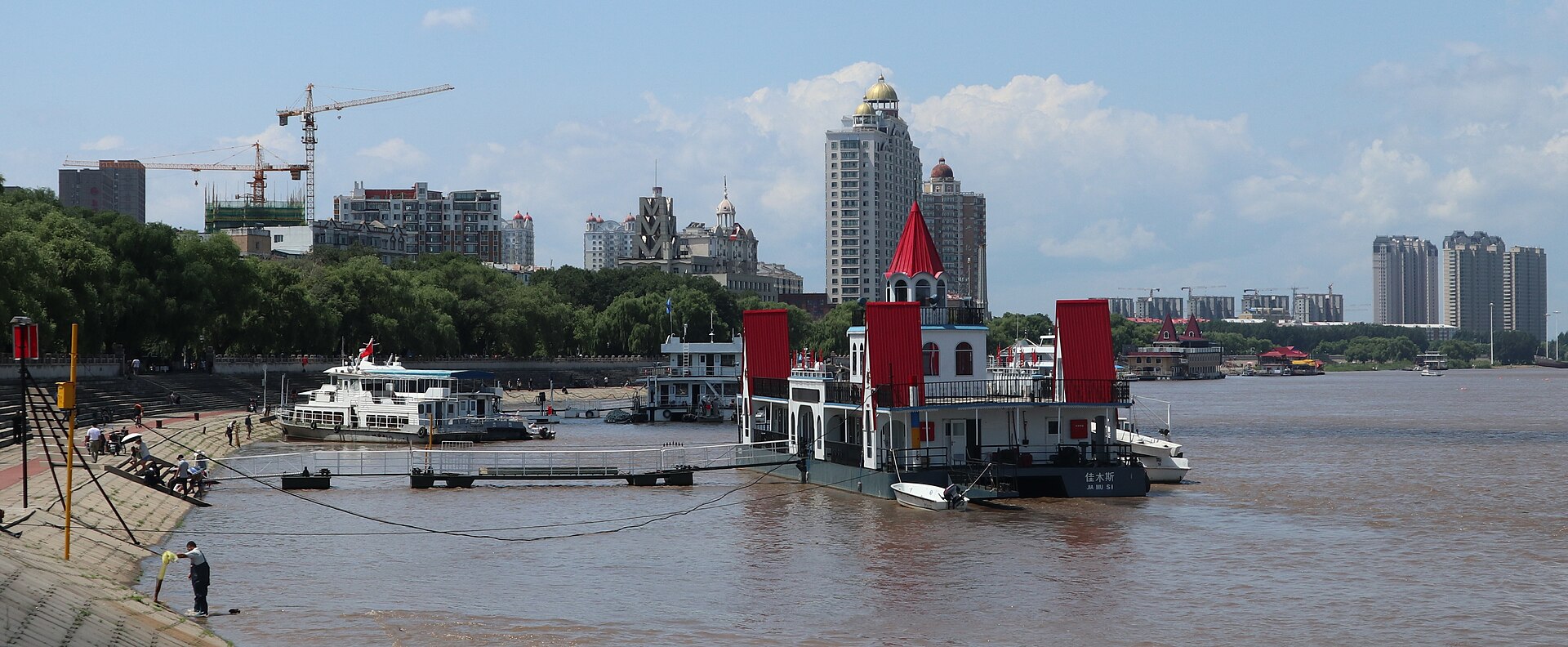
Getting Your Bearings
Jiamusi sits in eastern Heilongjiang province, along the middle and lower reaches of the Songhua River, and serves as the transport hub for the region. For a visitor, the practical geography is simple: the built-up urban core is made up of four districts — Qianjin, Xiangyang, Dongfeng and Jiaoqu — and most of what you'll want to see, plus the main railway station and the long-distance bus terminal, lies within it. The city's sights, including Songhua River Park, Sifengshan Reservoir and the Jiamusi Museum, are only a short ride from the downtown area.
One thing to settle before you arrive: Jiamusi has no metro and no tram system. Buses, taxis and ride-hailing are how you get around, and that's true for residents as much as visitors.
Buses
The bus network is the backbone of public transport and is described as extensive, covering residential areas, commercial centres, tourist spots and the railway station. The main hubs are Jiamusi Railway Station and the major commercial districts, so if you're unsure where to start, head for one of those and you'll find routes radiating outward.
- Fares: low and generally flat-rate, in the region of a few yuan per ride. Sources differ slightly on the exact band, so treat the fare as cheap and carry small notes.
- Payment: cash is accepted but exact change is often required, and drivers may not carry change. Mobile QR payment through WeChat Pay or Alipay is the smoother option.
- Hours: buses run from roughly early morning until around 9–10 PM, with more frequent service on popular routes at peak times.
- Stops: marked with route numbers and destinations, but signage is mainly in Chinese characters, so having your destination written in Chinese helps.
Buses are the cheapest way to move around the urban core, but accessibility is limited for travellers with mobility needs, and the wider street infrastructure can be a challenge too.
Taxis and Ride-Hailing
Taxis are plentiful and can be flagged down at many points around the city, or booked by phone or app. Licensed cars are identifiable by their colours and roof signs, and they run on meters.
- Cost: metered, with a modest flag-fall charge and a per-kilometre rate; night surcharges may apply. For longer trips, agree the price with the driver in advance.
- Payment: cash is accepted, but drivers generally prefer WeChat Pay or Alipay.
- Ride-hailing: Didi Chuxing is the dominant app. It has an English interface and supports registration with an international phone number and credit card, and it shows driver and vehicle details plus trip sharing — useful if you don't speak Chinese.
Two practical cautions: language barriers with taxi drivers are common, so a translation app is worth having, and make sure the meter is running or that you've agreed a fare before setting off. Tipping isn't expected and can cause confusion.
Walking and Cycling
The city centre and the riverside along the Songhua River are the most pedestrian-friendly parts of Jiamusi. Sidewalks exist throughout but can be crowded or obstructed, so allow extra time.
For cyclists, there are some dedicated bike lanes, and the urban core has riverside cycling lanes separated from motor traffic — a flat, traffic-free greenway along the Songhua is the standout option. Away from the dedicated lanes, cyclists often share the road with vehicles or the pavement with pedestrians, and helmets are not widely used locally. Shared bicycles may be available through apps, though these typically require WeChat or Alipay integration.
Note that there are no formal guided walking tours commonly available for international visitors, and tour buses or hop-on-hop-off services are uncommon. River excursions on the Songhua in the warm months are for sightseeing rather than commuting.
Rail Connections
Jiamusi is a rail hub for northeast Heilongjiang, and trains from Jiamusi Railway Station connect the city with Beijing, Jinan, Dalian, Harbin, Tianjin and other cities. The Harbin–Jiamusi intercity railway has cut the trip to Harbin substantially, making the provincial capital a straightforward journey rather than an overnight undertaking.
For local planning, two stations matter most:
- Jiamusi Railway Station — on Zhanqian Road in Qianjin District, handling conventional services and also a hub for city buses.
- Jiamusi West Railway Station — on Xilin Road in Qianjin District, the hub for high-speed lines.
There's also Lianjiangkou Station out in Lianjiangkou Town, a suburban stop where the Suijia and Hegang lines meet. Beyond the city, trains reach Tongjiang, Fujin and Fuyuan, which is how you'd approach the border and easternmost sights if you're not driving.
Long-Distance Buses and River Transport
The main long-distance bus station is Jiamusi Passenger Terminal on Shunhe Street in Qianjin District, serving surrounding cities and regions. Another reference point for the main bus station is Zhanqian Lu, also in Qianjin District — convenient if you're arriving or departing by train.
In summer months, boats run along the river from Harbin, and passenger ships sail from Jiamusi up the Songhua to Qiqihar and Harbin, or downstream to Tongjiang and on to Khabarovsk in Russia. The river season is limited, generally mid-April until early November. In winter and spring there's also a hovercraft service into Tongjiang from Nizhneleninskoye in Russia.
Getting In from the Airport
Jiamusi Dongjiao Airport (JMU) is the city's main airport, located east of the city centre on Andong Road in Songjiang Township, Dongfeng District. It handles domestic flights from cities including Beijing, Shanghai, Guangzhou, Shenzhen, Dalian and Harbin, along with international services such as Khabarovsk and Seoul.
Two options get you into town:
- Airport shuttle bus: links the airport with downtown, the railway station and the bus terminals — the simplest choice if you're heading straight for a onward connection.
- Taxi: reaches the city centre in roughly 15–20 minutes.
Heilongjiang has other civil airports in the region — Fuyuan Dongji Airport, which mainly serves Harbin flights and is the closest airport to the Easternmost Scenic Area, and Jiansanjiang Wetland Airport, serving Fujin and the wetland tourism zones. If your plans extend east, it's worth checking whether one of those fits better than routing back through Jiamusi.
Practical Tips
- Navigation apps: Baidu Maps or Amap are useful for real-time routes, schedules and arrival times, though they're mainly in Chinese.
- Language: have destination names written in Chinese characters or Pinyin to show locals and drivers.
- Payments: WeChat Pay and Alipay dominate. If you rely on international platforms that are blocked, install a VPN before you arrive.
- Cash: carry exact change for bus fares.
- Traffic: can be unpredictable, especially at intersections.
- Weather: extreme winter cold and heavy summer rain affect every mode of transport. Air quality may also limit outdoor activity in certain seasons.
- Beyond the city: county-level scenic areas generally require bus transfers or a chartered vehicle, and long-distance border travel isn't well served by public transport alone. Charter vehicles are commonly arranged for small groups, often through hotels or local agencies.
- Driving yourself: car rental is not available to foreign tourists for self-driving, though cars with drivers can be arranged.