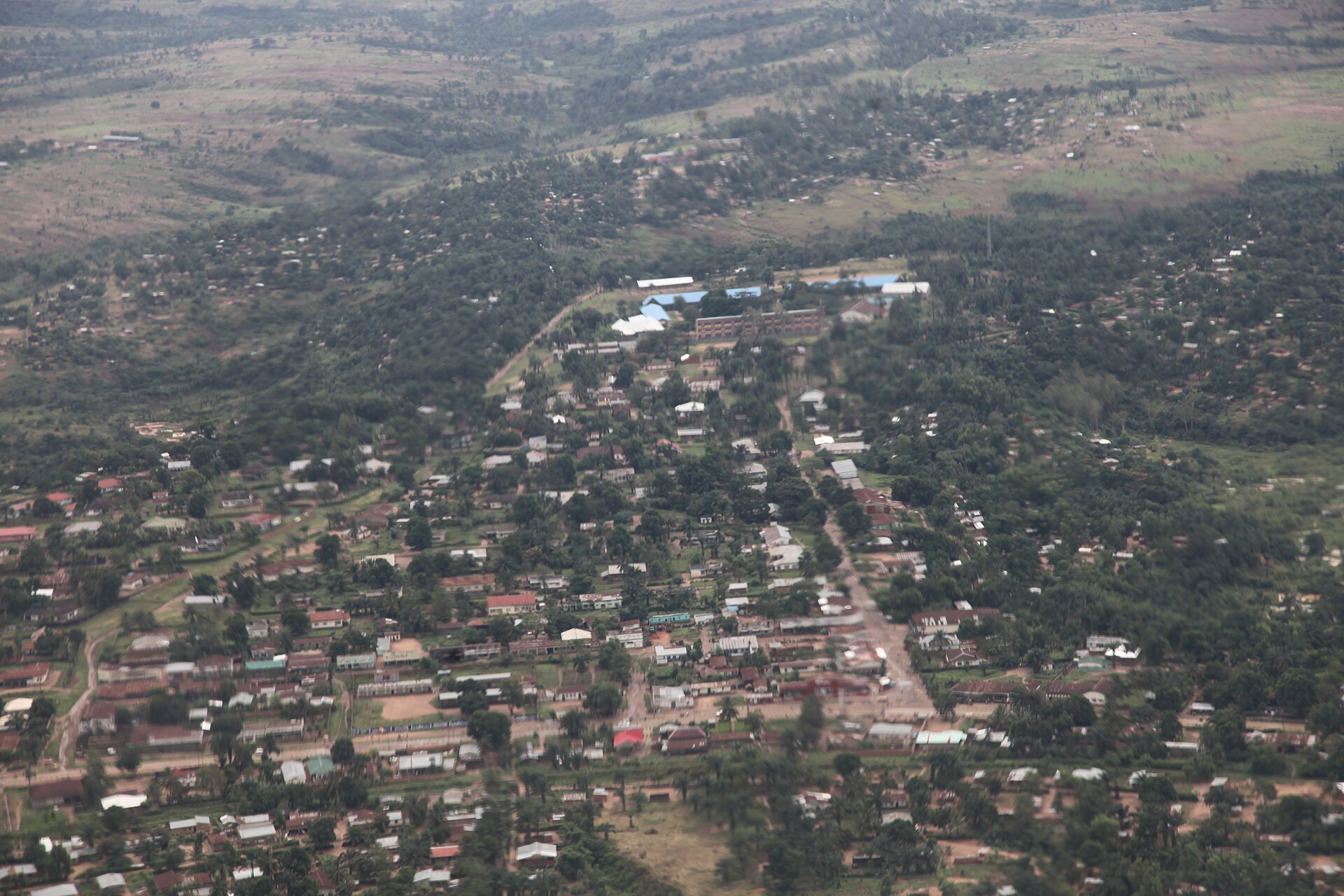
Understanding How Kananga Moves
Kananga is the capital of Kasai-Central Province and the transport hub of the region, but it does not have an organised public transit system. There are no route maps, no ticketing machines, and no formal network of buses or trams. Instead, transport is informal and demand-based: vehicles ply the main roads, mostly during daylight hours from early morning to late evening, and how often they run depends on how many people are travelling. Options thin out and become less safe at night.
For a visitor, this means planning ahead matters more than in a city with a formal network. The practical anchors of the city are Kananga Airport, the railway station at Place de la Gare, the local markets that serve as pickup landmarks, and the road corridors heading out to Mbuji-Mayi, Tshikapa, Ilebo, Luebo, Demba and Luiza.
Rail: Long-Distance Only
Kananga sits on the railway line between Ilebo and Lubumbashi, and the impressive Kananga railway station is right in the city centre at Place de la Gare — a reminder of a time when rail traffic here was more reliable. The station is operated by SNCC.
It is important to understand that this is long-distance transport, not urban transit or a commuter service. Trains are very erratic, with at most one departure per week, and cancellations and delays are the norm. Service can be affected by infrastructure condition, rehabilitation work, rolling-stock availability and long-distance scheduling; reports have described the resumption of the Kananga–Lubumbashi train after months of interruption caused by bridge work. If you are considering the train, confirm the current passenger service, ticketing, timing and operating condition before planning around it.
Buses and Other Public Transport
There is no established public transit system in Kananga, and no single definitive mapped main bus station. Intercity vehicles may use operator yards, roadside points, or a pickup arranged by your host. In practice, the exact pickup and drop-off point matters far more than a generic "bus station" label.
Useful local reference points when arranging transport include the railway station and Place de la Gare, the marketplace near the station, the airport-side marketplace, the marketplaces on the west side of the city, and hotel or operator pickup points. For longer road journeys, use daylight departures, avoid improvised after-dark intercity travel, and build in a buffer for delays.
Taxis, Moto-Taxis and Ride-Hailing
Day-to-day movement in Kananga relies on a few informal options:
- Moto-taxis ("Wewas") — ubiquitous and the fastest way to get around, but with a significant accident risk. Fares for short rides are typically in the low thousands of Congolese francs.
- Shared taxis — older cars and vans running semi-fixed routes and picking up multiple passengers, with very low fares for short city rides.
- Private hire cars — the most comfortable and secure option, arranged through your hotel or a trusted local contact.
Fares vary with distance, waiting time, luggage and road conditions, so treat any figure you are quoted as a starting point for negotiation rather than an official tariff. Always confirm the fare before departure, and confirm whether the price is for the whole vehicle or per passenger. Carry Congolese francs in cash, including small notes, for short rides and market-side pickups.
International ride-hailing apps such as Uber and Bolt do not operate in Kananga. Instead, use known local taxis, hotel or host drivers, organisation vehicles, or drivers recommended locally.
Safety deserves real attention here. Moto-taxis carry a high accident risk, with reckless driving and bag-snatching reported; collective taxis can be overcrowded and carry a petty theft risk, so use them with caution during daylight. Avoid travelling alone in informal transport at night. A private car with a trusted driver is the most secure option, especially after dark. All local transport carries inherent risks from road conditions, vehicle maintenance and driver behaviour, and the absence of reliable emergency services heightens the consequences of any incident.
Car Rental and Driving
There are no major international car rental companies in Kananga. Local "rental" generally means hiring a car with a driver. There is no formal motorcycle or scooter rental, and self-driving is highly inadvisable. Driving laws exist but are rarely enforced, and traffic is informal and aggressive. If you arrange a private vehicle for a regional trip, make sure the quote covers fuel, route, waiting time, the return leg, road-condition assumptions, the overnight plan, and whether the driver stays at the destination.
Walking and Cycling
Walking is limited as a practical way to get around. Pedestrian-friendly areas are scarce, and sidewalks are often non-existent or broken. Hazards include dense traffic, uneven surfaces and open drains. Walking alone at night is highly unsafe. There are no organised walking tours, and self-guided walking is not recommended without a local companion.
Cycling is not recommended for tourists: there are no dedicated bicycle lanes or cycling infrastructure, and no bicycle-sharing programmes or formal rental shops. There are no car-free zones in the city.
Accessibility
Accessibility infrastructure for travellers with mobility challenges is virtually non-existent. Roads, buildings and transport are not designed for accessibility, and local transport is generally not accessible. Plan accordingly and arrange private, pre-arranged vehicles where possible.
Getting from Kananga Airport into the City
Kananga Airport (KGA) is a small airport located east of the city centre along the N1 road, on or near Avenue Kabila. It is close to the centre and to the railway station, but not walkable with luggage. Congo Airways operates twice-weekly flights from Kinshasa.
There is no formal airport bus or rail link. The practical way into town is a pre-booked transfer or taxi. Pre-booking is strongly advised so that someone meets you on arrival. Airport taxi fares to the centre, station or a hotel are considerably higher than short city rides, so agree the price before you set off. Mbuji-Mayi Airport is a regional alternative only, reached by a long road journey.
Practical Tips for Getting Around
- Learn a few phrases in French or Tshiluba to negotiate costs and direct drivers.
- Ask your hotel staff or a local contact to help arrange transport.
- Confirm fares upfront before starting any journey.
- State your destination clearly, or show it on an offline map.
- Save contacts offline: hotel, host, driver, rail contact, road operator and destination contact.
- Have destinations written down — for example Aéroport de Kananga, Place de la Gare, Gare de Kananga, Mbuji-Mayi, Tshikapa, Ilebo, Luebo, Demba, Luiza.
- Choose a base in central Kananga or one arranged by your host rather than picking accommodation by map distance alone.
- Use daylight for long road trips and avoid improvised after-dark intercity travel.
Finally, note that while Kananga lies outside the acute North and South Kivu conflict zone, long-distance movement in the DRC can be affected by road conditions, security, fuel, weather, administrative controls and service disruption. Build flexibility into your plans.