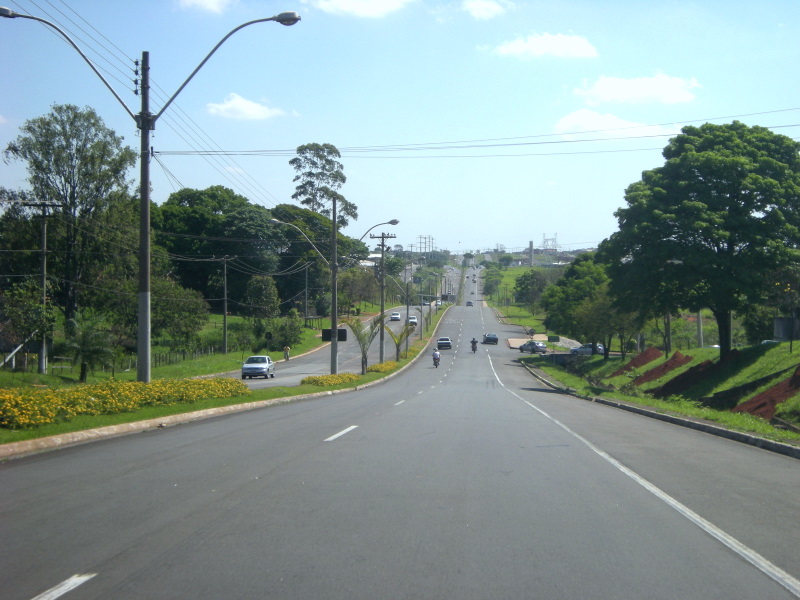
Getting Around Santa Bárbara d'Oeste
Santa Bárbara d'Oeste sits in the Campinas Metropolitan Region of São Paulo state, and it has grown together with its neighbour Americana into a single built-up area. That matters for getting around: much of the transport you will use is regional rather than purely local, and the practical centre of gravity for connections is the corridor between the two cities. The city itself is heavily urbanised, so most trips are short and made on foot, by bus, or by car.
How Visitors Move Around
Public transport in the Campinas region is bus-based — there is no metro or tram network to rely on. Visitors typically combine walking in the central area with city buses for longer hops, and intercity buses when crossing to Americana or heading toward Campinas. For anything off the main routes, taxis and ride-hailing apps fill the gap.
One practical thing to understand is that Santa Bárbara d'Oeste is served by a multimodal integration terminal rather than a traditional downtown bus station. It sits on a state highway outside the city's downtown area, and its main role is handling intercity buses. Inside, it brings together city bus lines, intercity and metropolitan lines, and long-distance services on separate platforms. The terminal has an overpass for pedestrian and bicycle access, a nearby parking lot, seating, displays showing lines, schedules and maps, ticket booths, a coffee shop, a rest area, public toilets and a central control office. If you are arriving from another city or planning a longer trip out, this is the place to start.
Rail, Metro and Trams
There is no rail, metro or tram service for getting around Santa Bárbara d'Oeste or the surrounding region. Regional transit in the Campinas area is bus-only, operated by a number of different agencies. The only rail heritage in the area is historical — an old railway station from 1875 stands in Americana, opposite the site of the planned new bus terminal — but it is not part of a working passenger network.
Buses and Public Transport
Buses are the backbone of local and regional travel, and they come in a few distinct layers:
- City buses serve routes within Santa Bárbara d'Oeste. Some local lines have been reorganised as feeder services that connect to the terminal and to transfer points, using single buses.
- Intercity and metropolitan buses link Santa Bárbara d'Oeste with Americana and other cities in the region. These are operated by agencies including EMTU, which runs routes such as 627 between the Santa Bárbara d'Oeste terminal and the Americana metropolitan terminal, along with related routes like 624 and 625 that connect Americana terminals with the Jardim Europa area of Santa Bárbara d'Oeste. Regional services like these generally run on weekdays rather than weekends, and frequencies can be widely spaced, so it is worth checking schedules before you set out.
- Long-distance buses also use the Santa Bárbara d'Oeste terminal, giving the city a direct link to destinations further afield.
The region has been developing a bus rapid transit corridor — the Northwest Corridor — that connects Sumaré, Nova Odessa, Americana and Santa Bárbara d'Oeste. It uses existing streets and avenues in places, with two patterns of stops: bus stops on the central median of wide avenues, and simpler sidewalk stops in downtown sections. Median stops have closing platform doors, lighting, ventilation, seating and real-time operational information. Terminals and median stops provide bicycle parking.
On fares and tickets, the direction of travel is toward convenience: intercity buses on the corridor are equipped with automatic fare collectors, and the system is designed around pre-paid fares with free transfers and time-and-fare integration. In practice, you should expect to pay as you board or buy at the terminal's ticket booths, and to ask locally whether a transfer is included on your particular route.
Taxis and Ride-Hailing
For trips that buses do not cover conveniently — late evenings, luggage, or destinations away from the main corridors — taxis and ride-hailing apps are the practical option. The terminal has a nearby parking lot, which is also useful if you are being picked up or dropped off by car. Because Santa Bárbara d'Oeste and Americana form a conurbation, a car or ride-hailing trip between the two is straightforward, though Santa Bárbara Avenue, the main link between the cities, is the most congested spot in the area, so allow extra time at busy periods.
Walking
The city is almost entirely urban, and its central districts are compact enough that walking is a realistic way to cover shops, services and the main meeting points. The Tivoli shopping mall is one of the city's principal gathering places and serves Santa Bárbara d'Oeste along with Americana, Nova Odessa, Sumaré and Hortolândia. Walking is less practical for reaching the intercity terminal, which sits outside the downtown area on a state highway — plan to arrive by bus, taxi or car, and use the pedestrian overpass if you are coming on foot or by bike.
Getting In from the Airport
Santa Bárbara d'Oeste does not have its own airport. The practical arrival point for the region is the Campinas area, and from there you continue by road. The most reliable approach is a long-distance or intercity bus into the Santa Bárbara d'Oeste terminal, or a taxi or ride-hailing car for the final leg. Because regional buses are bus-only and some services run on weekdays with limited frequency, it is worth confirming your connection in advance rather than assuming a frequent service. If you are arriving with a lot of luggage or at an awkward hour, arranging a car directly is the simpler choice.
Practical Tips
- Start any regional journey at the Santa Bárbara d'Oeste integration terminal, where city, intercity and long-distance services meet and where you can buy tickets and find schedule information.
- Check whether your route runs on weekends — some regional services operate on weekdays only.
- Allow extra time on Santa Bárbara Avenue, the main and most congested link between Santa Bárbara d'Oeste and Americana.
- Ask about transfers when you buy your fare; the network is designed around pre-paid fares and free transfers, but this depends on the route.
- Keep taxi and ride-hailing as your backup for evenings, luggage and destinations off the bus corridors.