Overview
Toulouse's public transport is run by Tisséo, under the authority of Tisséo Collectivités (also known as the Syndicat Mixte des Transports en Commun), which has managed the network since 2003. The system is built around a fully automated, driverless metro using VAL technology, supplemented by trams, suburban trains, buses, a cable car and even river ferries. In 2018 the network carried 110.3 million passengers, and by 2024 annual ridership had reached about 118.3 million.
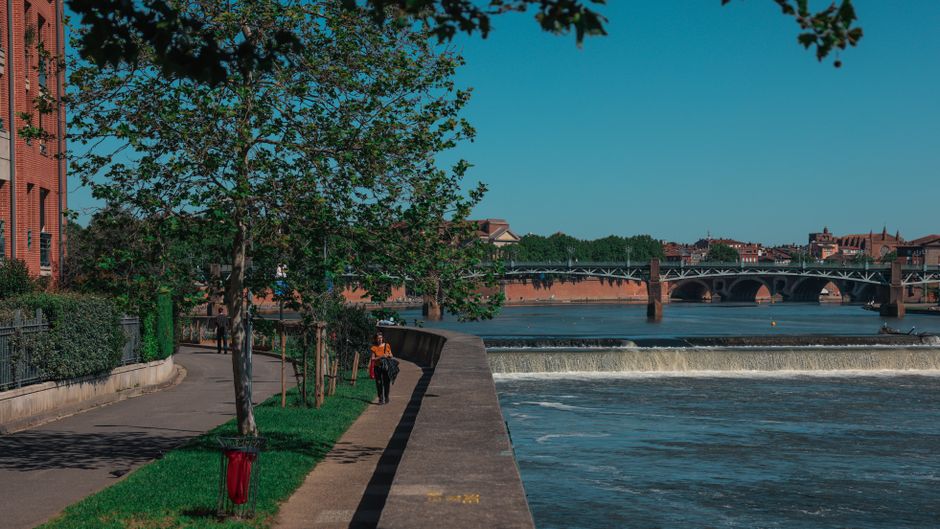
For a visitor, riding end to end is simple. Buy a ticket or pass from a machine or kiosk, validate it as you board, and you can transfer between metro, tram, bus and the cable car within the validity window. The metro itself is fast and frequent: first service is at 05:15 daily, with the last trains around midnight from Sunday to Wednesday and as late as 03:00 on Thursday, Friday and Saturday nights. An extensive night bus network also runs after the metro stops. The historic centre is compact and walkable, sitting between the Garonne River and Metro Line B, so you will often combine short walks with a couple of metro hops.
The network
The network is a patchwork of modes, each with its own line names. Here is what you will actually see on maps and signs.
Metro (Métro de Toulouse / Mètro de Tolosa)
- Line A (red) — Basso Cambo to Balma-Gramont, 12.5 km with 18 stations, opened in 1993 and extended in 2003. It runs southwest to northeast, passing through Arènes, the main railway station area and the University of Mirail. It is mainly underground but has some elevated sections.
- Line B (yellow) — Borderouge to Ramonville, 15.7 km with 20 stations, opened on 30 June 2007. It runs north–south and is entirely underground.
- The two lines interchange at Jean-Jaurès, the busiest station and a crowded spot at rush hour. Together they serve 37 stations (38 counting both lines' full station lists) over 28.2 km.
- A third line, Line C, is under construction: a 27 km, roughly 21-station route from Colomiers Gare to Labège Gare, about 80% underground, due to open around late 2028. It will link the airport area, Matabiau railway station and the southeast, and will interchange with Line B at La Vache.
Tramway (Tramway de Toulouse)
- Line T1 — runs between MEETT and Arènes via the city of Blagnac, with 25 stops. It opened in December 2010 (after a delay caused by industrial action), was extended to Palais de Justice in 2013 and to MEETT in 2020. It connects with Metro Line B at Palais de Justice and with Metro Line A and the suburban Arènes-Colomiers train at Arènes.
- Line T2 — formerly a branch of T1 running from Palais de Justice toward Toulouse–Blagnac Airport, opened in 2015. It was closed in 2023 to allow construction of the Aéroport Express line, which is planned to replace it around 2026.
Suburban rail
- The Toulouse railway network supplements the metro with suburban lines, including Line Arènes-Colomiers (formerly called Line C, renamed to avoid confusion with the future metro line), Line D and Line F. The western suburban train to Colomiers and Arènes can be used with a Tisséo fare.
Buses and the city-centre shuttle
- Buses run along all the main streets but do not enter the pedestrianised core, with one exception: a free city-centre shuttle (Monday to Saturday). There are no fixed bus stops for it — just wave at the driver.
- An extensive night bus network operates after metro services end.
Cable car and ferries
- Téléo — an urban tricable gondola line in the south of the city, opened in May 2022.
- River ferries also form part of the wider Tisséo network, alongside the metro, tram, buses and cable car.
Tickets & fares
Fares are set by Tisséo and are approximate here — always check current prices at tisseo.fr before you travel, as they change.
- Single ticket bought on the bus: about €2.50 (as of January 2025).
- Single ticket from a machine or kiosk: about €1.80, valid on any Tisséo transport.
- Book of 10 tickets: about €15.40.
- One-day pass: about €6.90.
- Airport Navette single: about €9, valid for 90 minutes including transfers onto city public transport.
Validate your ticket when you board. It is then good for transfers within one hour, or within 90 minutes to and from the airport. Tickets and passes are sold at machines and kiosks across the network; you can also pay on the bus, though at a higher price. For the airport connection by Tisséo bus and tram, the ordinary fare applies — around €1.80.
Bike rental is organised separately by the Town Hall through velo.toulouse.fr or at a bike station: a one-day ticket is about €1.20 and a 7-day pass about €5, with unlimited journeys and no extra charge for the first 30 minutes of each ride.
From the airport
Toulouse–Blagnac Airport (TLS) sits about 8 km west of the city. In 2023 your public-transport options were:
- Airport Navette — runs from Arrivals Gate C to the main railway station, taking about 25 minutes via four downtown stops, every 15 minutes from 06:00 to 00:00. The single fare is about €9 and is valid for 90 minutes for transfers onto city public transport.
- Tisséo buses to the tram — take whichever departs next: Bus 30 to Odyssud-Ritouret or Bus 31 to Pasteur–Mairie de Blagnac, both on Tram Line T1. Ride the tram to Palais de Justice (Metro B) or get off at Arènes for the west bank and Metro A. This connection runs every 10–20 minutes from 06:00 to midnight, takes about 50 minutes, and costs around €1.80. Note that the direct Tram T2 has been discontinued because of Metro Line C construction.
- Taxi — about €35 to central Toulouse if your destination is in Zone 3, or €25 in Zone 2 (most of the historic centre falls in Zone 3), as of 2024. Uber and Bolt are available and should be considerably cheaper than a taxi.
Etiquette & customs
- Validate your ticket on boarding — this is expected on every mode, and inspectors do check.
- Queuing: let passengers off before you board, and stand aside from the doors on the platform.
- Escalators: stand on the right, walk on the left, as is standard in France.
- Priority seating: seats near the doors are reserved for the elderly, pregnant passengers and people with reduced mobility; give them up without being asked.
- Eating and drinking: keep it off the metro and tram — it is not the done thing and is often discouraged.
- Rush hour: Jean-Jaurès, the A/B interchange, gets very crowded at peak times; move down the platform and away from the stairs to find space.
- Quiet: keep phone calls and music low, especially in the enclosed underground sections.
Official links
Survival terms
- métro (métro) — subway/metro
- ticket (ticket) — ticket
- ligne (ligne) — line
- entrée (entrée) — entrance
- sortie (sortie) — exit
- correspondance (correspondance) — transfer/connection
- aller simple (aller simple) — single fare
- forfait journée (forfait journée) — day pass
Before you travel, check the Tisséo website or app for live service updates, since ongoing Metro Line C construction can affect routes and station access.