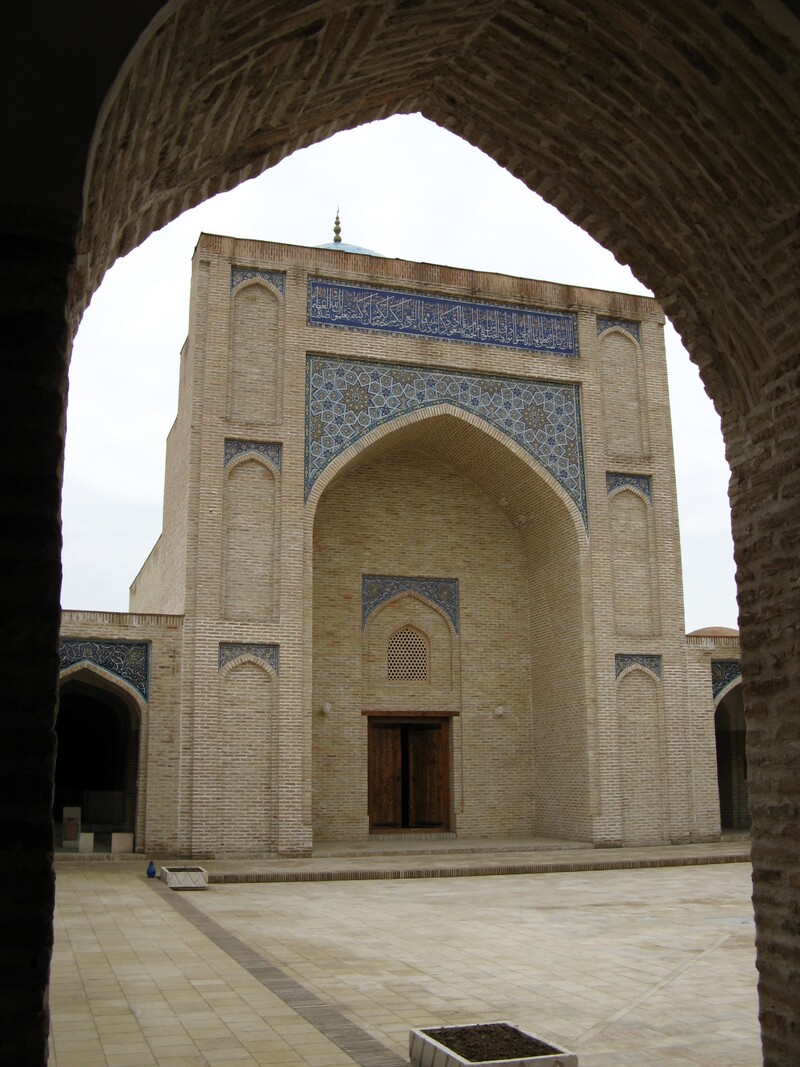
Stand on the square where three madrassas face each other, their portals weathered and their courtyards quiet, and you have Qarshi at its most characteristic: a southern Uzbek city whose monuments are still part of the everyday streets around them. The Eski Bazaar is a short walk away, and beyond it the domed silhouette of the Odina Mosque marks the edge of the old town.
Qarshi suits travellers who are already in southern Uzbekistan and want a day or two of Timurid and later architecture without the crowds of Samarkand or Bukhara. The sites are close together, the bazaar gives the city its rhythm, and a handful of places further out reward a half-day trip.
This guide covers the main sites in the city, a few places worth the detour, and how to string them together if you only have one day.
Top things to do in Qarshi
1. Kok Gumbaz Mosque
Kok Gumbaz means "blue dome", and this is Qarshi's Friday Mosque and the largest such mosque in the region. It was constructed by Emperor Ulugbek on behalf of his father, Shah Rukh, in the late 16th century, and it sits on Nasaf St.
It is architecturally similar to other Timurid mosques, including those in Shakhrisabz, but it has been less heavily restored, so more of the original features remain intact. Pair it with the madrassas on the same square, which are a short walk away.
2. Odina Mosque
Odina Mosque was built in the 16th century and stands on the southeast side of Qarshi's Eski Bazaar. It was built on the site of an older Mongol palace, which had also been used as a prison.
The mosque has an attractive domed exterior and a sardoba, a domed reservoir that kept the water supply from becoming contaminated or evaporating. It is no longer used for worship and instead houses Qarshi's Regional Museum, so combine a look at the building with the collection inside.
3. The three madrassas on the same square
Kalizbek, Bakmir, and Khodjaev Abdul Aziz Madrasas all stand on the same square and were all built between 1904 and 1915. They no longer have a religious function and are in need of restoration, but you can enter inside if you ask the guardian.
Because they face one another, this is the easiest place in the city to see several monuments in one stop. Ask politely before stepping in, and allow time to look at the tilework and courtyards rather than rushing through.
4. Khoja Abdul Aziz Madrassah
This is the largest madrassah in town and now houses the Regional Museum, with a few exhibits about the history of the Bukhara emirate and a lot of old photographs. It is on Nasaf St.
The combination of building and museum makes it a good introduction to the city early in your visit. Look for it alongside Kok Gumbaz Mosque, which is on the same street.
5. Rabiya Madrassah
Rabiya Madrassah is a late 19th-century female madrassah on Bazaar Square. It is also listed as Odin Madrasah in some references.
Its position on the bazaar square means you can see it while you are already in the market area. Combine it with a walk through the Eski Bazaar and the Odina Mosque nearby.
6. Qarshi Bridge (Kashkadarya Bridge)
Qarshi Bridge is an ancient brick bridge built over the Qashqadaryo River in the second half of the 16th century.
It is a straightforward stop rather than a long visit, but the brickwork is worth a look if you are interested in the city's older infrastructure. It works well as a short addition to a walk rather than a destination on its own.
7. World War II Memorial
Qarshi's war memorial to casualties of the Great Patriotic War is one of the largest Soviet-era memorials in Central Asia. It is a mix of walkways, plaques, an eternal flame, and a red star-topped tower with a series of stained-glass windows. The centerpiece is a bronze figure which stands closely behind the Eternal Flame of Remembrance.
It is possible to access the upper levels of the memorial on request, so ask if you want the view from the tower. Set aside a quiet half hour here.
8. Kurgancha Mosque
Kurgancha Mosque is one of the city's places of worship and is listed among the sites to see in Qarshi.
It is a modest stop compared with the Kok Gumbaz and the madrassas, so treat it as part of a wider walk through the city rather than a separate outing.
9. Khasim Ata Ensemble
Further afield, in Pudina village halfway between Karshi and Kasan, the Khasim Ata Ensemble is a complex built around the tomb of an 11th-century Islamic teacher.
Because it sits outside the city, plan it as a half-day trip rather than a stop on a walking route. It pairs naturally with travel toward Kasan.
10. Sultan Mir Haidor complex
The Sultan Mir Haidor complex lies about 30 km southeast of Qarshi and is one of the sites worth leaving the city for.
Given the distance, treat it as a separate excursion and combine it with the other out-of-town sites if you have transport for the day.
11. Er-kurgan Fortress
Er-kurgan Fortress is listed among the sites further afield from Qarshi.
Like the other outlying sites, it is best visited with your own transport and as part of a longer loop rather than a quick stop.
If you only have one day
Morning. Start on Nasaf St with Kok Gumbaz Mosque, Qarshi's Friday Mosque and the largest in the region, then walk to the Khoja Abdul Aziz Madrassah, the largest madrassah in town, which now houses the Regional Museum. The old photographs and exhibits on the Bukhara emirate make a good introduction before you see the rest of the city.
Afternoon. Move on to the square where the Kalizbek, Bakmir, and Khodjaev Abdul Aziz Madrasas stand together, and ask the guardian if you can look inside. Then walk to Bazaar Square for Rabiya Madrassah and continue to the Odina Mosque on the southeast side of the Eski Bazaar, where the domed exterior, the sardoba and the Regional Museum collection are all in one place. If time allows, add Kurgancha Mosque and the Qarshi Bridge.
Evening. Finish at the World War II Memorial, with its walkways, plaques, eternal flame and red star-topped tower. Ask about access to the upper levels if you want to see the memorial from above before the light goes.
Frequently asked questions
When is the best time of day to visit the sites?
The sites are close together in the centre, so a morning start on Nasaf St and an afternoon around the bazaar square works well. The World War II Memorial, with its eternal flame and stained-glass windows, is a fitting end to the day.
Can I go inside the madrassas?
The madrassas no longer have a religious function and are in need of restoration, but tourists can enter inside if they ask the guardian. The Khoja Abdul Aziz Madrassah now houses the Regional Museum and is open to visitors as a museum.
What can I see outside the city?
Further afield you can visit the Khasim Ata Ensemble in Pudina village, halfway between Karshi and Kasan, built around the tomb of an 11th-century Islamic teacher; the Er-kurgan Fortress; and the Sultan Mir Haidor complex about 30 km southeast of Qarshi. These are best done with your own transport.
How do I reach Qarshi?
Qarshi is served by Qarshi Airport, with flights to Tashkent, Navoi and some major Russian cities.
With the old town's mosques and madrassas within walking distance of each other and a handful of sites a short drive away, Qarshi is easy to plan around a single full day or a relaxed two.