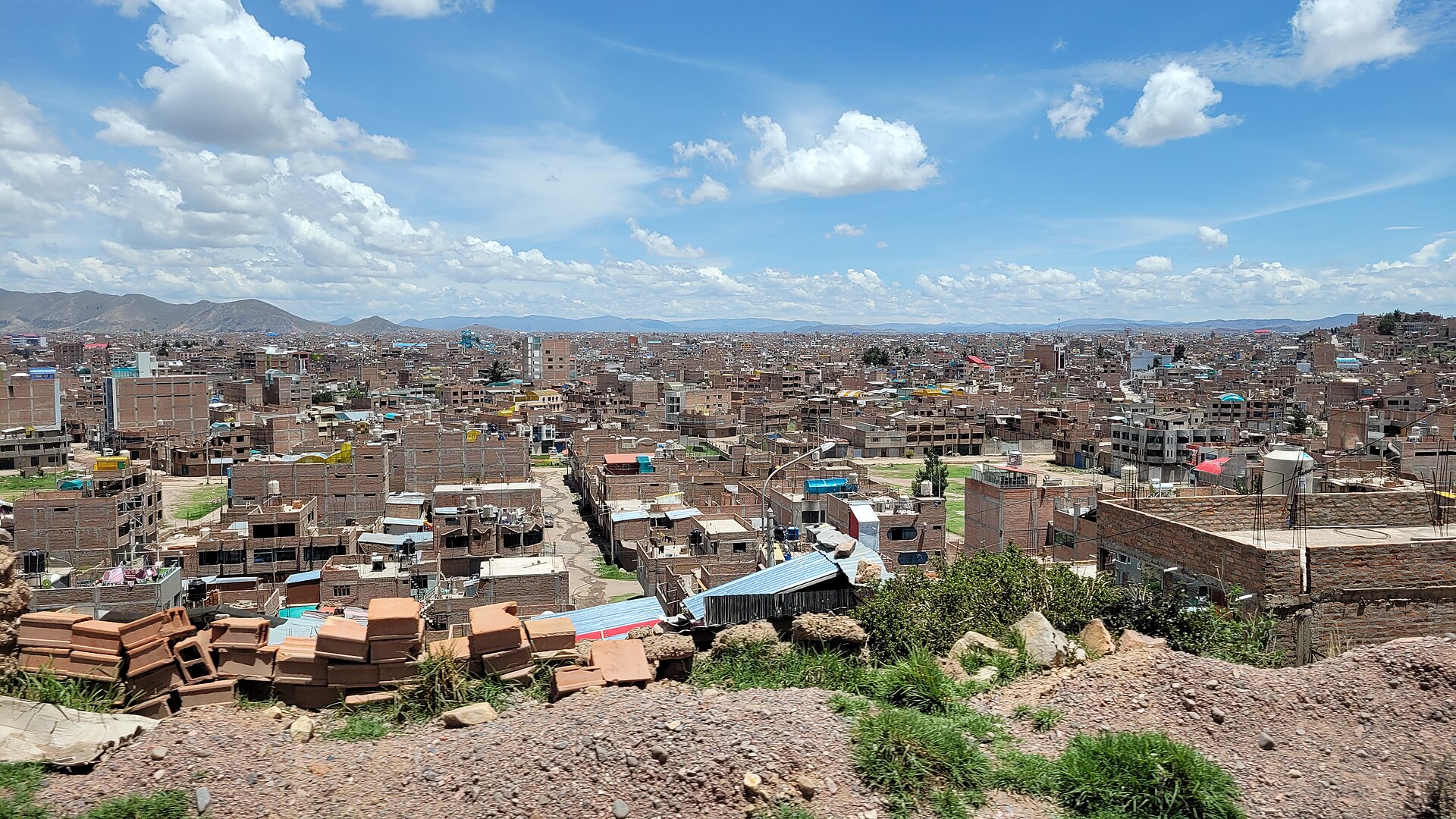
Stand on the Plaza de Armas and the first thing you notice is the wind. Juliaca sits on the Collao Plateau, and the same gusts that give the city its nickname sweep across the plaza in front of the Mother Church of Santa Catalina, whose carved ashlar doorway and single bell tower face the open square. Look southeast and you can pick out the Cristo Blanco del Mirador Huaynarroque on its hill above the rooftops.
This is a working city and a major transit point, not a polished tourist town, and it suits travellers who are passing through the Puno region and want to see what is actually here rather than what has been staged for visitors. The sights are close together in the centre, with one lagoon and one hilltop viewpoint just outside it.
This guide covers the churches and convent around the plazas, the hilltop monument, the craft galleries, the lagoon to the northwest, and the two annual festivals that fill the streets.
Top things to do in Juliaca
1. Mother Church of Santa Catalina
On the Plaza de Armas, this church shows an indigenous baroque style. The Jesuits began construction in 1649, but it was not completed until 125 years later, which is why it has a single bell tower, built entirely with ashlar brought from the quarries of Arequipa. Carved ashlar predominates in its structure, and its dome, doorway and bell tower stand out. Canvases and other works of art are preserved inside.
It is under the command of the Franciscan congregation. Pair it with the rest of the plaza, since it is the square's defining building and the natural place to start a walk through the centre.
2. Cristo Blanco del Mirador Huaynarroque
Southeast of the Plaza de Armas, on the summit of the Huaynarroque hill, stands a colossal figure in reinforced concrete and fibreglass representing the vigorous redeemer with outstretched arms. It has good night lighting that highlights a sacred purple and radiant heart. At the foot of the monument there is a viewpoint over the urban and non-urban area that includes the city of Juliaca.
The complex was built in just two and a half weeks and inaugurated in 1987. Come for the view, and consider the evening, when the lighting is the point.
3. Las Calceteras Gallery
In the north wing of Plaza Bolognesi, this three-storey crafts shopping centre sells garments of all kinds: socks, chullos, booties, shawls, sweaters, rugs and gloves, woven or made with native materials such as llama, alpaca and vicuña. You can also watch the handwork done by the artisan women in their typical clothing, called the hosiery, working different types of wool and fibres.
This is the place to buy textiles directly, and it sits on the same plaza as the Church of La Merced, so the two fit into one stop.
4. Church of La Merced
In the west wing of Plaza Bolognesi in the city centre, this church is a work of architecture from the time of the republic, carved in red limestone and built with a structure typical of the modern era, an iron frame. Like the Mother Church of Santa Catalina it has only one bell tower, arranged symmetrically, and it also features a clock with four circular faces.
It was inaugurated in 1959 and renovated in 1995, when indigenous elements were included. Combine it with the Las Calceteras Gallery across the plaza.
5. Franciscan Convent
Also called the Convent of Santa Bárbara, this is a four-level building on the Hatun Rumi or Santa Bárbara hill, 40 m from the Plaza de Armas of Juliaca. It has an essentially Romanesque style and is built from rocks, bricks, iron and cement, roofed with stainless steel sheets. Its four levels hold more than a hundred finely finished arched windows in a clear Greco-Roman style, and a watchtower and a flanking tower suggest the idea of a medieval castle.
Because it is so close to the Plaza de Armas, it slots easily into the same walk as the Mother Church of Santa Catalina.
6. Chacas Lagoon
About 10 km northwest of Juliaca, in the area of the towns of Kokan and Chacas, this lagoon is surrounded by vast hills, including Iquinito, the highest in the area. Local flora and fauna abound here, mainly during the summer rainy season.
Go in the rainy season if wildlife is what you are after, and treat it as a half-day out of the city rather than a quick stop.
7. Juliaca's Carnival
The city hosts this event each year between February and March. Participants dressed in colourful costumes gather on the streets to dance in the style of the Collao Plateau.
It is a street event, so plan around the crowds and expect the centre to be busy for the duration.
8. Saint Sebastian's feast
Celebrated on 20 January every year, this is the city's other fixed date in the calendar.
If your trip falls in mid-January, build your time in Juliaca around this day rather than treating the city as a quick transfer stop.
If you only have one day
Morning. Start at the Plaza de Armas and visit the Mother Church of Santa Catalina, then walk the short distance to the Franciscan Convent on the Hatun Rumi or Santa Bárbara hill. Both are in the centre, so you can cover them on foot before the day gets busy.
Afternoon. Move to Plaza Bolognesi for the Church of La Merced and the Las Calceteras Gallery, where you can watch the artisan women at work and buy textiles in llama, alpaca and vicuña. If you have a vehicle and the time, Chacas Lagoon is about 10 km northwest, in the area of Kokan and Chacas.
Evening. Go up to the Cristo Blanco del Mirador Huaynarroque, southeast of the Plaza de Armas on the summit of the Huaynarroque hill, for the viewpoint and the night lighting on the monument.
Frequently asked questions
When is the best time to visit Juliaca for the festivals?
Juliaca's Carnival runs between February and March, and Saint Sebastian's feast is celebrated on 20 January. Both fill the streets, so plan around them if you want to see the city at its busiest.
What can I buy in Juliaca?
Textiles. The Las Calceteras Gallery on Plaza Bolognesi sells socks, chullos, booties, shawls, sweaters, rugs and gloves made with native materials including llama, alpaca and vicuña, and you can watch the artisan women work.
Is there anywhere to go outside the city centre?
Yes. Chacas Lagoon lies about 10 km northwest, in the area of the towns of Kokan and Chacas, surrounded by hills including Iquinito. Local flora and fauna are most abundant there during the summer rainy season.
What is the weather like?
Juliaca has a subtropical highland climate with cool to cold temperatures most of the year. Winters are dry with freezing nights and mornings and pleasant afternoons, and the city is known for the wind on the Collao Plateau.
Check the calendar against Carnival or Saint Sebastian's feast, pick your days, and start planning your time in Juliaca around the plazas.