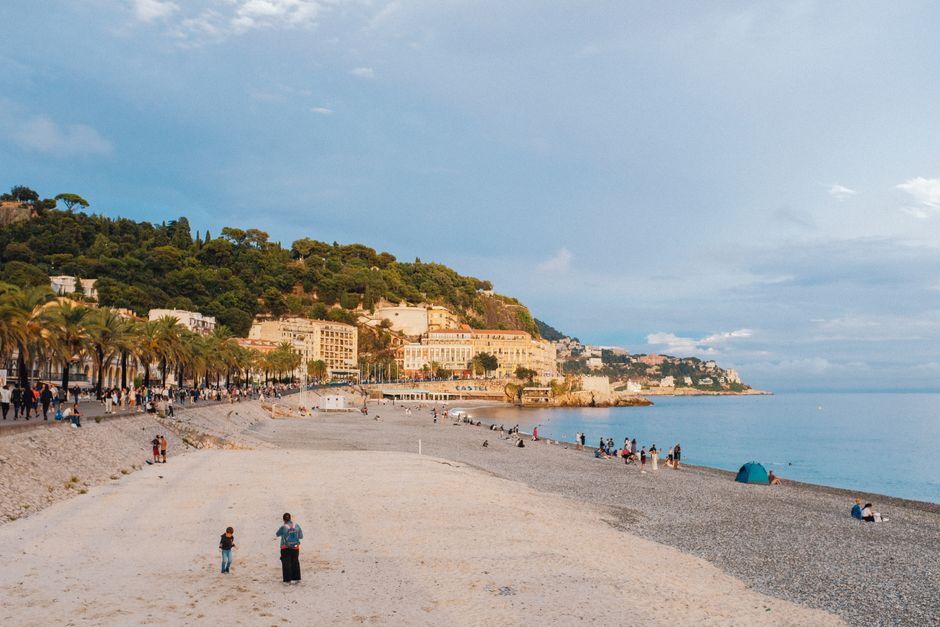
Stand at the eastern end of the Promenade des Anglais, where the curve of the Baie des Anges opens up in front of you, and the reason Nice became a winter resort is immediately clear: soft light, a long seafront walk, and hills rising behind the town. This is a city you explore on foot, moving between the seafront, the old town and the upper districts.
Nice suits travellers who are happy to walk, take the occasional bus uphill, and split their time between sea views, markets and museums. It also suits anyone basing themselves on the Riviera for a few days and making short trips along the coast.
This guide covers the sights and experiences worth your time in the city itself, followed by a one-day plan and answers to common questions.
Top things to do in Nice
1. Promenade des Anglais
The Promenade des Anglais skirts the seacoast for over 5 km and ends at Nice Airport. The views along it are the ones you will have seen in postcards and in paintings by Henri Matisse, who spent many years living in Nice, and walking some of this stretch is the single best thing to do in the city.
Combine it with the beach: the public beaches here are made of large flat stones rather than sand, so bring sandals and a cushion if you plan to sit. Free showers are provided on all public beaches.
2. Vieux Nice (old town)
The old town beneath the hill is a maze of streets and alleys with picturesque houses and boutiques, and it is home to the daily flower and fruit market of the Cours Saleya. Walk through it slowly rather than trying to cover it in one pass.
While you are in the old city, walk through the Place Sainte-Réparate and look in at the Baroque Cathédrale Sainte-Réparate, the local cathedral in the heart of Vieux Nice. If the doors are open, go in and look at the interior and paintings.
3. Colline du Château
The castle hill overlooks the Baie des Anges and the harbour and offers a spectacular vantage point over the city. Little remains of the ruined castle besides crumbling walls, but climbing the stairs to the platforms 90 m above Nice is well worth it for the view.
There is also a lift (ascenseur) that takes you three quarters of the way up. The castle hill park closes at around sunset, and you can expect to be escorted outside if you stay longer.
4. Musée Marc Chagall
This museum includes stained glass windows by Marc Chagall. Even if you are not especially interested in art, it is a museum that should not be missed.
It is closed on Tuesdays and on 1 January, 1 May and 25 December. Entry is free for everybody on the first Sunday of the month.
5. Musée Matisse
The Musée Matisse holds a charming collection of paintings, drawings and sculptures in a 17th-century Genoese villa, in Cimiez, the older upper part of the city. It is closed on Tuesdays.
It sits next to the Musée d’Archéologie de Nice, so the two are easy to combine in one visit. Buses 15, 22, 17 and 20 serve the avenue.
6. Musée d’Archéologie de Nice
Next to the Matisse museum, this site covers the ruins of the Gallo-Roman settlement in Cimiez, plus a museum with good documentation on Gallo-Roman life, though mostly not in English. There are activities for children and guided tours are available.
It is closed on Tuesdays and on major holidays. Pair it with the Musée Matisse next door rather than making a separate trip.
7. Museum of Modern and Contemporary Art (MAMAC)
Just north of the old town, MAMAC has four connected towers featuring modern and contemporary artists and their sculptures, paintings and conceptual installations. Its open-air roof terraces offer one of the best panoramas of the city.
It is closed on Mondays, and on 1 January, 1 May and 25 December. Go up to the terraces even if you are short on time.
8. Musée des Beaux-Arts Jules Chéret
To the west of the centre, this museum houses an excellent collection of pastels and other works by Jules Chéret, among other artists. It is closed on Mondays, and on 1 January, Easter, 1 May and 25 December.
Bus 38 stops at Musée Chéret. It is a good match with a walk along the western end of the seafront.
9. Musée des Arts Asiatiques
Indian, Chinese, Southeast Asian and world art displayed in striking architecture on a lake, just across the street from the airport. Entry to the visit is free, and there are conferences plus Qi Gong and Tai Chi Chuan sessions.
From July to August it opens Wednesday to Monday 10:00-18:00; from September to June, Wednesday to Monday 10:00-17:00. It is closed on 1 January, 1 May and 25 December.
10. Parc Phoenix
At 405 Promenade des Anglais, this park holds 2,500 different plants in a botanical garden and tropical glass house, along with various animals. It opens daily, 09:30-19:30 from April to September and 09:30-18:00 from October to March.
It is on the Promenade des Anglais, so it fits naturally into a walk along the seafront. Holders of the Nice museums pass pay a reduced rate.
11. Cliff Walk (Sentier Littoral)
Go past the old port, roughly a 15-minute walk, heading east toward Monaco, and a little pathway leads from Coco Beach along the side of the cliff. You can follow it around Cap de Nice halfway to Villefranche, and it is a very beautiful walk used mostly by local people.
Be prepared for several hundred steps up to rejoin the road. Wear proper shoes and carry water.
12. Château de Bellet
Château de Bellet has a winery, vineyards and wine tastings in a deconsecrated chapel. The wine cellar, built in 2015, is partially underground and semi-circular, conceived for the reception of the grape by gravity and the ageing of wines in optimal conditions.
The visit includes a secret crypt in the chapel, and the tour and wine tasting cost €20. Bus 62 stops at Le Pilon.
13. Cimetière du Château
Those interred at the Cimetière du Château include the jeweller Alfred Van Cleef, Emil Jellinek-Mercedes, founder of the Mercedes car company, poet Agathe-Sophie Sasserno, Asterix comics creator René Goscinny, The Phantom of the Opera author Gaston Leroux, French prime minister Léon Gambetta, and the first president of the International Court of Justice José Gustavo Guerrero.
It is a quiet counterpoint to the busy seafront, and it pairs naturally with the Colline du Château above the old town.
14. Russian Orthodox Cemetery, Nice
Prince Nicholas Alexandrovich, heir apparent to Imperial Russia, died in Nice and was a patron of this cemetery, where Princess Catherine Dolgorukova, morganatic wife of Tsar Alexander II of Russia, is buried. Also buried here are General Dmitry Shcherbachev and General Nikolai Yudenich, leaders of the anti-Communist White Movement.
It reflects the Russian upper classes who made Nice their winter home, and it is worth visiting alongside the city's other memorial sites.
15. Monument aux morts de Rauba-Capèu
This memorial stands at Rauba-Capèu, the point where the old port meets the sea below the castle hill. It is one of the city's named monuments and fits into a walk between the port and the Colline du Château.
Combine it with the Cliff Walk, which begins past the old port heading east toward Monaco.
If you only have one day
Morning. Start on the Promenade des Anglais and walk a stretch of the seafront, then continue into Vieux Nice and wander the alleys of the old town. Walk through the Place Sainte-Réparate and look in at the Cathédrale Sainte-Réparate if the doors are open, and pass through the daily flower and fruit market of the Cours Saleya.
Afternoon. Climb the stairs of the Colline du Château for the view over the Baie des Anges and the harbour, or take the lift three quarters of the way up. Come down and walk to the Monument aux morts de Rauba-Capèu, then follow the Cliff Walk from Coco Beach along the side of the cliff toward Cap de Nice, keeping in mind the several hundred steps back up to the road.
Evening. Head north of the old town to the Museum of Modern and Contemporary Art (MAMAC) for its roof terraces and one of the best panoramas of the city, then return to Vieux Nice for the evening.
Frequently asked questions
Are the beaches in Nice sandy?
No. The beaches consist entirely of large flat stones (gallets). A few private beaches have added a layer of sand, but the free public beaches are a stony experience, so bring sandals, a cushion and a mat. Free showers are provided on all public beaches, and there is a beach volleyball area netted off with white sand.
Is the sea good for swimming?
Many visitors enjoy the light blue sea for a swim. The beach drops quickly and the tidal pull can be very strong, so it is an opportunity for swimming rather than playing in the water, and it is not for beginners.
Is there a pass for the city museums?
Yes. A pass for all City of Nice museums provides access for 4 days for €15 per person, one entry per museum, covering MAMAC, Musée de la Photographie Charles Nègre, Musée Matisse, Musée des Beaux-Arts Jules Chéret, Anatole Jakovsky Naive Art Museum, Masséna Museum, Palais Lascaris, Nice/Cimiez Archeology Museum, Terra Amata Prehistory Museum, Natural History Museum, and Priory of Vieux-Logis.
Where can I find better beaches nearby?
Much nicer beaches exist in other towns close by, such as Villefranche-sur-Mer, Antibes and Cannes, which are far more sandy. Villefranche is a particularly preferred choice, especially if travelling with children, and is only 20 minutes away by the Zou! 100 bus.
Use this list to sketch your days, check the closing days of the museums you want to see, and start planning your trip to Nice.