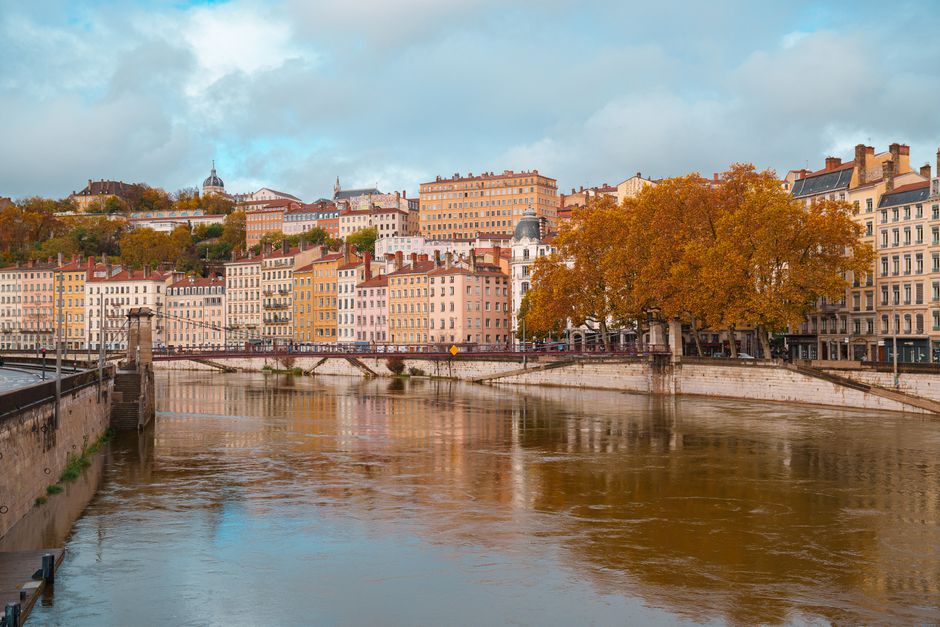
Stand on the Pont de la Guillotière side of the Saône at first light and the old town across the water is still quiet: cobbles, shutters, a few delivery vans. By noon the same streets are shoulder to shoulder. Lyon rewards the early riser, and it rewards walkers generally, because the four districts inscribed on the UNESCO World Heritage List — Old Lyon, the Fourvière hill, the Presqu'île and the slopes of the Croix-Rousse — are best taken on foot and mostly free to enter.
The city suits travellers who would rather wander a Renaissance street than queue for a single monument, and who are happy to build a day around churches, courtyards, passageways and parks. It also suits museum-goers: the museums are almost the only attractions you cannot see for free, and the Lyon City Card, available from the Tourist office and some hotels, bundles transport with free or reduced museum entry and one guided tour per day.
This guide covers the highlights of Old Lyon and Fourvière, the Croix-Rousse and Presqu'île sights, and a few places further out, followed by a one-day plan and answers to common questions.
Top things to do in Lyon
1. Fourvière basilica and its view
The basilica and the panorama from it are the single strongest reason to climb the hill, and the view is the one image most visitors carry home. Come up for the light rather than the crowds.
Pair it with the Roman theatres of Fourvière, which sit close by, and with the Montée du Gourguillon, the old sloping street that links the Saône to the top of the hill and ends near the theatres.
2. Streets and traboules of Vieux Lyon
Old Lyon is a narrow strip along the right bank of the Saône and, after Venice, the largest Renaissance area in Europe. Its traboules are corridors linking one street to another through a building, usually by way of a courtyard, and many are architectural masterpieces influenced by Italy and especially Florence.
Several are officially open to the public: 54 rue St Jean to 27 rue du Boeuf, which is the longest in Lyon; 27 rue St Jean to 6 rue des Trois Maries; and 2 place du Gouvernement to quai Romain Rolland. Press the service button next to the door code keyboard, and if you cannot enter from one side, try the opposite entrance. In the morning many other doors are open for service, so more traboules are accessible; they are closed at night.
3. St Jean Cathedral
Dedicated to St John the Baptist and St Stephen, the cathedral holds the title of primatiale because the Bishop of Lyon is also Primate of the Gauls. Built between 1180 and 1480, it is mostly Gothic with Romanesque elements, and the style becomes more Gothic as you move towards the façade.
Its astronomical clock, built in the 14th century and modified later, is especially worth seeing when the bells ring, daily on the hour from 12:00 to 16:00. Over the main door, the "Lamb rose window" depicts the lives of St Stephen and St John the Baptist. Entry is free and appropriate dress is required; note that services take place on weekday and Saturday mornings and on Sunday morning.
4. St Jean archaeological garden
This small garden on the northern side of St Jean Cathedral shows the remains of the religious buildings that occupied the site before the cathedral was erected, the oldest dating to the 4th century baptistery of the former St Etienne church. It is free and takes only minutes.
It sits directly beside the cathedral, so visit the two together before continuing along rue St Jean.
5. Rue St Jean
This cobblestone pedestrian street is the main axis of Old Lyon, lined with souvenir shops and restaurants aimed at visitors. It is worth walking for the fabric of the old town rather than for its commerce, and locals know that real good bouchons are extremely rare here.
On a sunny Sunday afternoon it can be hard to walk for the crowd. For a quieter parallel route, take rue des Trois Maries between place de la Baleine and rue du Palais de Justice.
6. Rue du Boeuf
Running parallel to rue St Jean, this street is much quieter and just as beautiful. Its restaurants are more expensive than those on rue St Jean but, on average, much more worth the money.
Combine it with the traboule that links 54 rue St Jean to 27 rue du Boeuf, and with the Renaissance courtyards nearby.
7. Renaissance courtyards
Some old-town buildings have very beautiful courtyards but no real traboules, meaning no crossing from one street to another. The most outstanding are the Maison du Chamarier at 37 rue St Jean and the Maison du Crible at 16 rue du Boeuf, where the "Pink Tower" stands. They are free and closed at night.
Look for them as you walk between rue St Jean and rue du Boeuf, rather than making a separate trip.
8. Place du Change
The largest square in Old Lyon has two remarkable buildings. The Loge du Change on the west side was partially built by the architect Soufflot and is now a Protestant church known as the Temple du Change, which can be visited on Saturdays, with services on Sundays at 10:30. Opposite stands the Maison Thomassin with its Gothic 14th-century façade, bearing above the second-floor windows the arms of the King of France, of the Dauphin and of Duchess Anne of Brittany.
The Thomassin courtyard is closed to the public, so admire the façade from the square. The square is served by the C3 bus at Gare St Paul.
9. Rue Juiverie
Another typical street of Old Lyon, named after the Jewish community who settled there and were expelled in the 14th century. At number 8, the Hôtel Builloud, the back courtyard has a magnificent first-floor gallery designed by Philibert Delorme, one of the most prominent local architects of the Renaissance.
It is a short walk from place du Change, so fold it into the same wander.
10. St Paul church
A very nice church in mixed Romanesque and Gothic styles, with the oldest parts dating from the 10th century. It gives its name to the northern part of Old Lyon, which was the commercial area during the Renaissance.
It sits on rue St Paul near the Gare St Paul bus stop, making it a natural first or last stop when entering or leaving the old town from the north.
11. St Georges neighbourhood
St Georges is the southern part of Vieux Lyon, with nice Renaissance buildings that do not really compare to the palaces of St Jean but which come with far fewer people. The streets to walk are rue St Georges, rue du Doyenné and the smaller lanes around them.
It pairs well with the Montée du Gourguillon, which starts behind the Vieux Lyon metro station.
12. Montée du Gourguillon
This picturesque sloping street begins behind the Vieux Lyon metro station and ends quite close to the Roman theatres of Fourvière. It was the main link between the Saône and the top of Fourvière through the Roman era, the Middle Ages and the Renaissance, and it keeps a medieval character.
Use it as your route up the hill rather than as a destination in itself; it connects the old town to the theatres and the basilica.
13. Parc de la Tête d'Or
One of the city's highlights and one of the many attractions that will not cost you a cent. It is the obvious change of pace from the stone streets of the old town.
Because most of Lyon's attractions are free, a park like this fits easily into a day without disturbing a museum budget.
14. Musée Gadagne
Named among the city's highlights, this museum sits in the old town and is one of the attractions you cannot see for free. If you plan to visit several museums, the Lyon City Card may be worth counting up before you buy.
Pair it with a morning walk through the traboules, before the old town fills up in the afternoon.
15. Musée urbain Tony Garnier and the États-Unis neighbourhood
Listed among the places off the beaten path, this museum and its neighbourhood reward anyone who has already walked the centre and wants to see another side of the city.
It is one of several outlying options, alongside St Irénée church, Parc de Gerland and the Gratte-ciel neighbourhood in Villeurbanne.
If you only have one day
Morning. Start early in Vieux Lyon, when the streets are at their best and many traboule doors are still open for service. Walk the traboules between 54 rue St Jean and 27 rue du Boeuf, and between 27 rue St Jean and 6 rue des Trois Maries, then visit St Jean Cathedral and the St Jean archaeological garden beside it. Continue along rue St Jean and the quieter rue du Boeuf, looking into the courtyards of the Maison du Chamarier and the Maison du Crible.
Afternoon. Take the Montée du Gourguillon up from behind the Vieux Lyon metro station to the Roman theatres of Fourvière, then go on to the Fourvière basilica for the view. Come back down through St Georges, walking rue St Georges and rue du Doyenné, and finish the afternoon in the old town at place du Change and rue Juiverie.
Evening. Cross to the Presqu'île and end with a drink on Place Sathonay, one of the simple pleasures the city offers off the main tourist track.
Frequently asked questions
Do I need to pay to see most of Lyon's attractions?
No. Most attractions will not cost you a cent, including churches, traboules and parks. Museums are almost the only attractions you cannot see for free, and for those the Lyon City Card, available from the Tourist office and some hotels, includes unlimited public transport, free or reduced entry to major museums and exhibitions, and one guided tour per day per person. It costs €29 for one day, €39 for two, €49 for three and €59 for four, with a 10% discount if you order online and pick up.
When is the best time to walk Vieux Lyon?
The morning. The area is generally crowded in the afternoon, especially at weekends, and around lunchtime the streets disappear behind restaurant terraces, postcard racks and crowds. Morning is also when more traboule doors are open for service.
How do I get into a traboule?
Press the service button next to the door code keyboard. If you cannot enter from one side, try the opposite entrance. Traboules are closed at night.
Are guided tours available?
Yes. Guided tours in several languages, including English, are available from the tourist office for €7–12, and the Lyon City Card includes one guided tour per day per person, such as Vieux Lyon or Croix-Rousse.
Buy a detailed map with a street index before you go, since many places of interest sit in small streets that simplified maps leave out, and start planning your days around the old town and the hill.