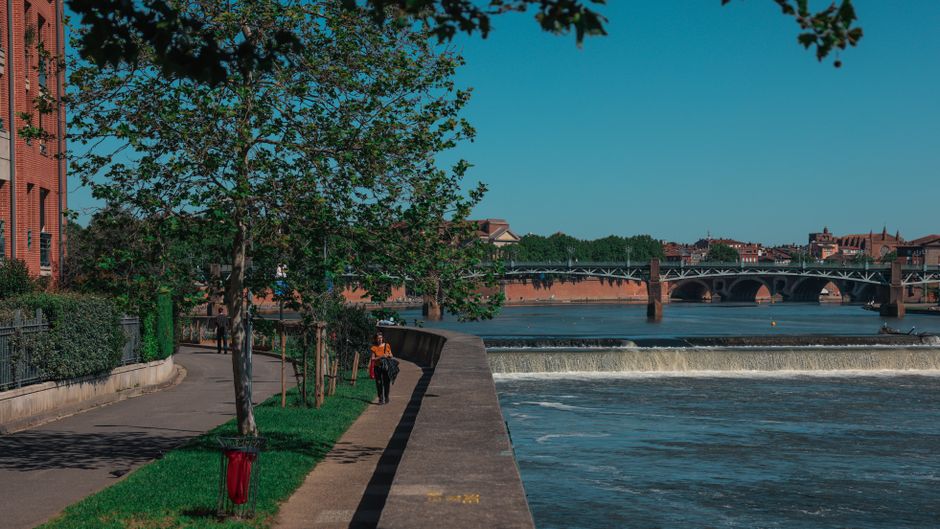
Stand on the Pont-Neuf at dusk and the whole city turns the colour of the bricks it is built from: pinkish terracotta on every side, the Garonne moving underneath, and the dome of a hospital behind you. That colour is why Toulouse is known as La Ville rose, and it is the first thing you notice and the last thing you remember.
Toulouse suits travellers who like to cover a city on foot, who are happy to spend a morning in a Romanesque basilica and an afternoon in a space theme park, and who do not mind that the best of it is spread between a compact old centre and a few sites further out. The old centre sits east of the River Garonne and is bounded to the east and north by Bvd Lazare Carnot and Bvd de Strasbourg, and to the south by the cathedral, Rue Metz and Pont Neuf.
This guide covers the sights and experiences worth your time, ordered so the strongest come first, followed by a one-day plan and answers to the questions visitors ask most.
Top things to do in Toulouse
1. Basilique Saint-Sernin
A red-brick church from the 11th and 12th centuries, and possibly the largest Romanesque construction in the world, partly because it was an important stopover on the pilgrimage to Santiago. It is the only remnant of the former Abbey of Saint-Sernin. Look for the great bell-tower, the gates, the ambulatory passage and the organ.
It stands at 7 Place St-Sernin, next to the Saint Raymond Museum, so pair the two in a single visit. Metro: Jean-Jaurès.
2. Capitole
A magnificent red-brick building in Neoclassical style, lording it over the pedestrianised main plaza. It houses City Hall, including the grandiose Salle des Illustres, and the city's main theatre. Guided tours are no longer offered, but you can see much of it free.
It is open daily 08:30–18:45 and sits right on the Metro at Capitole, which makes it an easy anchor for a morning in the old centre.
3. Couvent des Jacobins
The deconsecrated mother-church of the Dominicans, called Jacobins in France because their first convent was in Rue St-Jacques in Paris. Built in Gothic red brick, it contains St Thomas Aquinas' relics, and it is now a museum enclosing the convent, refectory, chapel of St Antonin and Salle Capitulaire.
It is on Rue Joseph Lakanal, open Tuesday to Sunday 10:00–18:00, and Metro: Capitole. Adult admission is €5.
4. Musée des Augustins
A fine arts museum set in a former Augustinian monastery surrounding two cloisters. The cloisters alone justify the stop, and admission is free.
It is at 21 Rue de Metz, open Thursday to Monday 11:00–19:00, Metro: Esquirol. Combine it with Notre-Dame de la Daurade, which is a short walk away.
5. Pont-Neuf
Pont-Neuf means "New Bridge", but it is by far the oldest bridge across the Garonne, built from 1544 to 1626. The arches are not symmetrical: they were supposed to represent the face and haunches of a lion, though you will need a lot of imagination to visualise that.
The water-tower at its west end hosts photography exhibitions. Walk it late in the day, then continue 500 m downstream to Pont Saint-Pierre for more pleasant river views.
6. Saint Raymond Museum (Musée Saint-Raymond)
An archaeological museum with Roman artefacts from around Toulouse and the largest collection of Roman busts found in France. The site was a necropolis in ancient times, then a hospital for pilgrims on the road to Santiago; the present building dates from 1523 and became a museum in 1892.
It is at Place Saint-Sernin, next to the basilica, open Tuesday to Sunday 10:00–18:00. Adult €5, concession €3. Metro: Jeanne-d'Arc.
7. Cathédrale Saint-Étienne
A great ramshackle edifice, partly Gothic but mostly a jumble: the medieval builders half-built one church, abandoned it, started another, abandoned that, and added sections rather than starting over on a clear site. The result is worth seeing precisely for its oddity.
It is at Place Saint-Étienne, open daily 08:00–19:00, Metro: François Verdier. It marks the southern edge of the old centre, so use it as a turning point on a walking loop.
8. Hôtel d'Assézat
A great mansion house built in the 16th century in Renaissance style for a rich merchant. It now houses the personal art collection of Georges Bemberg (1915–2011).
It is at Place d'Assézat, open 10:00 to 18:00. It sits comfortably between the Capitole and the river quays.
9. Musée du Vieux Toulouse
A museum of the history of the city, useful for making sense of the pink-brick streets you have been walking. It is at 7 Rue du May, Metro: Capitole or Esquirol.
It is open April to November, Monday to Saturday 14:00–18:00. Adult €5, concession or child €3. Go in the afternoon, after the Capitole.
10. Notre-Dame de la Daurade
This church was founded in 410 AD as a pagan temple to Apollo, demolished in 1761, and replaced by the present neoclassical building, completed in 1883 and restored in 2017–19.
It is at 1 Place de la Daurade, open daily 09:00–18:00, Metro: Esquirol. It faces the river, so it works well as a stop on a quayside walk.
11. Canal du Midi
The eastern and more interesting section of the Canal des Deux Mers, and a UNESCO World Heritage Site. It starts from the River Garonne to the northwest and circles the city centre, so its first few kilometres are walkable, but the best sections are further out as it climbs the hillside and descends towards the Mediterranean.
For anything beyond the first stretch you will want a bike or a canal barge. Rent a bike and treat it as a half-day rather than a stroll.
12. Les Abattoirs
A vast former abattoir now housing a contemporary arts museum, with a garden overlooking the Garonne. It is at 76 Allee Charles de Fitte, open Wednesday to Sunday 12:00–18:00, Metro: Saint Cyprien – République. Adult €9, concession €6.
Because it opens at noon, it suits an afternoon rather than a morning start.
13. Jardin des Plantes
The gardens were part of an old Carmelite friary before expanding south, and the layout still gives the impression of walking into a monastery. Admission is free.
They are at 31 Allée Jules Guesde, open daily 08:00–20:00, Metro: Carmes. The Muséum de Toulouse is on the north side of the gardens at 35 Allée Jules Guesde if you want to extend the visit.
14. Jardin Japonais Pierre-Baudis
A Japanese garden incorporating the typical features of the form: a lake, a tea pavilion, a planted garden with a dry waterfall, lanterns and a red bridge. Admission is free.
It is on Bvd Lascrosses, open daily 08:00–20:00, Metro: Compans-Caffarelli. It is a good change of pace from brick and stone.
15. Cité de l'Espace (Space City)
A scientific theme park with interactive exhibits on space travel and replica spacecraft, best suited to children roughly aged 5 to 14. It is 5 km east of the centre off the A61; take the Metro to Jolimont then bus 37 towards La Plaine, or bus 15 from downtown and walk.
It is open Tuesday to Sunday 10:00–17:00. Adult €25, child €18, rising to €27 and €20.50 in July and August.
16. Airbus Visit
A 90-minute guided tour of the Airbus A350 production line in the JJ Lagardere factory, followed by a visit to the Aeroscopia Museum. Tours no longer take in the older factory in the Clement Ader building.
It is at Allée André Turcat in Blagnac, 2 km north of Toulouse airport, open Monday to Saturday 09:00–19:00. Advance online booking through Manatours is essential and must be made at least two days ahead. Adult €25 for tour plus museum, concession €21.
17. Aeroscopia Museum
An aircraft museum where you can see more than 20 aircraft, notably Airbus ones such as Concorde, the A320, A340, A380 and A400, as well as various fighter jets. It is the museum element of the Airbus Visit, and it stands next to L'Envol des Pionniers, a museum of aviation history at 6 Rue Jacqueline Auriol.
L'Envol des Pionniers is open Tuesday to Sunday 10:00–18:00, so the two can be combined in one trip out of the centre.
18. Halle de la Machine
Demonstrations of custom contraptions, plus the chance to ride on a huge animatronic Minotaur, which costs the same again as entry. It is at 3 Ave de l'Aérodrome de Montaudran, reached by train at Montaudran, open daily 10:00–19:00. Adult €11, concession or child €8.
It sits next to L'Envol des Pionniers, so the Montaudran cluster can fill an afternoon.
19. Musée Paul-Dupuy
A museum of fine and decorative arts from the Middle Ages to 1939. Dupuy (1867–1944) was an art collector whose wealth came from pickled gherkins. Admission is free.
It is at 13 Rue de la Pleau, open Tuesday to Sunday 10:00–18:00, Metro: Carmes. Pair it with the Jardin des Plantes nearby.
20. Musée départemental de la Résistance & de la Déportation
Stark depictions of wartime events, at 52 Allée des Demoiselles, reached by bus L9. It is open Tuesday to Saturday 10:00–18:00 and admission is free.
Note that the Musée Georges Labit, 200 m north at 17 Rue du Japon, remains closed, so do not plan around it.
21. Stade Toulousain rugby
Stade Toulousain, known as Les rouges et noirs, play Rugby Union in the French Top 14 and are seldom out of the top places, so they regularly qualify for European tournaments. Their home ground is Stade Ernest Wallon, though big matches are often played at the Stadium de Toulouse.
If you are in the city between February and October, Toulouse Olympique or TO XIII play Rugby League in the English system and were promoted in 2025 to Super League.
If you only have one day
Morning. Start at the Capitole, open from 08:30, and see the Salle des Illustres while it is quiet. Walk the short distance to the Basilique Saint-Sernin and then step next door into the Saint Raymond Museum, which opens at 10:00. If time allows, continue to the Couvent des Jacobins, also open from 10:00.
Afternoon. Head south to the Cathédrale Saint-Étienne, then work back via the Musée des Augustins, open from 11:00, and its two cloisters. Take in the Hôtel d'Assézat on the way, and finish the afternoon at the Musée du Vieux Toulouse, which opens at 14:00.
Evening. Walk down to Notre-Dame de la Daurade on the river, then cross the Pont-Neuf as the light goes, and continue 500 m downstream to Pont Saint-Pierre for the view back at the city. If you have energy left, the Jardin des Plantes and the Jardin Japonais Pierre-Baudis both stay open until 20:00.
Frequently asked questions
Do I need to book the Airbus Visit in advance?
Yes. Advance online booking through Manatours is essential and must be made at least two days before your visit.
Is the old centre walkable?
Yes. The old centre is east of the River Garonne, compact, and most places of interest can easily be visited on foot. It is bounded to the east and north by Bvd Lazare Carnot and Bvd de Strasbourg, and to the south by the cathedral, Rue Metz and Pont Neuf.
Which sights are free?
The Capitole, the Musée des Augustins, the Musée Paul-Dupuy, the Musée départemental de la Résistance & de la Déportation, the Jardin des Plantes and the Jardin Japonais Pierre-Baudis all have free admission.
When should I visit the Canal du Midi?
The first few kilometres around the city are walkable, but the best sections are further out as the canal climbs the hillside, so plan on a bike or a canal barge rather than a short walk.
Pick your dates, book the Airbus Visit early, and let the pink-brick streets of Toulouse fill in the rest.