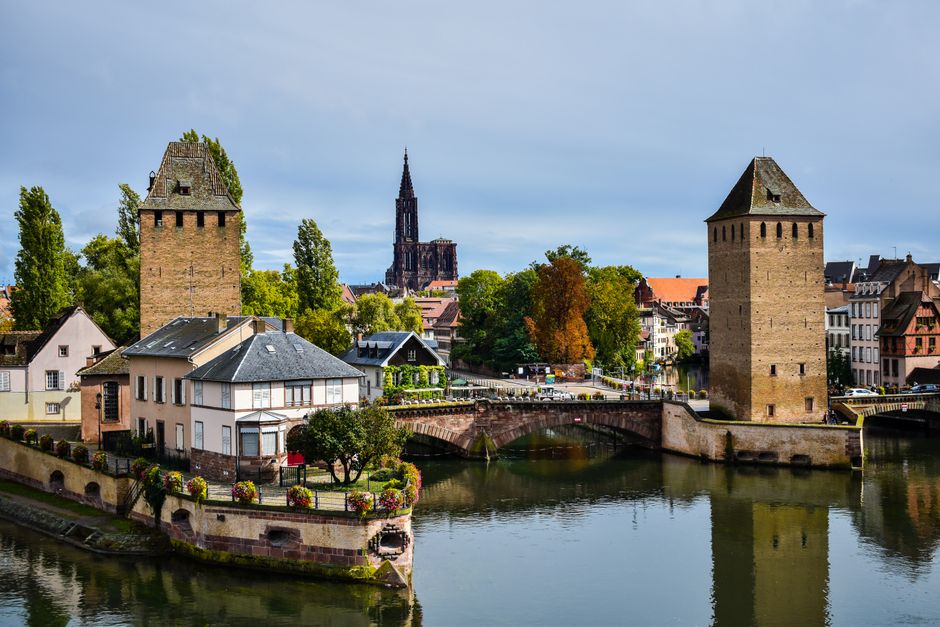
Stand on the Ponts Couverts and the water below you splits around four medieval towers, with the half-timbered backs of Petite France leaning out over the canal just upstream. A few minutes' walk north, the single spire of the cathedral rises over the rooftops of the Grande Île, and you can hear the trams before you see them.
Strasbourg suits travellers who like to cover a historic centre on foot, then cross a bridge and find themselves among European institutions. The old town is compact and walkable, the museums cluster in a few buildings, and the river is never far away.
This guide covers the sights and experiences in and around the city, with a one-day plan at the end that strings the best of them together.
Top things to do in Strasbourg
1. Cathédrale Notre Dame
Built between 1176 and 1439, with a 142-m tower that is the highest cathedral tower in France, this Gothic cathedral is the city's finest architectural highlight. Inside, look for the astrometric clock.
Admission is free. It sits on the Grande Île, so you can step straight out into the old town afterwards.
2. Petite France
This is the small area between the rivers, just south of the Grande Île, and it holds some of Strasbourg's prettiest and most photogenic streets and buildings, with half-timbered townhouses leaning out over narrow cobbled streets. It resembles Colmar, with its canal and half-timber houses.
Walking around the old town is a good way to pass a day, and there are plenty of cafes to rest in as you go. Combine Petite France with the Ponts Couverts and the Barrage Vauban, which are right there.
3. Ponts Couverts
These are three bridges dominated by four towers from the 12th and 14th centuries. The bridges got their name from their roofs, which they lost in the 18th century, and the towers are the remains of the ancient ramparts.
They stand at the edge of Petite France, so pair them with a walk through those streets.
4. Barrage Vauban
This is a bridge, weir and defensive work erected in the 17th century, known at the time as the Great Lock. It does not function as a navigation lock in the modern sense; today it displays sculptures and has a viewing terrace on its roof.
From the terrace you get views of the earlier Ponts Couverts bridges and the Petite France quarter. It is at Place du Quartier Blanc.
5. Musée Alsacien
This museum features articles from the daily lives of Alsatian peoples from the 13th to 19th centuries: clothing, furniture, toys, tools of artisans and farmers, and religious objects used in Christian, Jewish and even pagan rites.
The exhibits are in rooms connected by wooden staircases and balconies in adjacent multistory Renaissance-era houses around a central courtyard. It is at 23-25, Quai Saint-Nicolas, just across the river from the Ancienne Douane. Admission is €6.5, and it is open Mon and Wed-Fri 12:00-18:00, Sat and Sun 10:00-18:00.
6. Palais des Rohan
This French-style palace was built after the acquisition of the town by the French in 1681. It is home to the Museum of Fine Arts, the Archaeological Museum and the Museum of Applied Arts.
Because three collections sit under one roof, it is an efficient stop if you want to see several museums in a single visit.
7. Musée de l'Oeuvre Notre Dame
This is a splendid museum of medieval religious art related to the cathedral, covering the medieval and Renaissance periods. It is at place du Château.
Admission is €6.5. Its subject matter makes it a natural follow-up to the cathedral itself.
8. Maison Kammerzell
The intricately carved half-timbered frames decorating the upper floors of this house date from 1589. It stands to the left of the front of the cathedral.
Look up at the carvings as you pass between the cathedral and the old town streets.
9. Boat tours along the Rhine
Boat tours offer views over both Strasbourg and neighbouring Germany. Batorama run several river tours lasting from around 45 minutes to a few hours, costing around €10 per person.
The 45-minute tours run around the town centre and the European district. Boats can be found below Place du Marché aux Poissons.
10. European district
This is where you find the Council of Europe's seat (Le Palais de l'Europe), built in 1977 by Henry Bernard; the European Court of Human Rights, built in 1995 by Richard Rogers; and the European Parliament.
Use bus lines #6, 30 or 72 to get there. The 45-minute Batorama boat tours also take in this district, so you can see the institutions from the water.
11. Parc de l'Orangerie
This is a classical park with a small free zoo featuring birds and a few other animals, plus an excellent playground for young children.
It works well as a break from the streets of the old town, particularly if you are travelling with children.
12. Place de la République
This is a central crossroad encircled by neoclassical public buildings.
It sits between the old town and the European district, making it an easy point to pass through on the way between the two.
13. Museum of Modern and Contemporary Art (Musée d'Art Moderne et Contemporain)
This museum is recommended also because of the interesting building. Admission is €10.
It is a good counterpoint to the medieval and Renaissance collections elsewhere in the city.
14. Historical Museum
This is the museum of Strasbourg's history. Admission is €6.5.
Visit it if you want context for the buildings you have been walking past in the old town.
15. Christmas Markets
Christmas markets can be found in many places, but the most important and beautiful are place Broglie and place de la Cathédrale, although they are crowded.
They are the best places to drink mulled wine (vin chaud) and to eat Christmas cookies (Brädeles). Expect crowds at the two main squares.
If you only have one day
Morning: Start on the Grande Île at the Cathédrale Notre Dame, and check the astrometric clock inside. Step outside to see the Maison Kammerzell to the left of the cathedral front, then walk to the Musée de l'Oeuvre Notre Dame at place du Château.
Afternoon: Cross into Petite France and walk its cobbled streets, then continue to the Ponts Couverts and the Barrage Vauban, where the roof terrace looks back over the bridges and the quarter. If time allows, take a 45-minute Batorama boat tour from below Place du Marché aux Poissons, which covers the town centre and the European district.
Evening: Return to the old town for a walk and a stop at one of the cafes, or, if you are visiting in the Christmas season, head to the markets at place Broglie and place de la Cathédrale for mulled wine and Brädeles.
Frequently asked questions
How much does the cathedral cost to enter?
Admission to the Cathédrale Notre Dame is free.
How do I reach the European district?
Use bus lines #6, 30 or 72. The 45-minute Batorama boat tours also run around the European district.
Where can I drink mulled wine at the Christmas markets?
The most important and beautiful markets are at place Broglie and place de la Cathédrale, and they are the best places to drink mulled wine (vin chaud) and eat Christmas cookies (Brädeles). They are crowded.
Which museums are housed in the Palais des Rohan?
The Palais des Rohan is home to the Museum of Fine Arts, the Archaeological Museum and the Museum of Applied Arts.
Pick your dates, decide how many of the museums you want to fit in, and start planning your trip to Strasbourg.