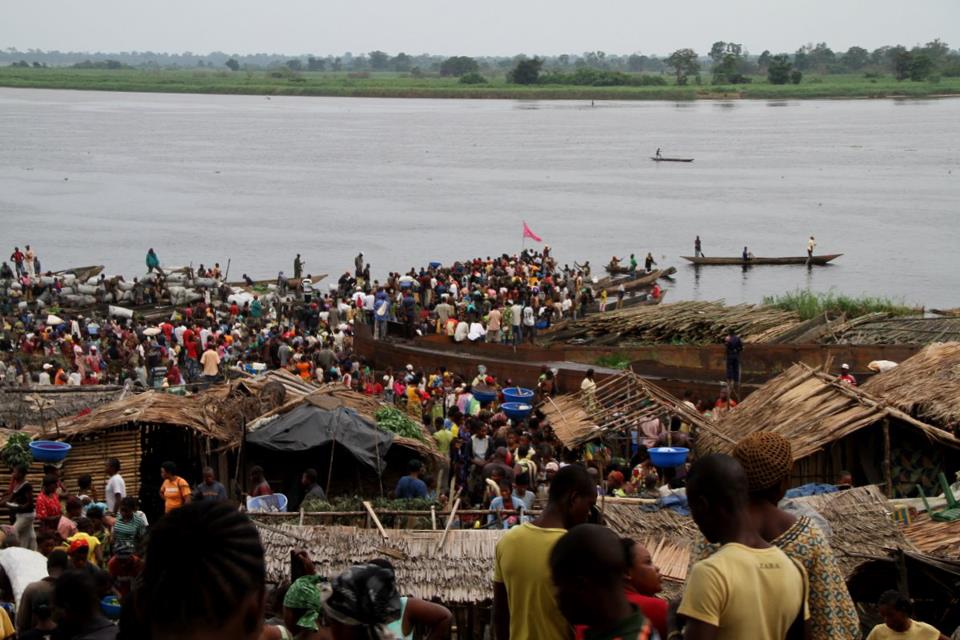
Mbandaka sits on the east bank of the Congo River, just below the mouth of the Ruki, in the heart of a vast wetland landscape and only a few kilometres from the equator. It is the capital of Équateur Province, and the river is the defining fact of the place: the city is reached by air in about an hour from Kinshasa, or by a river barge journey of four to seven days.
For a visitor, the city is spread out along the riverside and inland from it, with most streets and avenues unpaved dirt roads and large areas without electricity or running water. The main sights lie east of the town centre, at Bamanya and Eala, so where you base yourself affects how easily you reach them. This guide covers the areas you can choose between, and what each one suits.
Best areas to stay in Mbandaka
1. The riverside area
The riverside is the natural base for a first visit. Accommodation here looks out over the Congo, and the riverbank is where you find the Equator Stone placed by Henry Morton Stanley to mark where he believed the equator crossed the river. A riverside base keeps you close to the water and to the city's main orientation point.
This suits first-time visitors and anyone who wants the river as the backdrop to their stay. It is also the most practical choice if your onward travel is by river barge to Kinshasa or Boende. Expect riverside properties rather than a dense strip of options, and expect the unpaved roads and patchy utilities that affect the city as a whole.
2. Avenue Bolenge
Avenue Bolenge is a named street with accommodation on it, including riverside places with a pool. It gives you an address to aim for when arranging a room, rather than an abstract part of town.
It suits travellers who prefer to fix a specific street before arriving, and it works for couples and independent visitors rather than for those who need a wide choice of rooms in one spot. Because the city's streets are largely dirt roads, allow time for any journey from here to the centre or out towards the eastern sights.
3. The town centre
The town centre is the reference point for distances in Mbandaka: the Eala Botanical Garden lies about 7 km east of it, and the Catholic mission station and Central African history research centre at Bamanya about 10 km east. Basing yourself centrally means the eastern sights are a straightforward run out.
This suits visitors whose priority is the botanical garden and the research centre, and anyone who wants to be within reach of the city's commercial life. The centre is also where the town hall once stood, about 4 km north of the equator. Weigh this against the riverside if the river itself is what you have come for.
4. The eastern side, towards Eala and Bamanya
The area east of the centre puts you closest to the two principal sights: the Eala Botanical Garden, roughly 7 km out, and the Bamanya mission station with its Central African history research centre, roughly 10 km out. The garden is unfenced and has suffered from neglect and illegal logging, so it is a place to visit with a local arrangement rather than to wander into casually.
This suits visitors with a specific interest in the botanical collections or in Central African history research, and those who would rather shorten the daily journey than stay in the middle of town. It is less suited to anyone who wants to be near the river or who needs a range of services within walking distance.
Where to stay on a budget, mid-range or splurge
- Budget: Guesthouse-style and church-run accommodation, including a Catholic welcome centre. Rooms are simple, and you should expect the city's wider infrastructure problems to apply: unpaved roads, and areas without reliable electricity or running water.
- Mid-range: Established hotels in the city, including named properties on Avenue Bolenge and elsewhere. This is the most common level of accommodation in Mbandaka, with private rooms and, in some cases, a pool.
- Splurge: Riverside hotels are the top of the range here. The choice at this level is limited, so book early if you want a river-facing room.
Best area for a first visit
Base yourself in the riverside area. It gives you the Congo River on your doorstep, the Equator Stone nearby, and the easiest connection to onward river travel. From there the eastern sights at Eala and Bamanya are a day trip rather than your daily setting.
Frequently asked questions
How do I get to Mbandaka?
By air from Kinshasa, which takes about an hour, or by river barge, a journey of four to seven days from Kinshasa and Boende. The city has its own airport.
What language will I need?
The main languages spoken in Mbandaka are Lingala, French and Mongo. French is the most useful for visitors arranging accommodation and transport.
When is the best time to visit?
Mbandaka has a tropical rainforest climate with no dry season. January is the driest month and September the wettest, and temperatures stay relatively constant through the year, so there is no season to avoid on temperature grounds.
What should I expect from the roads and utilities?
Most streets and avenues are unpaved dirt roads, and large areas of the city have no electricity or running water. Plan journeys with extra time and check what your accommodation can provide before you arrive.
Compare live prices for the areas above with the booking tools on this page before you commit.