The Baroque Heart of Ragusa Ibla, Waiting at the Top of a Grand Staircase
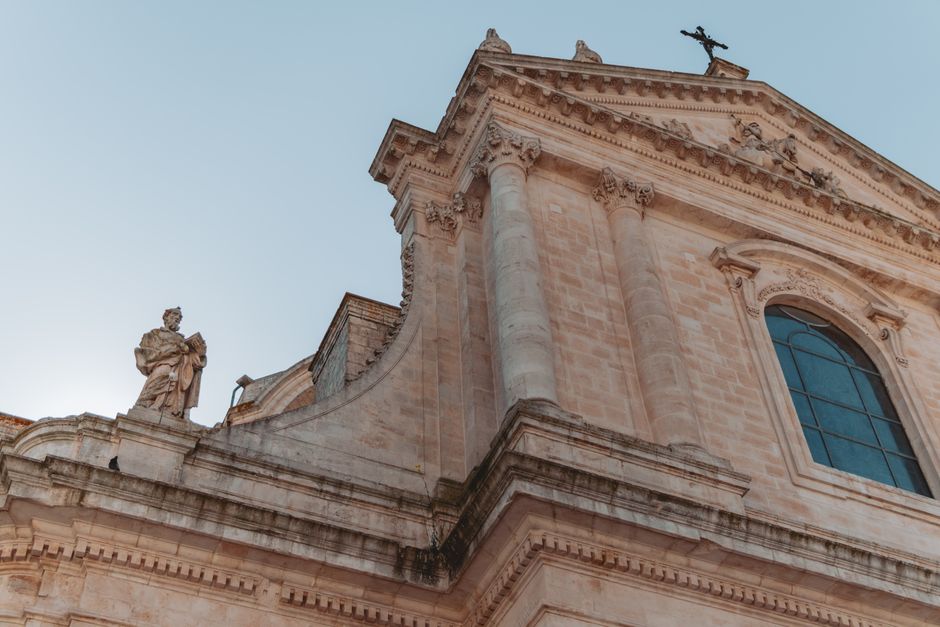
You stand at the foot of an imposing stone staircase in Piazza Duomo, looking up at a three-tiered facade of cream and pink limestone studded with Corinthian columns, statues, and baroque ornamentation that catches the Sicilian light. This is the Duomo di San Giorgio, the principal religious monument of Ragusa Ibla, and it commands the old town the way few churches in Sicily do. The original medieval church that stood here survived the catastrophic 1693 earthquake only as a single Gothic-Catalan portal—the Portale di San Giorgio, now bricked up but still visible a short walk away on Via Normanni, its relief of Saint George slaying the dragon worn smooth by centuries of wind. What you see now rose between 1739 and 1781, designed by Rosario Gagliardi, the baroque architect who rebuilt much of southeastern Sicily after the quake. The facade alone makes the climb worthwhile.
What You See Inside: Light, Devotion, and Saint George's Presence
Step through the main door beneath its pointed arch and enter a Latin cross interior divided by stone pillars into a central nave and two side aisles. The light comes from above: a large dome above the transept rises on columns with windows that flood the stone with natural radiance, supplemented by smaller domes toward the rear. The 13 stained glass windows flanking both sides of the nave depict the martyrdom of Saint George—your eye follows them as you walk forward. Red velvet curtains hang between the columns. In the side chapels, 18th-century paintings punctuate the walls. The left transept leads to the sacristy, where 16th-century sculptures salvaged from the original medieval church are kept. But the most telling detail is Saint George himself: a statue of the saint on horseback stands in the church, and nearby rests a large silver-covered reliquary that is carried in procession through Ragusa Ibla each year on the Festa di San Giorgio. This is not a museum church—it remains a living seat of devotion.
When to Visit and How to Make the Most of Your Time
The cathedral is open in the late morning and late afternoon—roughly 10:00 to 12:30 and 16:00 to 18:30, though hours may shift seasonally. The morning light is gentler on the interior; the late afternoon catches the facade in warm, low-angle sun. If you visit in late May or early June, you may find concerts from the Melodica festival, a series of piano recitals held in Ragusa's churches through November. The Festa di San Giorgio, the saint's celebration, brings the church and the piazza to life with religious observance. Allow thirty minutes to an hour inside; the architecture is the thing, and the proportions repay slow looking. Before or after, climb to the top of the staircase and turn around—Piazza Duomo opens below you, and the views across the valley toward the baroque palaces of Ibla justify the ascent. Visit in the evening if you can; the illuminated facade at night is another thing entirely.
The Medieval Portal and the Shadow of the 1693 Earthquake
Before you leave the church, walk to Via Normanni to see the Portale di San Giorgio, all that survives of the 14th-century church destroyed in 1693. It is bricked up now, and the relief carving of Saint George on horseback, the dragon beneath him, and the damsel he rescues have been eroded by wind until they are nearly cadaverous—the horse's ribs show, the saint's face is worn, the woman is barely legible. To stand before it is to understand viscerally what the earthquake took, and what the 18th-century builders chose to resurrect.
What Lies Close By in Ragusa Ibla
From Piazza Duomo, the old town unfolds in narrow streets and steep steps. The Giardini Iblea at the foot of Ibla offers restful views and three small medieval churches. The Cattedrale di San Giovanni Battista sits in Ragusa Superiore, the newer town above, a grand baroque cathedral begun in 1706. The Chiesa della Madonna del Carmine and Museo Archeologico Ibleo are nearby. The Ponte dei Cappucini, an old arched bridge from 1825, connects the two parts of town. If you are in Ragusa Ibla in October, the Ibla Buskers festival fills the streets with street performers; if in June or July, the Ibla Grand Prize brings world-class pianists to outdoor concerts in the piazzas.
Begin your visit by standing at the foot of that staircase in the late afternoon, when the sun hits the limestone facade. Then climb.