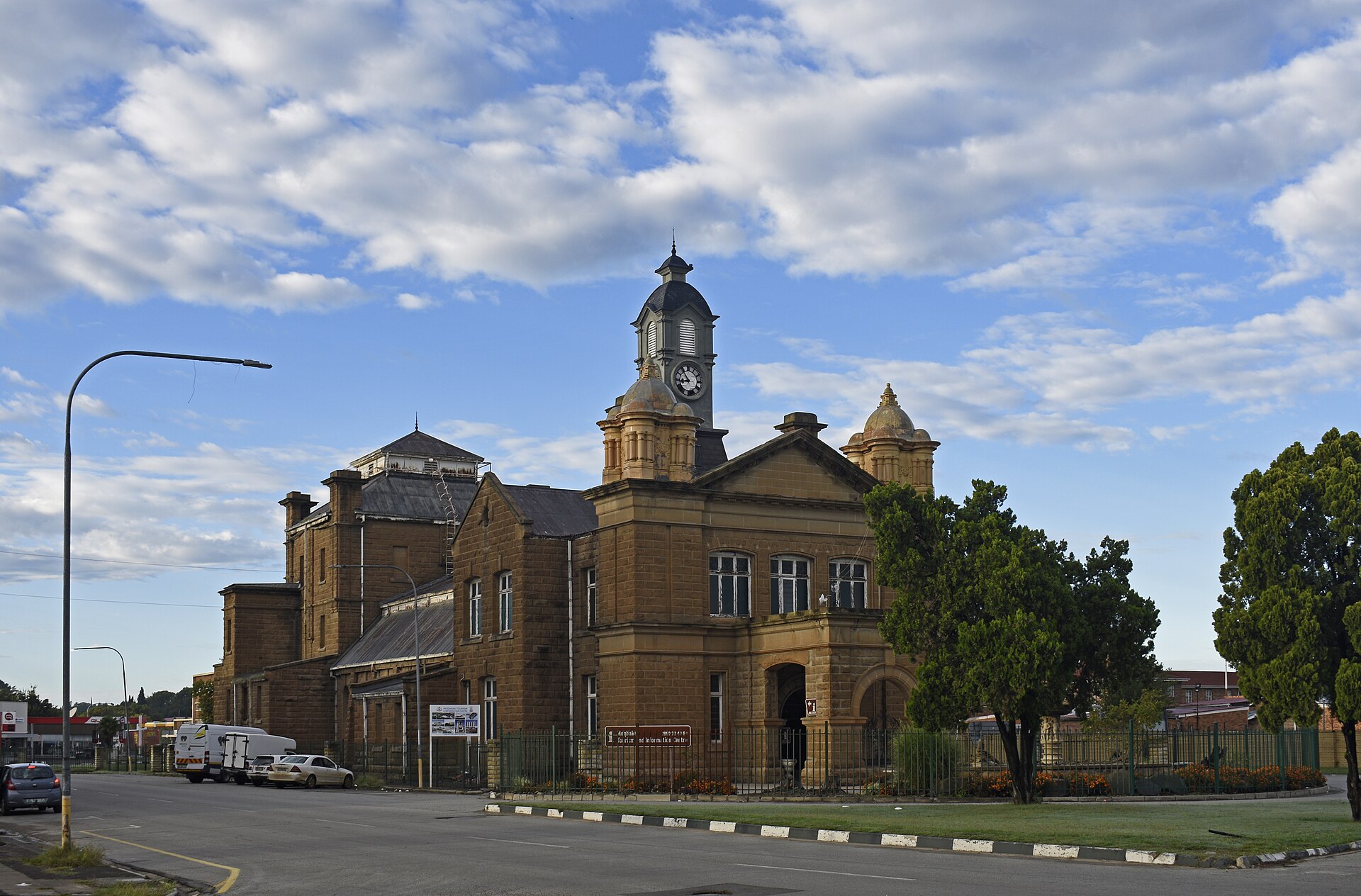
Kroonstad
Introduction
Kroonstad sits on the N1 highway in South Africa's Free State, serving as the commercial and urban centre of the Northern Free State. It is also an important railway junction on the main line between Cape Town and Johannesburg, which makes it a practical stopover if you are travelling along that corridor.
As one of the larger towns in the province, it offers the services and infrastructure of a regional hub rather than the quiet of a small dorp, so you can use it as a base for exploring the surrounding part of the Free State.
Before you go
Kroonstad sits in South Africa's Free State, and a little background will help you read the place as you arrive. The town's Afrikaans name means "Crown City", but the "crown" in question was a horse that drowned in a nearby ford; a witness to the accident, Orpen, named the infant settlement after the animal. Maokeng, the Sesotho name for an area within Kroonstad that is sometimes used as a synonym for the town, means "place of the thorn trees (mimosa trees)".
The Bloemhoek Dam lies just east of town and supplies much of its water, so expect the landscape around that side to be shaped by the reservoir. The source gives no detail on climate, costs or facilities, so check practical arrangements before you travel.
Getting there
By car, Kroonstad sits directly on the N1, the main route between Cape Town and Johannesburg, which bypasses the town to the east and makes it a convenient stopover when driving between those two parts of the country. Several regional roads also converge here: the R34 to Odendaalsrus to the south-west, the R76 to Steynsrus to the south-east, the R721 to Vredefort to the north-west and the R82 to Heilbron to the north-east.
By train, Kroonstad railway station on Stasie St serves the town and lies on the important junction from Cape Town to Johannesburg via Bloemfontein. Overnight trains operated by Shosholoza Meyl between Johannesburg and Cape Town, East London, Durban and Port Elizabeth all call here, though most run only two or three times per week in each direction. By plane, the town has a small airport with no passenger flights.
Getting around
Kroonstad is oriented around road travel, so a car is the practical default for most visitors. The N1 bypasses the town centre to the east, meaning you will need to leave the highway to reach the civic core. Once you have parked, the town centre with its civic buildings, church squares and monuments is best explored on foot, and the flat ground makes the willow-lined banks and riverside parks of the Vals River the most pleasant and lowest-effort places to walk. Heritage sites, however, are not concentrated in a single tourist core, so you will likely need wheels to link them together. Several regional roads fan out from the town — the R34, R76, R721 and R82 — and the N1 is a modern toll road, so budget for tolls if you are driving in or out on it.
Kroonstad Railway Station on Stasie Street sits at a key junction on the main line between Cape Town and Johannesburg via Bloemfontein, but this is long-distance rail rather than a local commuter service: overnight Shosholoza Meyl trains call here, most running only a few times per week in each direction, so rail works best if you can be flexible with your dates. There is no metro, tram or light-rail network, and no substantial local bus network for visitors to rely on — confirm what is actually running before you arrive rather than assuming a service exists. Minibus taxis are the main form of shared transport used by residents and connect the town with surrounding areas, but they are not designed around tourist itineraries. Ride-hailing apps are more straightforward if you have a working phone and data, though availability can be inconsistent, particularly outside the centre or late in the day, so arrange your return trip in advance. For anything beyond the centre — the golf course, the dams, or the lion and tiger park — organise transport ahead rather than counting on finding it on the spot. Note also that the town's small airport has no passenger flights, so commercial air travellers usually arrive via Johannesburg and complete the journey by road or long-distance rail.
Where to stay
Kroonstad has plenty of B&Bs, though many of them don't yet show up in online searches, so don't rely on the internet alone to find a bed. As you come into town from the N1, pull into the lay-by in front of the large billboard: it works like a noticeboard for local accommodation, with a basic map of the town ringed by panels listing the names and contact numbers of various establishments. Use it to pick a place and phone ahead before you drive in.
Food & drink
The source material for Kroonstad contains no listings for eating or drinking, so there is nothing to recommend here.What to see and do
Kroonstad's sights are mostly memorials and traces of the past, scattered in and around town. The Bloemspruit Monument commemorates those who died in the Kroonstad Concentration Camp, and a Garden of Remembrance honours Allied soldiers who fell in the two world wars. South of the city, a blockhouse stands as a reminder of the later stages of the Second Boer War. Further back in time, stone corbelled huts built as refuges by the region's prehistoric inhabitants can be found at various spots about the city, and the surrounding area holds fossils and San rock art.
For leisure, you can play a round on the town's 18-hole golf course, or visit the Boskoppie Lion and Tiger Park for lion tours and interaction with lion and tiger cubs. Anglers can fish the well-stocked Vals River or the Bloemhoek Dam, and boaters can head out on the Serfontein Dam. Horseriding, gliding and hiking trails are also available.
Three days in Kroonstad
Day one: Start in Kroonstad itself, the town known as Crown City in South Africa's Free State, and get your bearings along Stasie St, where the Kroonstad Railway Station sits on Stasie Street. The Vals River runs through town, and the Bloemhoek Dam lies nearby for a look at the water. Afrikaans and Sesotho are the languages you'll hear around you, and the town's heritage is worth seeking out. Overnight in Kroonstad.
- Kroonstad town centre and Stasie St
- Kroonstad Railway Station on Stasie Street
- Vals River and the Bloemhoek Dam
Day two: Use Kroonstad as your base for the surrounding Northern Free State towns. Odendaalsrus, Steynsrus, Vredefort and Heilbron are all within reach, and Bloemfontein lies further south if you want a longer run. Minibus taxis are the way to ride between places, so note the routes before you set out. Return to Kroonstad for the night.
- Odendaalsrus
- Steynsrus
- Vredefort
- Heilbron
- Bloemfontein
Day three: Spend your last day in Maokeng, the Sesotho-speaking township, before moving on. If you're continuing by rail, the Shosholoza Meyl connects Kroonstad with Cape Town, Johannesburg, East London, Durban and Port Elizabeth, so check which service suits your onward route. Use the remaining time to revisit Stasie St and the station area before you leave.
- Maokeng
- Shosholoza Meyl connections to Cape Town, Johannesburg, East London, Durban and Port Elizabeth
- Stasie St and Kroonstad Railway Station