Ladysmith
Introduction
Ladysmith, officially known as uMnambithi since 2024, is a town in KwaZulu-Natal that serves as the seat of both the Alfred Duma Local Municipality and the Uthukela District Municipality. It sits roughly midway between Durban to the south-east and Johannesburg to the north-west, making it a natural stopover on the route between the two.
The local economy gives you a sense of a working town rather than a resort: food processing, textiles and tyre production are among the area's important industries.
Before you go
Ladysmith's recorded history is dominated by the Anglo Boer War, and a little background reading will make your visit far more meaningful. On 30 October 1899, known as Mournful Monday, Boer forces began a siege of the town after British troops retreated there following their defeat at the Battle of Modderstroom. The siege lasted 118 days before British reinforcements arrived and brought it to an end.
- For a first-hand account of the siege and of the Anglo Boer War in general, read Sir Winston Churchill's London to Ladysmith via Pretoria before you travel.
Getting there
By road, Ladysmith sits just off the N3: take the N11 from the N3 junction and continue for roughly 20 km to reach the town.
- By car: Leave the N3 at the N11 and follow it for about 20 km into Ladysmith.
- By train: Passenger trains on the Johannesburg–Durban route call at Ladysmith railway station. Be aware that the service was suspended during the COVID pandemic and, following looting and cable theft, had not resumed as of early 2023 — check the current status before planning rail travel.
- By plane: Ladysmith Airport (LAY) handles general aviation only, so scheduled commercial flights are not an option.
Getting around
Ladysmith is a compact town, and walking is a reasonable way to cover short distances in the central area. For anything beyond the town centre, or for reaching the bus stop or railway station with luggage, you will generally need a vehicle or a pre-arranged transfer. There is no metro, tram or commuter rail network, so plan your movements around road transport.
If you are driving yourself, the N11 connects the town to the N3, the main highway between Johannesburg and Durban, and the link from the N3 into Ladysmith is a short drive; having your own vehicle is the most flexible way to explore the town and the surrounding area. Intercity buses are the main form of public transport, with operators such as Intercape Megaliner serving Ladysmith and connections to Durban, Johannesburg, Bloemfontein, Kimberley, Cape Town and many other towns and cities; book tickets in advance, particularly on busier routes. Ladysmith has a railway station, and passenger trains between Johannesburg and Durban have historically called there, but the service was suspended and had not resumed as of a February 2023 update, so check the current status before planning any journey by rail. Ladysmith Airport serves general aviation only and does not handle scheduled commercial passenger flights, so most visitors fly into a larger airport and continue by road or bus. Taxi and ride-hailing options are limited, so arrange any necessary transfers in advance rather than assuming you can hail a ride on arrival.
Where to stay
Ladysmith has a small choice of places to stay, with options both in town and just outside it. On Murchison Street in the centre, the Royal Hotel offers bed and breakfast rooms, making it a convenient base if you want to be within walking distance of the town's core.
- Royal Hotel — 140 Murchison Street, in the town centre; bed and breakfast rooms.
- Platrand Lodge — on Fourie's Kraal Farm beside the Ladysmith airfield, reached by following the N11 to the airfield and then the signs; a rural stay on the edge of town.
- Idwala Lodge — just outside town on the N11 towards Dundee, for those arriving from or heading onward in that direction.
If you prefer a quieter setting away from the streets, the two lodges outside the centre put you closer to open country while keeping the town within easy reach by road.
Food & drink
The source material for Ladysmith contains no information on where or what to eat or drink, so there is nothing to build this section from. Rather than invent restaurants, dishes or bars, this section is left empty.What to see and do
Ladysmith's centre holds the core of its Anglo-Boer War story. In front of the Town Hall you'll find Castor and Pollux, the twin British howitzers that defended the town during the siege, and next door the Siege Museum occupies the old market building with exhibits on the town's encirclement. Nearby, the Soofie Mosque is open to visitors and has been declared a National Monument, while at the Lord Vishnu Temple a statue of Gandhi recalls his time as a stretcher bearer after the Siege of Ladysmith and during the Battle of Spioenkop.
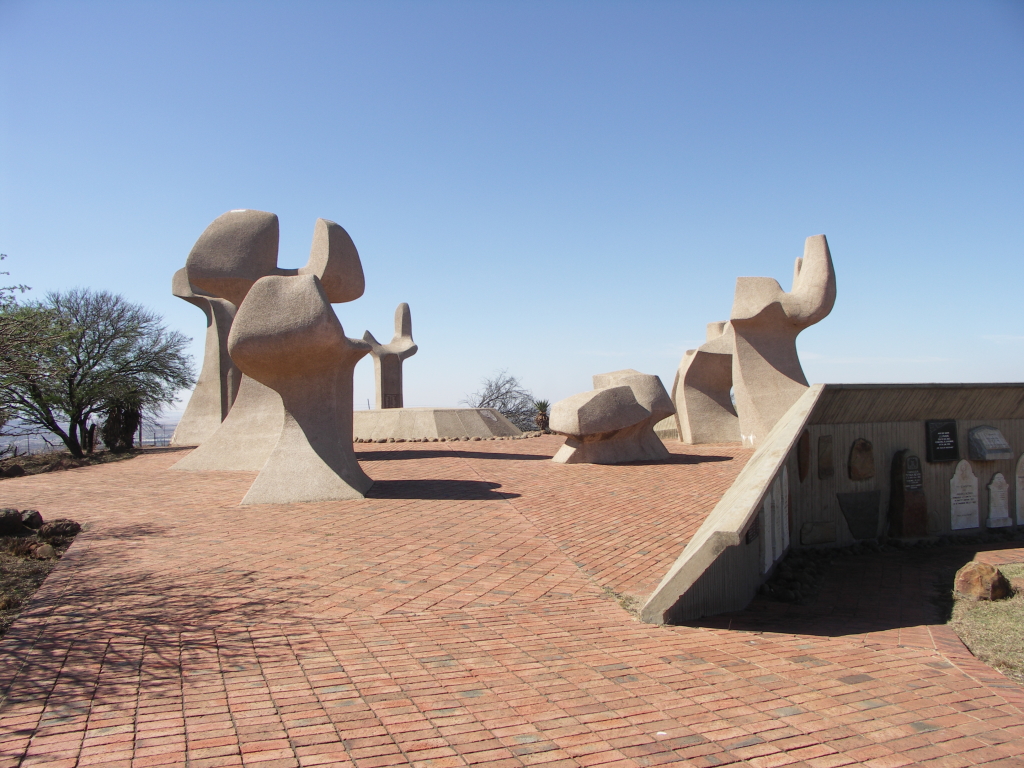
- Wagon Hill/Platrand Monument and Museum, on the battlefield of the same name, commemorates those who died in the Anglo-Boer War.
- Bloukrans Memorial, reached from Colenso along the R74 and a dirt road, marks the site of the 1838 killings of Voortrekker settlers; there are no visitor facilities.
- The Robert E Stevenson Museum at Colenso, in the old toll house by the Tugela River, holds maps of the Battle of Colenso and the Battle of Tugela Heights and gives directions to associated memorials and graveyards; the key is kept at the neighbouring police station.
- Llandaff Oratory at Van Reenan, northwest of Ladysmith on the N3, is said to be possibly the smallest church in the world, with only eight seats.
For walking, head to Spioenkop, roughly 30 km outside town via the N11 and R616 towards Bergville, where hiking trails cross the complete battlefield of one of the war's bloodiest engagements. A map is available from the attendant, but be prepared for a long walk, as turn-of-the-century battles covered a large area.
Three days in Ladysmith
Day one: Start in Ladysmith itself, in KwaZulu-Natal, and get your bearings on Murchison Street, the town's main artery, where you can find the Royal Hotel and pick up a taxi. Spend the day with the town's Anglo Boer War history, which is central to Ladysmith's identity, and take in the monuments and story of the siege. October brings Mournful Monday to mind, when the Boer and British forces clashed near Modderstroom; Sir Winston Churchill passed through this story on his way from London to Pretoria. By evening, settle in and plan the rest of your stay.
- Walk Murchison Street and note the Royal Hotel as a landmark.
- Focus on the Anglo Boer War heritage around town.
- Use a taxi to get around if you are without your own transport.
Day two: Use Ladysmith as your base for exploring the wider Uthukela District Municipality and Alfred Duma Local Municipality area. If you are arriving by air, Ladysmith Airport (LAY) serves the town, and intercity buses such as the Intercape Megaliner connect it with Durban, Johannesburg, Bloemfontein, Kimberley and Cape Town. February is a good month to plan around, and the warmer months are generally warm and humid, so carry water and pace yourself. Keep the day flexible and return to Murchison Street for the evening.
- Check connections from Durban, Johannesburg, Bloemfontein, Kimberley and Cape Town.
- Ladysmith Airport (LAY) is the local air option.
- Intercity services include the Intercape Megaliner.
Day three: Spend your final day revisiting the town's wartime story at a slower pace, then handle practicalities. Be aware that COVID disrupted travel and services in the past, so confirm arrangements before you leave. Leave time for a last walk along Murchison Street and a stop near the Royal Hotel before your onward journey to Durban, Johannesburg or beyond.
- Revisit the Anglo Boer War sites at an easy pace.
- Confirm transport and services in advance.
- Finish with a stroll along Murchison Street.