Qarshi
Introduction
Qarshi is a city in southern Uzbekistan and the capital of Qashqadaryo Region. It sits roughly 520 km south-southwest of Tashkent and about 335 km north of the country's border with Afghanistan, placing it firmly in the south of the country. Administratively it is a district-level city that also takes in the urban-type settlement of Qashqadaryo.
The city's reputation rests on two things: natural gas production, which makes it important to the national economy, and its woven flat carpets, which Qarshi is famous for. If you want to understand what the city is known for, those flat-woven carpets are the tradition to look out for.
Before you go
Qarshi has been known by different names over its long history: the Persians called it Nakhshab and the Arabs called it Nasab. After the Mongol invasion, Kapak Khan built himself a couple of palaces here, and the name Qarshi, from the Mongolian word for palace, was subsequently given to the new settlement. Keep this layered history in mind as you plan, since the city's identity is bound up with the empires and rulers who passed through it.
This is a place to prepare for as a stop rooted in that history rather than a resort destination. Plan your visit around the old names and the story of Kapak Khan's palaces, and set your expectations accordingly.
Getting there
Karshi is served by Karshi Airport (KSQ), which receives flights from Moscow-Domodedovo, Navoi, Saint Petersburg and Tashkent, operated by Uzbekistan Airways. The city also has a railway station, so you can arrive by train as well as by air.
Getting around
Qarshi has no metro or tram system, so getting around relies on buses, taxis and your own two feet. Buses are the main form of public transport and the cheapest way to move between the centre and outlying districts; stops are spread across the city, so ask at your accommodation which one is nearest and which route serves your destination. Fares are typically paid on board, so carry small-denomination cash in local currency. Routes aren't designed around tourist itineraries, so confirm the direction with the driver or a fellow passenger before boarding — this is normal practice and locals are generally helpful about it. Shared taxis fill much of the gap, particularly for trips buses don't serve directly, and depart when the car fills, suiting travellers who aren't on a tight schedule.
Taxis are the most flexible option and what most visitors fall back on, useful for short cross-town hops and for reaching the railway station or airport. Street taxis are widely available, but agree on the fare before you set off, since metered operation isn't guaranteed. Ride-hailing apps are the most convenient way to book a car without negotiating and remove the language barrier from the transaction — have your destination written down or pinned on a map to show the driver. Walking works well for the historic core: the Odina Mosque sits on the southeast side of the Eski Bazaar, the Kalizbek, Bakmir and Khodjaev Abdul Aziz madrassas all stand on the same square, and the Kok Gumbaz Mosque is another walkable anchor. The madrassas no longer serve a religious function and are in need of restoration, but you can enter if you ask the guardian; the Odina Mosque now houses the Regional Museum, and at the World War II Memorial you can access the upper levels on request. The climate is cold semi-arid, with hot, dry summers and cold winters, so plan longer walks for the cooler parts of the day and carry water in summer. For sights further out, such as the World War II Memorial, combine walking with a taxi or bus.
Where to stay
Qarshi has a small handful of hotels, all in the budget-to-mid-range bracket, so it pays to sort out your room before you arrive rather than hoping to find something on the ground. The Afshona Hotel on B. Sherqulov Ko'ch is a newly built two-star property with forty air-conditioned rooms, each with a shower, telephone and cable TV, and a complimentary continental breakfast included. Nasaf Travel, formerly the Hotel Tong, sits at the corner of Uzbekistan Street and Bogzar Street; its twenty rooms come with air conditioning, hot showers and satellite TV, and the restaurant serves both Uzbek and European food.
For something a step up, the Nasaf Hotel on Navoi Street, opposite the children's hospital, is a three-star address, though it keeps only nine guest rooms, which makes it worth booking ahead. Wherever you settle, expect straightforward comfort rather than luxury, and confirm your reservation directly with the hotel before you travel.
Food & drink
Qarshi keeps its eating options simple, with a couple of straightforward places clustered along Uzbekistan Street. Restaurant Hafizaxon sits at the corner of Uzbekistan Street and Yassaviy Street, while Cafe Gulinur is nearby, close to the National Bank (also called Milliy Bank). Both are the sort of casual spots where you eat what's on offer rather than choosing from an extensive menu.
The source gives no detail on specific dishes or drinks, so treat these as convenient places to stop for a meal rather than destinations in their own right. For anything beyond a basic bite, your best bet is to ask locally about what's available.
What to see and do
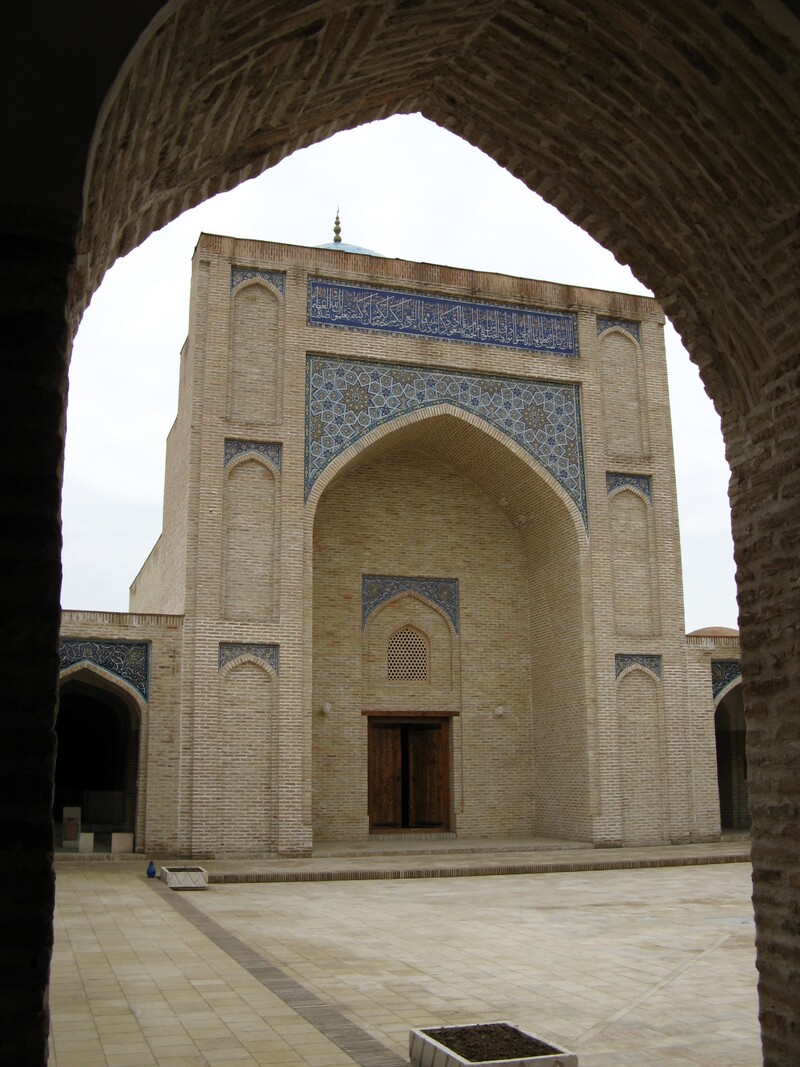
Most of Qarshi's sights cluster along Nasaf Street, where you'll find the Kok Gumbaz mosque, the city's largest and most striking, and the Khoja Abdul Aziz Madrassah, the biggest madrassah in town. The madrassah now houses the Regional Museum, whose modest exhibits and old photographs trace the history of the Bukhara emirate. Also on Nasaf Street is the Kurgancha Mosque, and at Bazaar Square you can see the Odin Madrasah, a female madrassah dating from the late 19th century. Nearby, the World War II Memorial honours Soviet casualties, with a bronze figure standing just behind the Eternal Flame of Remembrance, and the 16th-century Kashkadarya Bridge is worth a look for its age and setting.
To go further afield, head for the Khasim Ata Ensemble in Pudina village, roughly halfway between Qarshi and Kasan, a complex built around the tomb of an 11th-century Islamic teacher. About 30 km southeast of the city lies the Sultan Mir Haidor complex, and you can also seek out the Er-kurgan Fortress. The source lists no specific activities beyond these sites, so plan your time around seeing them.
When to go
Qarshi has a cold semi-arid climate, so the year divides into a hot, dry stretch and a colder stretch rather than a wet and dry season. In high summer you can expect strong heat and little rain, with dusty, sun-baked conditions around town. Plan your days around the heat of the day and count on dry, clear weather rather than showers.
Winters are cold, in keeping with the semi-arid continental setting, and this is the quietest stretch for travel. Expect low temperatures and a chill that makes warm layers essential, with little of the summer's heat.
Three days in Qarshi
Day one: Start in Qarshi itself, the regional centre of Qashqadaryo Region in southern Uzbekistan. Begin with the Odina Mosque, then wander through the Eski Bazaar to get a feel for the city's everyday life. Keep the pace easy on your first day and plan the rest of your stay around what you find.
- Odina Mosque
- Eski Bazaar
Day two: Give the day to the city's older layers. Qarshi was known as Nakhshab in earlier times, and the site of Kapak Khan recalls the Mongol period. Walking between these places is the best way to sense how the town has been shaped by Persians, Arabs and later rulers.
- Kapak Khan
Day three: Use the day for a wider look at the region. Shared taxis and buses connect Qarshi with other routes, and Karshi Airport (KSQ) links the city with Tashkent, Moscow's Domodedovo, Navoi and Saint Petersburg, with Uzbekistan Airways among the carriers serving it. If you are heading onward to Afghanistan or back to Tashkent, sort out your transport in the morning and leave the afternoon free for a last walk through the bazaar.
- Karshi Airport (KSQ)
- Eski Bazaar