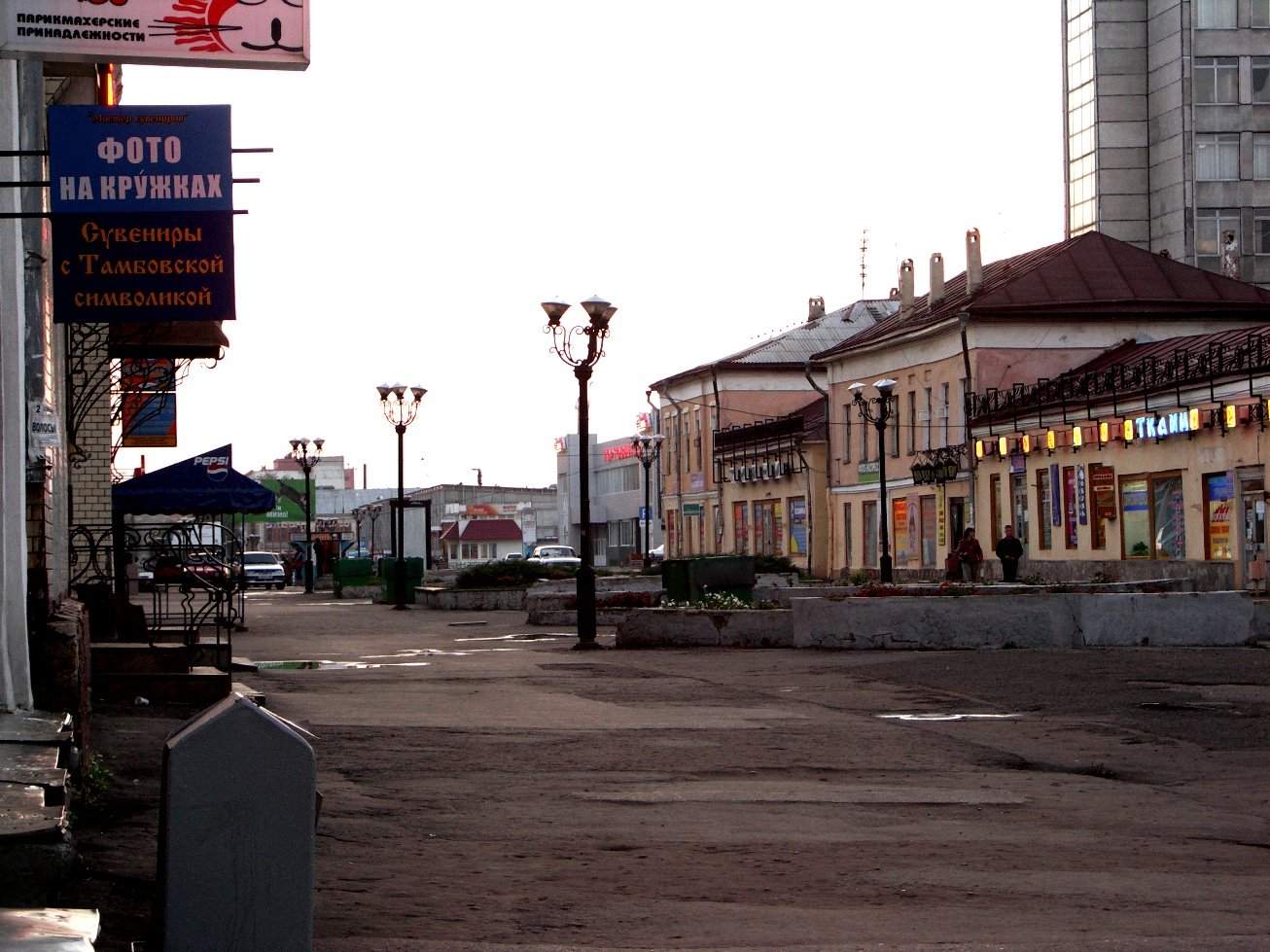
Tambov
Introduction
Tambov is the administrative centre of Tambov Oblast in central Russia, set at the confluence of the Tsna and Studenets rivers roughly 418 km south-southeast of Moscow. It is the largest city in the oblast and its historical centre, so it works naturally as a base for exploring the surrounding region.
Before you go
Tambov began as a southern fort raised in the 1636 against incursions from the Wild Field tribes, and grew into a provincial centre and a bread basket of Russia. Its history is bound up with the major events of Russian history, and traces of them are imprinted on the city's architecture. It is not a touristy hot spot, which is precisely why the centre has kept so many historical buildings, among them works of Russian Classicism such as the old Post Office and Art-Nouveau houses such as the Modern cinema.
Bear in mind the city's association with wolves: in the 19th century "wolf" was slang for a seasonal worker from Tambov, a person of rude manners. When you go out, don't walk alone after dark in the suburbs.
Getting there
Tambov is reached by rail or air. The railway station lies a long way south-east of Moscow, and direct trains run to Tambov from Saint Petersburg, Volgograd and Novorossiysk, so you can arrive from several directions without changing.
- By train: direct services from Saint Petersburg, Volgograd and Novorossiysk.
- By air: Tambov's airport has flights from Moscow and Sochi.
Getting around
Tambov has no metro or tram network, so getting around means buses, trolleybuses, marshrutkas (shared minibuses) and taxis. The centre follows a regular grid laid out under Catherine II's general plan of 1781, which makes it reasonably easy to navigate on foot; the central part of the city is where the former Kremlin and posad once stood. The centre is considered safe for evening walking, though more caution is advised in remote residential areas after dark. English is limited mainly to staff at major hotels and younger people, so an offline translator on your phone is worth having. Greeting people is customary when entering small shops or addressing passers-by.
For moving between the railway station and the central streets, buses No. 18C, 18KOM and 44 and trolleybus No. 5 run along Ulitsa Internatsionala and central Ulitsa Sovetskaya. Bus No. 144 links the railway station with Donskoye Airport via Ulitsa Internatsionalnaya and Ulitsa Sovetskaya. From the New (Novy) Bus Station, which sits far from the centre on the western entrance and handles regional and interregional routes including Moscow, take buses No. 41 or 45, or minibus No. 45, to reach the centre or the railway station. Between the Northern (Severny) and New bus stations, use buses No. 7, 14A, 14П, 60 and 61, trolleybus No. 6, or minibuses No. 16 and 30. Taxi apps are described as reliable and affordable and are especially recommended for evening trips or when carrying luggage; intercity taxis are also available. Carry some cash: bank cards are widely accepted in shops, cafes and museums, but cash is advisable for small kiosks and markets.
Where to stay
Tambov's accommodation is concentrated in the city centre, which puts you within easy reach of the main sights. The Derzhavinskaya sits right on Lva Tolstogo Square in the heart of town, making it a practical base for exploring on foot. It operates as a business centre as well as a hotel, with a restaurant, bar and cafe on site, a 24-hour reception, ATM and safe, and it can arrange excursions and taxis for guests.
- Derzhavinskaya — central location on Lva Tolstogo Square; restaurant, bar, cafe, 24-hour reception, ATM, safe, excursions and taxi service.
- Hotel Grand — on Karla Marksa Street; features a sauna, cafe-bar and concert hall.
If you prefer somewhere with leisure facilities, the Hotel Grand on Karla Marksa Street offers a sauna and cafe-bar, and even a concert hall, which makes it a reasonable choice if you want entertainment without leaving the building. Both hotels offer rooms ranging from standard singles up to VIP options, so you can choose according to your budget and how much space you need.
Food & drink
For eating out, the source points to Signor Pomidor, a pizza-house at the House of Artist (Дом художника) bus stop. That is the only food option named here, so plan around it rather than expecting a long list of recommendations.
No bars, cafés or other drinking spots are listed in the source, so there is nothing specific to recommend for a drink.
What to see and do
Begin along the River Tsna Promenade, a two-kilometre walk on two levels, and take in the Palace of Aseyev, once the home of a nineteenth-century factory owner, along with Kazansky Cathedral and Spaso-Preobrazhensky Cathedral. You will also pass the Monument to S. Rakhmaninov. In the city centre you can visit the Catholic Temple and the Museum of Regional Studies, or seek out the quirkier collections devoted to the wolf and to sin. The Lunacharsky Theatre and Tambov Zoo round out the options.When to go
Tambov has a humid continental climate, so plan around two very different seasons. February is the coldest month, and the surrounding winter months bring the deep cold typical of the region, with snow and freezing conditions — pack for real winter weather if you visit then.
July is the warmest month and the height of the warm period. Much of the year's rain falls in the warmer half of the year, so a summer visit can bring both pleasant warmth and wet spells; bring rain protection alongside your warm-weather clothing.
Three days in Tambov
Day one: Start in the heart of Tambov, where the city's layout opens up along Ulitsa Sovetskaya and Ulitsa Internatsionalnaya. These central streets are the place to get your bearings, with architecture that ranges from Russian Classicism to Art Nouveau and Modern. Seek out the Post Office as a fine example of the classical strain, and take your time along the main axis rather than rushing between sights. In the evening, settle into the unhurried pace of the city centre and eat where the locals do.
- Ulitsa Sovetskaya
- Ulitsa Internatsionalnaya
- Post Office
Day two: Follow the Tsna, the river that gives Tambov its setting, and use the day to understand the region rather than just the town. Tambov Oblast spreads out around the city, and the countryside is where the idea of the Wild Field still lingers in the open steppe landscape. If you want a change of scene without leaving the area, head out towards Studenets. Back in town, look for the older layers of the city associated with Catherine II and the Kremlin, and note how the street plan reflects a deliberate, planned origin.
- Tsna
- Tambov Oblast
- Wild Field
- Studenets
- Catherine II
- Kremlin
Day three: Spend your last day on the details. Return to the centre for the Art Nouveau and Modern facades you may have passed quickly, and look at how Russian Classicism sits alongside them. Use the bus network to reach the edges of the city if you want a wider view, and keep an eye out for the Bear as a local emblem. Connections from Tambov run towards Moscow and onward to cities such as Saint Petersburg, Volgograd, Novorossiysk and Sochi, so plan your departure with the bus station or Donskoye Airport in mind. Leave time for a final walk along Ulitsa Internatsionala before you go.
- Art Nouveau
- Modern
- Russian Classicism
- Bear
- Moscow
- Saint Petersburg
- Volgograd
- Novorossiysk
- Sochi
- Bus Station
- Donskoye Airport
- Ulitsa Internatsionala