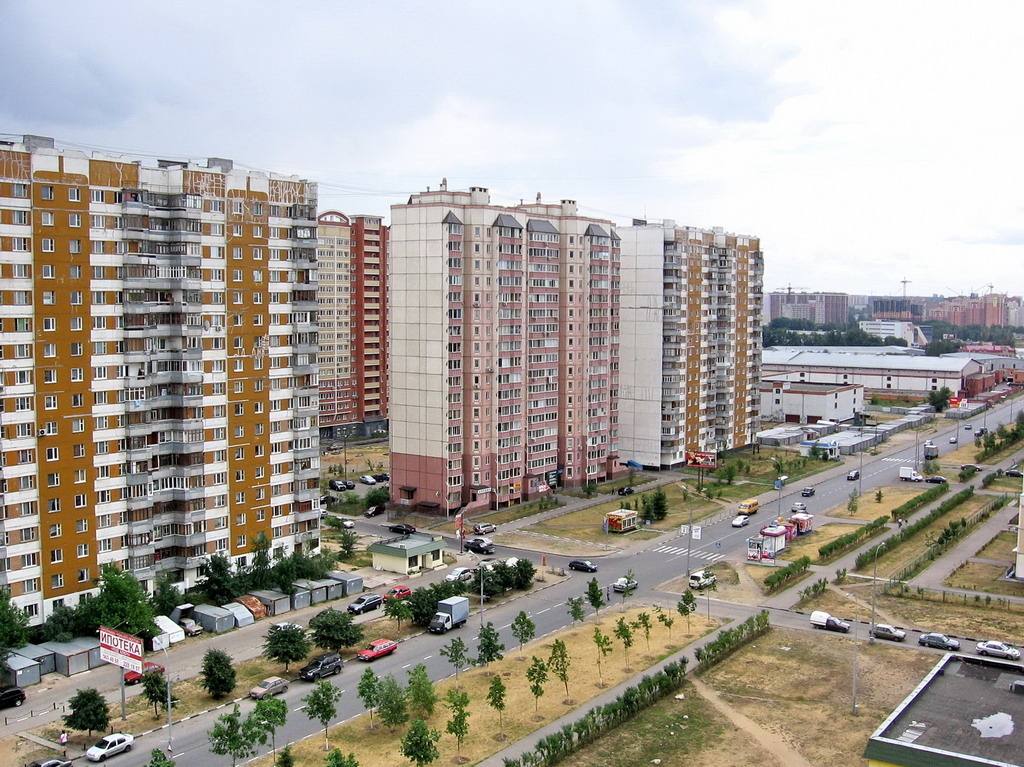
Vykhino-Zhulebino
Introduction
Vykhino-Zhulebino is an administrative district of Moscow, part of the South-Eastern Administrative Okrug. It covers an area of roughly fifteen square kilometres.
Getting around
Vykhino-Zhulebino is a sprawling, mostly residential district on Moscow's south-eastern edge, and it is well served by public transport, so you rarely need a car. Metro, suburban rail, buses, trams and shuttle minibuses (marshrutkas) all converge here, and the city centre is a straightforward metro ride away. Two metro lines serve the area: Line 7 (Tagansko-Krasnopresnenskaya), the workhorse for reaching central Moscow, and Line 15 (Nekrasovskaya). The ride from Vykhino to Taganskaya takes roughly twenty minutes, with trains running frequently throughout the day, making the metro the cheapest and usually the most predictable way into the centre. The Kazan direction of the Moscow railway also passes nearby, running from Moscow Kazanskaya station out toward Kurovskaya, which is a useful complement if your destination sits along that line.
Surface transport fills in the gaps. Buses run frequently on key corridors, and within the district bus lines 177, 279, 669, 722 and 731 serve the area around Zhulebinsky Boulevard, with the nearest stop at 27 Privolnaya Street only a few minutes' walk away and another at Khvalynsky Boulevard. Shuttle minibuses also operate here, including lines 144K, 315 and 552K, with stops at the Zhulebino 2nd Microdistrict and on Khvalynsky Boulevard. Service hours are long, so late-evening returns are usually feasible, though it is worth checking the specific route you plan to use. The local street grid that these routes thread through includes Privolnaya Street, Khvalynsky Boulevard, Morshansk Street, Saranskaya Street, Pronskaya Street, Lermontovsky Prospect, Aviakonstruktora Milya Street and the Lyubertsy passages.
Paying is simple and largely cashless: the Troika stored-value card is standard for the metro and surface transport, single (Ediny) tickets are also available, and contactless bank cards are accepted directly on the metro. If you are staying several days and using transport often, a Troika card is the least fuss. Taxis are the fastest option for short trips within or out of the district, and ride-hailing apps such as Citymobil are widely used — hailing through an app is usually easier than flagging a car on the street, especially if you do not speak Russian. Walking works best for short, local trips, since stops are generally only a few minutes apart on foot, but the district is large enough that longer journeys are better combined with metro, bus or shuttle. The source material does not describe a direct airport connection, so treat the airport leg as two stages: first reach the city's transport network, then use the metro, rail or a taxi onward to the district.
Three days in Vykhino-Zhulebino
Day one: Start in Vykhino, the older and busier half of the district, and use the metro as your anchor. The Tagansko-Krasnopresnenskaya Line runs through here, and Vykhino is also a stop on the Nekrasovskaya Line, so you can move between the two without much effort. Surface buses and shuttle microdistricts serve the residential blocks, but walking is the simplest way to get your bearings. Spend the afternoon along the streets around the metro, where daily life plays out in markets and courtyards, then ride one stop to Zhulebino for the evening.
Day two: Give Zhulebino a full day. Walk Zhulebinsky Boulevard and Khvalynsky Boulevard, then follow Privolnaya Street and Morshansk Street through the microdistricts to see how the district is laid out. Saranskaya Street, Pronskaya Street, Lermontovsky Prospect and Aviakonstruktora Milya Street are all worth threading into a long loop. If you prefer not to walk the whole way, buses and shuttles cover the same ground. For a change of scene, head to Lyubertsy just beyond the district boundary.
Day three: Use the transport network to see how Vykhino-Zhulebino connects to the rest of Moscow. The Tagansko-Krasnopresnenskaya Line and the Nekrasovskaya Line both serve the area, and the Kazan line of the railway stops at Moscow Kazanskaya, with Kurovskaya as a local halt. Paying for metro, buses and shuttles is easiest with a Troika or Ediny card; taxis such as Citymobil are another option if you are short on time. End your stay by walking the residential streets once more, since the district's character is in its everyday routines rather than in any single sight.