Rzeszow
Introduction
Rzeszów is the largest city in southeastern Poland, set on both banks of the Wisłok River in the heartland of the Sandomierz Basin. It serves as the capital of the Subcarpathian Voivodeship and the seat of Rzeszów County, which makes it the natural starting point for exploring this part of the country.
Before you go
Rzeszów has been a city since the mid-fourteenth century, and the Lubomirski family who owned it were patrons of culture, arts and science, shaping a place that has long been a meeting point of European nations. That heritage sits alongside a young, vibrant and dynamically developing city, so expect the historic and the modern side by side. A regional tourism information point operates on the Rynek, the main square, if you want to orient yourself on arrival. Polish is the only official language and all signs are in Polish. English is the main foreign language taught in schools, and while older people are more likely to know German or Russian, the younger generation usually speaks and understands English, so you should not have major difficulties communicating. Winters bring snow and night-time temperatures below zero, while summers are warm, with July the rainiest month thanks to short, intense cloudbursts and thunderstorms; annual rainfall is low by Polish standards. Rzeszów is a rather safe place for travellers, but keep an eye out for pickpocketing as in any city, avoid arguments with young, bald men in sweatshirts, do not advertise support for any football or speedway club given the rivalry between hooligans, and decline the "occasional bargains" offered by men wandering around parking places.Getting there
Rzeszów-Jasionka Airport (RZE) sits about 8 km north of the centre and is served by LOT Polish Airlines, Lufthansa and Ryanair. LOT connects the city directly with Warsaw and, via a stop-over there, with other Polish cities; Lufthansa flies from Munich, and Ryanair provides low-cost international links. More flights are available from Kraków, roughly three hours away by train, as well as from Warsaw and Katowice.
- By train: a direct rail line links the airport's "Jasionka Lotnisko" station with "Rzeszów Główny" in the centre, with trains running roughly hourly, though with breaks at night. The trains are modern and disabled friendly, and tickets can be bought online or on board.
- By bus: line 51 stops at "Jasionka - Port Lotniczy" just before the terminal and runs roughly every half hour during the day, taking about half an hour to the centre. Buy an A+B 60-minute ticket, since the airport lies outside the city limits.
- By taxi: Taxi Rzeszów and Super Taxi are the airport's partner companies, with cars waiting outside the terminal; expect a higher fare because much of the route falls outside the city borders.
- By car: car rental desks are on level 0 or 2 of the terminal, and all parking is paid, with short-term and cheaper long-term lots.
Rzeszów Główny station has connections to most Polish cities, usually with at least one direct train to the major ones and often a change for long distances; there are also direct services to Lviv, Odesa and Kyiv in Ukraine. Tickets can be bought at the station or online for selected PKP Intercity and TLK trains, and foreign students with a valid Polish student ID or ISIC card are eligible for a discount. By road, the city lies on the E40 and is reached via the A4 motorway from Kraków and the S19 from Lublin and the Slovak border, with the Ukrainian and Slovakian borders around 90 km away. Long-distance and international buses also serve the city, but check whether yours arrives at the Main bus station or the Bus station Podmiejski. Hitchhiking is common in Poland; a sign reading "Rzeszów" is enough, as it is the largest city in the south-east.
Getting around
The Old Town in the city centre is small and easily manageable on foot, and walking is the best way to see the Main Market Square, churches and synagogues. Regular buses run from the centre to the New Town and the suburbs. A single ticket is valid for one specific route and one bus on that route, so you cannot change buses on the same route; a one-hour ticket covers all buses and is useful if your trip involves a change, while a day pass suits several journeys in a day. Night buses cost twice as much as daytime ones, and large luggage must be paid for as an extra. Buy tickets from the small kiosks near bus stops or from the driver, where they may cost more, and validate your ticket in the machine once on board. If you travel beyond the Rzeszów area you need a second-zone ticket, which is more expensive. Timetables and information are available online.
Rzeszów has a well-developed network of cycle paths, though bicycle parking is lacking; you can rent a bike from commonly accessible stands, but you must register on the provider's website first. Driving and parking in the city can be difficult, though on ul. Krakowski, less than ten minutes' walk from the centre, there is a small complex with three free car parks. Taxis are convenient for trips too far to walk, especially at night or with luggage. To reach other towns near Rzeszów, take a bus if it serves your connection or a coach; coaches depart from the Main Bus Station (Dworzec Autobusowy), served by carriers including PKS Rzeszów and Veolia Podkarpacie, from the Suburban Bus Station (Dworzec Podmiejski), or from other stops, so check which station your service uses.
Where to stay
Rzeszów's accommodation clusters around the Rynek, the old market square at the heart of the city, so staying central puts you within walking distance of the main sights. For the cheapest beds, the Schronisko Młodzieżowe PTSM „Alko” on the Rynek itself offers both private rooms and dorms, and as a member of Hostelling International it gives discounts to card holders. Also on the square, Va Bank is a small mid-range option with single and double bedrooms.
If you'd rather be near the castle and the river, Hotel Fryderyk occupies a tenement house in that part of town and has single, double and triple rooms as well as suites. Travellers arriving by train may prefer the Best Western Plus Hotel Ferdynand, which sits very close to the station. For a more upmarket stay, the Bristol Tradition & Luxury on the Rynek, entered from Kopernika, offers chic rooms and suites in a high-end setting with a restaurant and a sushi spot, and it's centrally located.
Food & drink
For everyday eating, the city centre is well served by budget spots. You can grab a bite at Zacisze Bar & Cafe on 3 Maja, or try the pierogi at Pierogarnia "Na piętrze" nearby. Cafe Bar Murzynek on Tadeusza Kościuszki, Habanero on Mikołaja Kopernika, NK Strada Jedzenie na Wagę on Grunwaldzka, Rzeszowskie Słoiki on Sokoła and Restauracja Strażacka on Mochnackiego round out the cheap and cheerful options, all within the centre.
For something more substantial, head to the Rynek. Stary Brower Rzeszowski sits on the main square and pairs beers with filling snacks in a pub atmosphere. Kuk Nuk, on the edge of the Rynek by Jana Matejki street, serves burgers, salads, soups and meat-based mains, with vegetarian dishes and a children's menu available. If you're after Italian, Bellanuna Osteria on Stanisława Moniuszki is one of the city's best appreciated Italian restaurants, though it focuses on dishes beyond pizza. Oranżeria, the restaurant of Hotel Rzeszów on al. Józefa Piłsudskiego, is a popular fine-dining choice with Polish-European cuisine and gluten-free options. For a drink, Irish Pub Galway on 3-go Maja offers Irish beers and whiskeys.
What to see and do
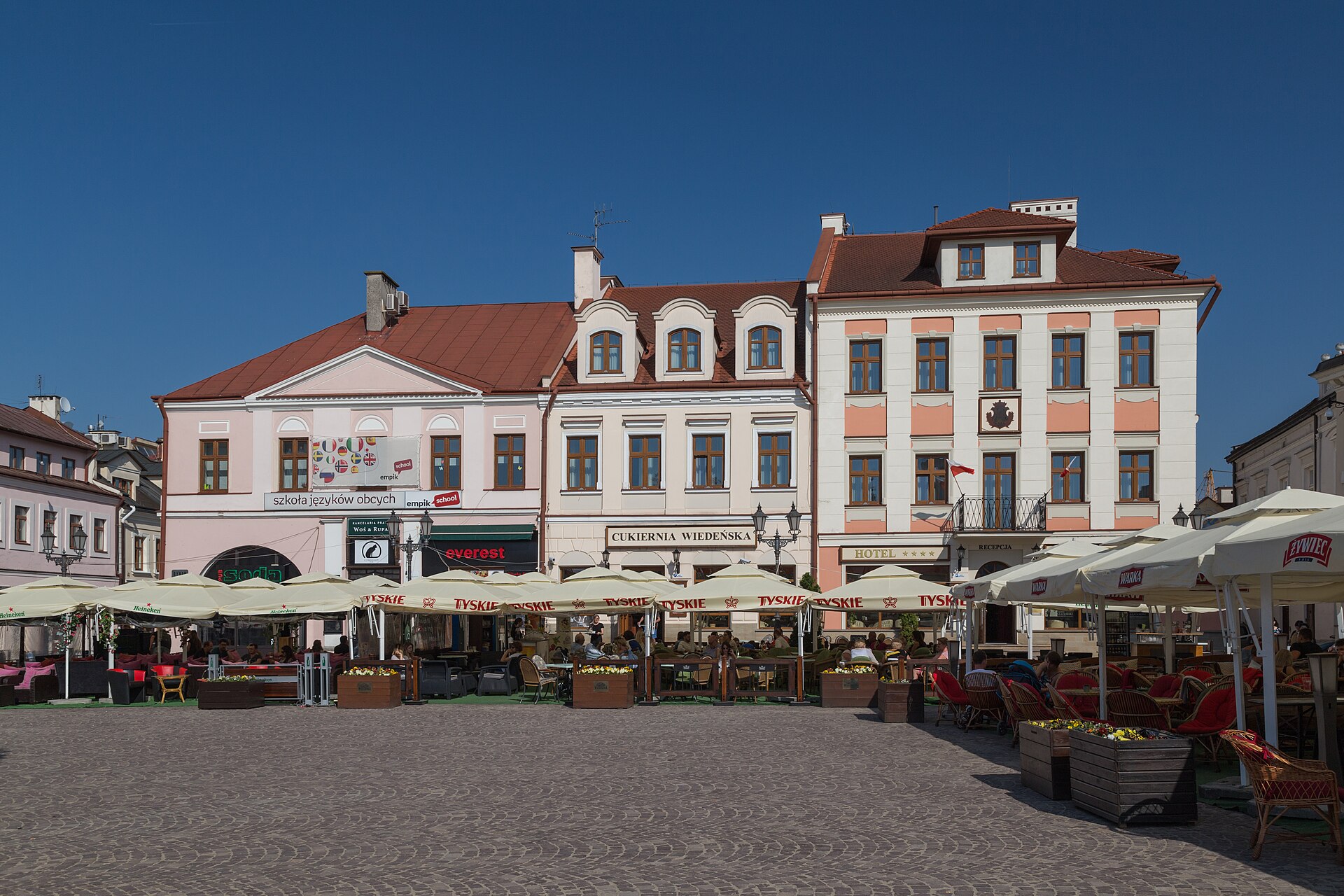
Start your walk at the Market Square, the city's central Rynek, where the 16th-century Town Hall sits on the southwestern corner and the Underground Tourist Route runs for 369 m beneath the square and the surrounding tenement houses. On the edge of the old town stands Lubomirski Castle, expanded in the 18th century and ringed with stone walls and bastions; the interior now serves as law courts, but the walls are worth a circuit. Nearby, between the castle and the late-baroque Lubomirski Summer Palace, you'll find the Multimedia Fountain, lit up at night. The city's religious and communal history is legible in its buildings: the Gothic Sts. Stanislaw and Adalbert Parish Church, whose origins reach back to the 14th century; the Old Convent of Piarist Friars; the Old and New Town Synagogues, now housing state archives and the Office for Art Exhibitions respectively; and the Bernardine Complex Convent. The Old Cemetery on Targowa and the Jewish cemetery on Dołowa, founded in 1849 and largely devastated during the Second World War, are quieter stops. For indoor viewing, the Rzeszów Regional Museum occupies the former Piarist monastery with a frescoed 17th-century vaulting, showing Polish painting from the 18th to 20th centuries alongside European art from the 16th to 19th. The Ethnographic Museum displays regional folk costumes and old woodcarvings, while the Museum of Bedtime Cartoons is the only one of its kind in Poland, devoted to the animated films shown to children before sleep. The Technology and Military Museum and the Dairy Museum both ask that you make contact before arriving. In the evening, the Wanda Siemaszkowa Theatre, the city's first professional dramatic stage, and the Maska puppet theatre both programme performances, though they are in Polish; the Artur Malawski Philharmony Hall and the Cultural House of the Voivodeship host concerts, exhibitions and film events. If you want to get outside the centre, the Lisia Góra nature reserve lies upstream along the Old Town riverside, with a short walk and a small café on the Wisłok river bank, and on hot summer days the Żwirownia city beach by the lake offers relief, though utilities are limited, so come prepared.When to go
Rzeszów has a continental climate with cold, snowy winters and warm summers. Snow is common in winter and night-time temperatures typically drop below zero, so pack for genuinely wintry conditions if you visit in that season. The city is one of the drier in Poland, which means you can generally expect less rainfall than elsewhere in the country.
Summer is warm, with temperatures that can climb high, and July stands out as the rainiest month — though the rain tends to arrive as short, intense cloudbursts and thunderstorms rather than lingering drizzle. If you want the mildest, driest conditions, aim for the warmer months outside the July storm peak.
Three days in Rzeszow
Day one: Start in the centre, where the Rynek forms the heart of the old town and sets the tone for the rest of your stay. Take your time wandering the market square and the surrounding streets, getting a feel for the architecture and the pace of the city. As evening comes, find a table and settle in for Polish cooking; menus are often available in English, German and Russian, so ordering is straightforward.
Day two: Head for the Wisłok River and follow its banks at an easy pace, watching the city give way to the flatter ground of the Sandomierz Basin. The riverside is a good place to slow down and take in the view rather than rush from sight to sight. If you would rather spend the day further out, the wider Subcarpathian Voivodeship and neighbouring Rzeszów County are within reach, and the Lubomirski connections in the city are worth a look before you go.
Day three: Use the morning for anything you missed in the centre, then plan your onward travel. Jasionka Airport, also known as Port Lotniczy Rzeszów-Jasionka, lies outside the city near Jasionka and carries the code RZE; LOT Polish Airlines, Lufthansa and Ryanair serve it, with LOT connecting through Warsaw and Lufthansa through Munich. Trains run from Rzeszów Główny, and road links reach Kraków and Katowice, while eastbound routes continue towards Lviv, Odesa and Kyiv. For the airport, taxis such as Taxi Rzeszów and Super Taxi are the simplest option. Winters here are bitterly cold, so if you are visiting in July you will find the weather warm instead.