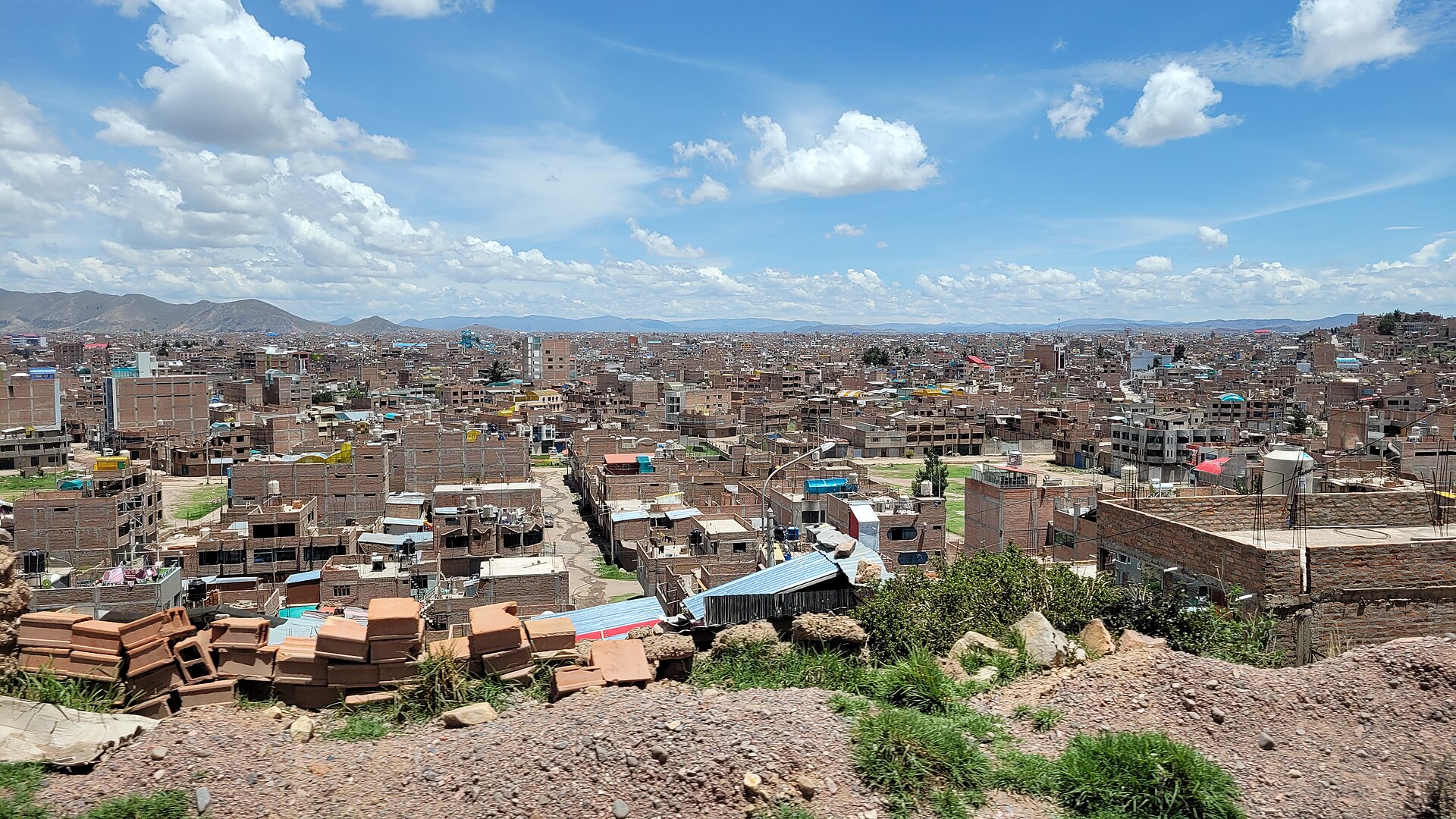
Juliaca
Introduction
Juliaca is the capital of San Román Province in the Puno Region of southeastern Peru, and the largest city in the region. It sits on the Altiplano, on the Collao Plateau at 3,825 metres above sea level, northwest of Lake Titicaca and near Chachas Lake, the Maravillas river, and the ruins of Sillustani.
Juliaca is the largest trade centre in the Puno region, which makes it a practical base for exploring the surrounding highland and lakeshore sights.
Before you go
Juliaca sits high on the Collao Plateau at well over 3,000 metres above sea level, northwest of Lake Titicaca. The altitude is the first thing to plan around: give yourself time to adjust before you do much, and expect the weather to be shaped by the exposed plateau setting that earned the city its nickname, "The Windy City".
The city is the largest trade centre in the Puno region, and its other nicknames — "Sock City" and "Knitting City" — point to its history as a major centre of sock, sweater and handicraft production. Clothes, wool and fabric production are now industrial processes, so come expecting a working commercial city rather than a resort.
Getting there
Juliaca is served by Inca Manco Cápac International Airport, the closest airport to the western shores of Lago Titicaca, including Capachica and Puno. The airport sits in the northwest part of town, roughly five kilometres from the Plaza de Armas along Av Ferrocarril and Av Aviacion. LATAM Peru and Sky Airlines Perú both fly here from Lima. Long-distance buses use the Terminal Terrestre, about a twenty-minute walk or a quick taxi ride east of the Plaza de Armas. Daily services connect Juliaca with Cusco, Arequipa, Puno, Copacabana and Lima, the latter a long haul via Arequipa. Operators include Cruz del Sur, Civa/ExcluCiva and Transzela.Getting around
Juliaca is compact around its centre, with the Plaza de Armas as your reference point. The city has no metro or tram network, so local movement relies on moto-taxis (auto-rickshaws), cholo-taxis (cycle rickshaws), and buses. Moto-taxis and cholo-taxis are the workhorses of local transport and the cheapest option for short trips; flag them down on the street. Fares are not metered, so agree on the price with the driver before boarding, and bring small notes and coins, as cash is needed almost everywhere. Taxis and moto-taxis are also the practical way to cover longer hops or reach the bus terminal with luggage, and ride-hailing apps are not part of the local transport picture, so plan on hailing vehicles on the street or arranging them through your accommodation. It is customary to greet the driver when you get in.
The centre is walkable, with the Plaza de Armas, the Santa Catalina church, and the Plaza Bolognesi area within easy reach of one another on foot. The Terminal Terrestre, the main bus terminal, is about a 20-minute walk east of the Plaza de Armas, or a much faster taxi ride. Daily buses connect the city with Cusco, Arequipa, Puno, Copacabana, and Lima, with operators including Cruz del Sur, Civa/ExcluCiva, and Transzela; buy tickets at the terminal or through the operators directly, and confirm departure times ahead of travel. Juliaca is also a railway junction served by PeruRail, with the Titicaca train stopping at Estación Juliaca on its route between Cusco and Puno, though passenger traffic there is minor and the train is more of a scenic and regional connection than a day-to-day commuter option. The tracks run through city streets and the market area, and vendors clear their goods from the rails before the train passes, so stay alert and keep clear of the line. Inca Manco Cápac International Airport sits in the northwest part of town, very close to the city limits, so the transfer into the centre is short by taxi or moto-taxi; agree the fare before you set off. Walking is a good way to explore the markets and central streets, but take it slowly at first given the altitude, and be mindful of the cold and the strong sun.
Where to stay
Juliaca has very little in the way of accommodation, and travellers generally base themselves in Puno instead, making the journey here as a day trip or a stopover. If you do need to spend the night, your options are limited.
- Hotel Sakura (San Roman 133) — a clean hotel with cable TV and wireless internet, described as pretty decent accommodation.
Food & drink
For a meat-free meal, head to La Fuente de la Salud on Jr. Jorge Chavez, around the corner from Hotel Sakura. It's a vegetarian restaurant with clean surroundings and friendly staff, and the set menu is filling and inexpensive. Worth stopping by while you're in town.
What to see and do
Juliaca's sights cluster around its central plazas. On the Plaza de Armas stands the Mother Church of Santa Catalina, an indigenous baroque building begun by the Jesuits in the seventeenth century and finished well over a century later. Carved ashlar predominates in its structure, and its dome, doorway and bell tower stand out; the bell tower was built entirely from ashlar brought from the quarries of Arequipa, and canvases and other works of art are preserved inside. The Franciscan Convent of Santa Bárbara sits on the Hatun Rumi or Santa Bárbara hill, a short distance from the plaza. Built of rock, brick, iron and cement and roofed with stainless steel sheets, it has four levels, more than a hundred finely finished arched windows in a Greco-Roman style, and a watchtower and flanking tower that give it the look of a medieval castle. On the Plaza Bolognesi, the Church of La Merced is a republican-era work carved in red limestone with a modern iron frame, a symmetrically arranged bell tower and a clock with four circular faces.
For views and shopping, head to the Cristo Blanco del Mirador Huaynarroque, southeast of the Plaza de Armas on the summit of the Huaynarroque hill. The colossal reinforced-concrete and fibreglass figure of the redeemer has outstretched arms and good night lighting that highlights a sacred purple and radiant heart; a viewpoint at its foot takes in the city and the surrounding area. In the north wing of Plaza Bolognesi, the three-story Las Calceteras Gallery sells garments woven or made from native materials such as llama, alpaca and vicuña — socks, chullos, booties, shawls, sweaters, rugs and gloves — and you can watch the artisan women, known as the hosiery, at their handwork. Further out, Chacas Lagoon lies to the northwest among vast hills, with local flora and fauna most abundant during the rainy season. If your visit falls between February and March, you can join Juliaca's Carnival, when participants in colourful costumes dance in the style of the Collao Plateau; Saint Sebastian's feast is celebrated on 20 January.
When to go
< p>Juliaca has a subtropical highland climate, which means you can expect cool to cold conditions for most of the year. Plan for dry winters with freezing nights and mornings, while afternoons turn pleasant enough that days feel mild despite the cold at either end of the day. < p>Rainfall is modest overall, averaging around 610 millimetres or 24 inches annually, so wet weather is not a constant concern. The key is to prepare for sharp swings in temperature between dark and daylight hours rather than for heavy rain.Festivals & events
Juliaca's festival calendar is anchored by the feast of Saint Sebastian, held each January. If your visit falls in that month, expect the city to mark the occasion with the processions, music and communal celebrations typical of a Peruvian highland fiesta.
Three days in Juliaca
Day one: Base yourself in Juliaca, the city known as the Windy City, Sock City and Knitting City, set on the Altiplano on the Collao Plateau in San Román Province, Puno Region, Peru. Start at the Plaza de Armas, then walk Av Ferrocarril and Av Aviacion for clothes, knitwear and the textile trade that gives the city its nicknames. If you arrive by air, Inca Manco Cápac International Airport is your gateway, with LATAM Peru and Sky Airlines Peru among the carriers serving Lima and other points.
Day two: Use the city as a base for the wider Puno Region. Head for Lake Titicaca and the Lago Titicaca shoreline, with Capachica as a stopping point, and consider Chachas Lake and Maravillas for quieter water and countryside. Sillustani, with its burial towers above the lake, makes a strong half-day outing, and Puno is within reach if you want a second lakeside town. Long-distance buses from the Terminal Terrestre run daily to Cusco, Arequipa and Copacabana, with operators including Cruz del Sur, Civa, ExcluCiva and Transzela.
Day three: Slow down and work the city itself. Return to the Plaza de Armas and the market streets around Av Ferrocarril for last purchases of socks, sweaters and knitted goods, then take a final look at the Altiplano light over the Collao Plateau. If your onward travel is by air, Inca Manco Cápac International Airport connects you to Lima; if by road, the Terminal Terrestre has daily services toward Cusco, Arequipa and Copacabana. Keep the pace easy: Juliaca sits high on the Altiplano, where the air is thin and the wind is a constant companion.