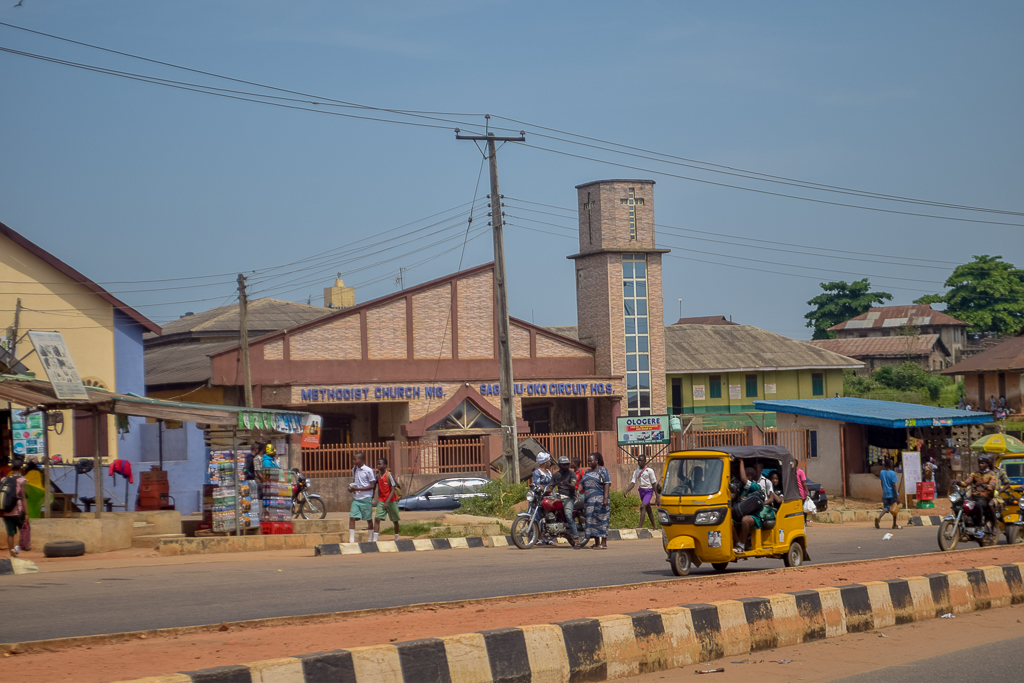
Shagamu
Introduction
Sagamu, also called Ishagamu or Orisagamu-Ewa, is a conurbation of thirteen towns in southwestern Nigeria. It sits in Ogun State along the Ibu River and Eruwuru Stream, on the route between Lagos and Ibadan. The thirteen towns are Makun, Offin, Sonyindo, Epe, Ibido, Igbepa, Ado, Oko, Ipoji, Batoro, Ijoku, Ijagba and Latawa.
The city was founded in the mid 19th century by members of the Remo branch of the Yoruba people, and it serves as the capital of the Remo Kingdom. The paramount ruler of the kingdom, the Akarigbo of Remo Land, keeps his palace in the town of Offin, making it a focal point for visitors wanting to understand the area's traditional authority.
Before you go
Sagamu sits in Nigeria's rainforest belt between Ibadan and Lagos, a position that has shaped its growth since the mid-20th century. It is the capital of the Remo Kingdom, and Remo is the main local language you will hear. The city's economy rests on limestone and cement production, alongside agriculture: cocoa and kola nuts are the region's key crops, and Sagamu is the country's largest kola nut collecting centre, with basket and rope manufacturing supporting that trade. Cassava, melon, maize and yam are grown as supplementary food crops. The city is also home to Olabisi Onabanjo University Teaching Hospital and the university's college of medicine, pharmacy and basic medical sciences.
The climate is tropical, with significant rainfall most months of the year; the short dry season does little to break the wet pattern, so plan for rain whenever you visit. Before you go, take the usual precautions: the city has become safer than in the past, with state spending on security and police patrols, but avoid deals or businesses that sound too good to be true, and do not openly flaunt your possessions, especially in public. Violent crime against tourists is rare, but stay alert on late-night outings, stick to crowded streets and go out in groups rather than alone. If it is your first visit, avoid going anywhere without a trusted guide. Expect to encounter street beggars, including people with psychological disorders and physically challenged people. If you move around by taxi or bus, sanitise your hands and wear a face mask to guard against coronavirus and other infectious diseases.
Getting there
Sagamu has no civilian airport of its own, so arriving by plane means flying into a nearby city first. Murtala Muhammed International Airport in Lagos and Ibadan Airport are the practical options, and from either you continue overland to reach Sagamu.
By road, different transport companies run daily bus services from almost all major cities around the country, making the bus a straightforward way to get in.
Getting around
Shagamu has no metro, tram or commuter rail network, so you get around almost entirely by road using shared taxis, minibuses, tricycles and motorcycles. These are plentiful and cover the city thoroughly, but there is no single ticketing system, no published timetable and no fixed stops — you flag down whatever is passing and pay the driver directly. Fares are low and paid in cash, so keep a supply of small naira notes; exact change is not always available, and haggling is not usually part of the deal.
- Shared taxis: abundant and hailed down by the roadside. The driver typically takes four passengers, three at the back and one in front. If you want the vehicle to yourself, negotiate with the driver, since the default arrangement is to fill the car.
- Minibuses: the most useful mode for reaching almost any part of town, plying every nook and cranny. Some drivers can be erratic, so hold on and keep your bearings.
- Tricycles (keke): everywhere in the city, a good middle option — more sheltered than a motorcycle, more nimble than a shared taxi.
- Motorcycles: the quickest way through congestion for a token fare, but also the least protected; use your judgement, especially after dark or in rain.
Walking works well within a single neighbourhood — around your hotel, the market, or a cluster of shops and eateries — but Shagamu is a conurbation of thirteen towns rather than a compact grid, and the areas of interest are spread out, so plan on using local transport rather than walking between neighbourhoods. The climate reinforces this: the rainy season is humid and wet, while the dry season from January to April is sunnier and drier, and either way you'll want to limit long walks in the middle of the day. The source material does not describe app-based ride-hailing operating here, so plan on hailing vehicles on the street or arranging a driver through your hotel rather than relying on a smartphone app.
Where to stay
Budget travellers have plenty of choice in Sagamu, with most of the cheaper hotels clustered around GRA Quarters and the streets off Akarigbo Road. In GRA you'll find Redgate Restolounge and Resorts on Obafemi Awolowo Avenue, Sagamu Palace Hotel in Palace Quarters, and Citizens Suites on Paddy Arikawe Street, while Soye Hotel sits along Nulec Road on the Benin Express Road and Limtob Hotel is on Akarigbo Street in Sabo. These places typically offer a restaurant and bar, and many add a gym, swimming pool and free wifi; Remo Majestic Hotel on Kehinde Isijola Avenue also provides room service, a shared lounge and a 24-hour front desk. Further out, Mabseed Suites is on Aiyepe Road off the local government area, Moye Sagamu on Abdul Abayomi Street offers small but decent low-budget rooms, and Edge Apartment on Sunday Owotutu Street provides a fully air-conditioned one-bedroom apartment with a kitchen, washing machine and balcony. Sunrise Hotel and Conference Center, on Bolanle Avenue in Sunrise Estate off Oba Erinwole Awolesi Road, and Hilltop Hotel on Omoba Daisi Akitan Avenue both add restaurants, bars, gyms, pools and free wifi to the mix.
If you'd rather trade up, the splurge options sit mostly in GRA and along Akarigbo Road. Conference Hotel and Suites, on Kolawole Oye-Igbemo Street off Obafemi Awolowo Road, offers a serene setting with free breakfast and wifi, an outdoor pool, a modern gym, a night club, barbeque and grill garden, restaurant and bar/lounge, a terrace, 24-hour electricity and parking. Nandas Hotel on Ajegunle Street off Akarigbo Road has a similar range of facilities — restaurant, executive bar, indoor pool, event and conference halls, gym and nightlife — with a reputation for courteous staff. Ogere Resort, further out at Ogere-Remo along the Lagos-Ibadan Expressway, is another option for those heading along that route.
Food & drink
Sagamu has plenty of places to eat, serving both local dishes and foreign fare. Most offer dine-in, takeaway and delivery, so you can eat in or have food brought to you. For local cooking, try Iya Toyosi on Express Rd after Awolowo market, or Ayobami Food Canteen Annex. Right Options Eatery on Akarigbo St and Olaass Café on GRA Road are other options, while Spicy M Restaurant sits on Agura Rd. If you want something quick or sweet, Sizzles Confectionary on Ajegunle St and Foladimo Bakery, Eatery and Confectionary out along the Lagos–Ibadan Expressway both fit the bill. La Rasita Place on Ewusi St and Mr. Bigg's round out the list.
For drinks, head to the bars and joints around town for alcoholic and non-alcoholic options. Tripple A Spot Bar on Shofola Street and D'Elders Lounge & Bar on GRA Road are good starting points, and Jisoro Cool Spot, also on GRA Road, stays open late. Emmadorc Bar on Ewusi Street and Sansiro Lounge on Surulere Road keep going around the clock, while Onihale Progressive Club on Ewusi Street and Redgate Restolounge & Resorts on Obafemi Awolowo Ave give you more places to settle in. On The Road Bar & Night Clubs on Oba Erinwole Road is another spot to keep in mind.
What to see and do
Sagamu is not a tourist city, but it offers plenty of places to slow down and relax. The Akarigbo's Palace, home of the paramount ruler of Remo land, sits on a large, beautiful estate and is the town's most prominent landmark. History-minded visitors can also seek out the Egbero Building, a historic architectural landmark that shows the colonial Brazilian style of the 19th and 20th centuries. For sport and recreation, head to the Lafarge Cement Golf Club at the Lafarge/Elephant Cement complex, where a green and quiet 18-hole, par-71 course welcomes both casual and competitive players and has hosted several tournaments. Gateway International Stadium on Ikenne Road is another option for taking in a match or event.Three days in Shagamu
Day one: Arrive via Murtala Muhammed International Airport in Lagos or Ibadan Airport, then travel onward to Sagamu, also known as Ishagamu or Orisagamu, in Ogun State. Settle into the town and get your bearings among its neighbourhoods, including Makun, Offin, Sonyindo, Epe, Ibido, Igbepa, Ado, Oko, Ipoji, Batoro, Ijoku, Ijagba and Latawa. As part of Remo Land and the historic Remo Kingdom, Sagamu has a Yoruba character shaped by the Akarigbo. Close your first day with a meal built around cassava.
- Arrive through Lagos or Ibadan
- Explore central Sagamu and its neighbourhoods
- Eat a cassava-based dish
Day two: Spend the morning around the town's institutions, including Olabisi Onabanjo University Teaching Hospital. Continue to the Ibu River and the Eruwuru Stream, the waterways that run through the area. Take your time moving between districts such as Makun, Offin, Sonyindo, Epe, Ibido, Igbepa, Ado, Oko, Ipoji, Batoro, Ijoku, Ijagba and Latawa, and note the Yoruba and Remo influences throughout.
- Olabisi Onabanjo University Teaching Hospital
- Ibu River and Eruwuru Stream
- Neighbourhoods across Remo Land
Day three: Use your final day to revisit the parts of Sagamu, Ishagamu or Orisagamu that appealed most, whether the markets, the streets or the riverside. If you are departing, allow time for the journey back to Murtala Muhammed International Airport in Lagos or to Ibadan Airport. Before you leave, take in one more taste of the town's cassava cooking and its Remo Kingdom heritage under the Akarigbo.
- Revisit favourite spots in town
- Return to Lagos or Ibadan for departure
- Final cassava meal