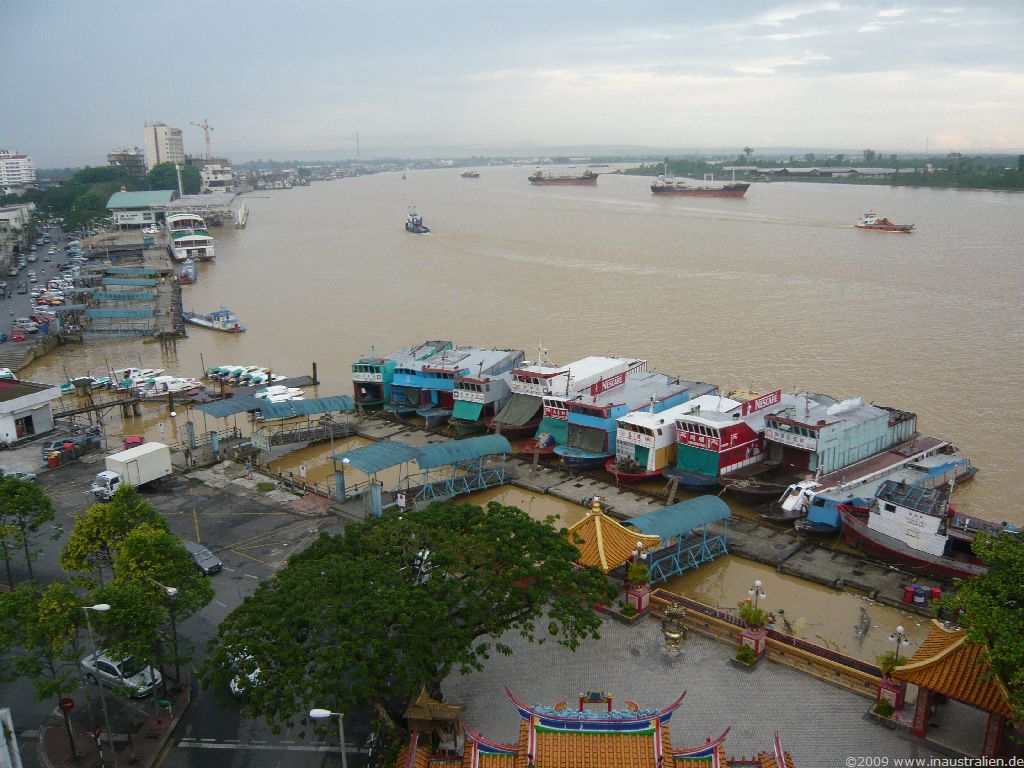
Sibu
Introduction
Sibu is a city in the central region of Sarawak, Malaysia, on the island of Borneo. It serves as the capital of Sibu District within Sibu Division, and sits at the confluence of the Rajang and Igan Rivers, roughly 60 kilometres from the South China Sea and some 191.5 kilometres north-east of Kuching, the state capital.
Before you go
Sibu is a quiet town on the Rejang River, and one of the few places in Malaysia with a predominantly Foochow-Chinese population. It is known for its food, including dishes such as Kompia and Kampua, and it is the hometown of the national patriot Rosli Dhoby. The town's symbol is the swan, and it has been nicknamed the "Wild West" of Malaysia. Before you arrive, it helps to know that the town has a reputation for lawlessness and gang activity, so it is worth planning how you will get around and where you will stay.
Keep a low profile during your visit. Gossip is an endemic problem, and unwanted, intrusive attention can be difficult to escape. There are many shady characters to avoid, and gangsterism is a problem, with most gangs probably connected to the town's timber barons. Stay on high alert while walking, especially at Sibu Central Market, where the risk of being pick-pocketed is high and cases have involved both customers and shop owners. If you are pick-pocketed, go to the nearest Tourist Police Station, not far from the Central Market. For visitor information, there is a centre at the Sibu Cultural Heritage Museum on Jalan Central.
Getting there
Sibu is served by Sibu Airport, which has frequent flights from Kuala Lumpur and Johor Bahru on Malaysia Airlines and AirAsia, and connections to major East Malaysian destinations including Kuching and Kota Kinabalu. There is also an international link to Singapore on the low-cost carrier Scoot. Malaysia Airlines flies twice daily from Kuala Lumpur, while AirAsia flies direct non-stop three times daily; from Johor Bahru, AirAsia operates on Monday, Wednesday, Friday and Sunday. From Kuching, Malaysia Airlines flies once daily, AirAsia twice daily and MasWings five times daily, while MasWings also flies five times daily from Kota Kinabalu, four of them direct and one via Bintulu. From the airport, you can buy a taxi coupon to downtown Sibu; there is no bus service between the town and the airport. By bus, numerous companies such as Biaramas, Suria Bus Express and Borneo Highway Express link Sibu with other Sarawak cities including Kuching, Miri, Mukah, Sarikei and Bintulu. Most express buses arrive at the long-distance Sibu Bus Terminal on Jalan Pahlawan, while buses from Sarikei arrive at the short-distance bus terminal downtown, near the express boat terminal. To reach the long-distance terminal from the city centre, take local bus Lanang 21/5A from the short-distance bus terminal; it runs only every 60–90 minutes from about 6AM to 6PM, so a Grab or taxi may be more convenient. Buses to Miri run several times a day, with daytime and overnight services taking about seven hours. By river, Sibu is the entry point of the upper Rajang, with four express boat services daily to and from Kapit; some boats transit at Song, a small town before Kapit.Getting around
Downtown Sibu is compact and easily walkable, with the Central Market, the waterfront, the express boat terminal and the short-distance bus terminal all sitting close together. There is no rail, metro or tram system, so getting around relies on walking, road transport and, for onward travel upriver, express boats.
- On foot: The city core is small enough that walking is a practical option for short trips between the main sights.
- Taxi: Widely available but mostly unmetered, so agree on the fare before setting off. Taxis wait at major hotels, the Central Market, the waterfront and the bus terminal, and yellow-roofed taxis near the Central Market serve destinations outside the city and on the outskirts.
- Ride-hailing: Grab is popular and widely available in the city and nearby suburbs, and is a convenient alternative if you would rather not negotiate a fare. Fares can rise during rain and at peak hours, which tend to fall in the morning and late afternoon.
- Local buses: The cheapest way to move around, but they require patience. Services run from the short-distance bus terminal near the Central Market and the express boat terminal, where there is an inquiry counter you can visit for directions. The buses are not air-conditioned and schedules are not strict, so plan for waiting and have exact change ready. Routes useful to visitors include the City Loop, Ulu Sungai Merah, Sibujaya, Salim Area, and Lanang / Wong King Huo Road.
- Intercity buses: Air-conditioned express buses to other parts of Sarawak depart from the terminal next to the local terminal on Jalan Pahlawan, using the Pan Borneo Highway.
- Express boats: Boats up the Rajang depart from the Sibu Express Boat Terminal on Jalan Khoo Peng Loong, near the Central Market and waterfront, serving destinations including Song, Kapit, Belaga and Kanowit. They are air-conditioned with assigned seating and luggage storage, and life jackets are provided. Tickets are cash only and advance booking is advisable during holidays; arrive about half an hour before departure, and note that heavy rain can delay schedules.
- From the airport: There is no bus service between the airport and town, so your options are an airport taxi coupon, a Grab, a hotel transfer or a rental car. Grab is generally the cheaper of the ride-hailing and taxi options, while the coupon taxi offers a set, predictable rate.
Keep small cash notes on hand, since some kiosks and the express boat counters do not accept cards or e-wallets, and agree on taxi fares before you set off. Car and motorcycle rentals are available if you prefer to travel independently.
Where to stay
Sibu's accommodation clusters around the town centre and the riverfront, putting you within walking distance of the Central Market and the express boat terminal. If you want to be close to both, the Tanahmas Hotel on Jalan Kampung Nyabor is a three-star option a short stroll from the terminal and the market, while the Lihua Hotel sits near the Rajang Esplanade and the same terminal. The Premier Hotel, a three-star property in the Sarawak House complex, and the Garden Hotel near Sarawak House offer further central choices. For something more upscale, the RH Hotel is connected by a sky bridge to the Wisma Sanyan shopping complex, and the Kingwood Hotel is the city's five-star address.
Budget travellers have plenty of options. The Kawan Hotel on Jalan Lanang, the Orchid Hotel on Brooke Drive, the Zuhra Hotel opposite the RH Hotel, and the Paramount Hotel in Kampung Dato all provide inexpensive rooms, while the Royal Inn, in front of the Premier Hotel, keeps things simple with air-conditioned rooms and private bathrooms but no Wi-Fi, close to the central market and heritage centre. The Ban Hin Hotel on Island Road is a no-frills budget choice with free Wi-Fi and air conditioning, though it isn't especially clean. If you'd rather have more space, the Destino 365 Homestay behind the old Sing Kwong offers a fully furnished semi-detached house with four bedrooms, two bathrooms, Wi-Fi, satellite TV, a washer, a refrigerator and light cooking equipment.
Food & drink
Sibu's food scene is rooted in Foochow cooking, and several local specialties are worth seeking out. Chai Pau, vegetable buns with generous vegetable fillings and less flour in the outer layer, are a common dim-sum choice. Diang Biang Hu is a rice porridge cooked on the surface of a heated wok, often pronounced Diang Miang Hu by locals. Kampua Mieng, meaning noodles on a dry plate in Foochow, consists of oily noodles soaked briefly in boiling water and then tossed with fried onion and sauce; the plain version comes without red pork slices. Kong Piang is a biscuit traditionally baked by sticking pre-mixed flour, glazed with peanut oil and dusted with sesame seeds, to the inner surface of a pottery flask heated over charcoal; it comes hard or soft and sometimes with meat fillings. Red Wine Chicken is a Foochow tradition, with red wine brewed from rice, yeast and herbs used in longevity noodles or rice vermicelli with pre-cooked chicken. Sibu is also known for Red Cao Chicken, where the cao is the residue of the wine. For a sit-down meal, New Capitol Restaurant on Jalan Kampung Nyabor serves lunch and dinner. Warung on Jalan Bandong offers a variety of local Halal Malaysian dishes, with items such as Nasi Ayam Dara, Nasi Goreng Seafood, Nasi Goreng Warung, Tom Yam Kung, steam fish, vegetables and Sup Tulang; it also provides catering for weddings and other occasions, and tends to be busy, so arriving early helps. To drink, don't miss the famous Teh C Special, available in most kopitiams. It is a three-layered drink of tea, milk and flavour, with Pandan and Gula Apong flavours among the options.What to see and do
Start at the Tua Pek Kong Temple, whose history reaches back to the 1870s; go around sunset and ask for the key to the tower's top floor for a view over the town and the river. From the Sibu Town Square you can walk to the waterfront at the end of the square and watch the meeting of two great rivers, the Rajang and the Igan — a spot locals favour for hanging out and recreation. Nearby are the Lau King Howe Hospital Memorial Museum and the Sibu Central Market, where you can browse local goods and head to the first floor for food and affordable attire. Temples reward further wandering: Tan Hua Hu Temple on Jalan Bukit Assek is noted for its intricate design, Yu Long Shang Tian En Shi is dedicated to three faiths at once, and Poh Guan Hong, opposite the central market, is a long-running Chinese medicine shop where you can learn about herbs and spices kept in a huge wall of drawers. For open air, Bukit Aup Jubilee Park lies some distance from town and centres on a lake full of fish you can feed; hiking trails lead to the top of the hill, the highest point in Sibu, passing a cemetery and an indigenous religious site, with views of the Igan river and the town. Closer in, Sibu Lake Park in the uptown area gathers a lake with footpaths, jogging tracks, a boat house, a habitat island, a bird sanctuary, picnic and barbecue areas, a splash pool, a canteen and a jetty. The Bukit Lima Nature Reserve keeps a patch of swampy jungle within the city limits, with boardwalk trails popular for jogging — the longer route runs about 5 km past plants, birds and insects, and possibly lizards, small mammals or monkeys, though the path can be slippery. Near the town of Sungai Merah, the Sungai Merah Heritage Walk commemorates the Foochow immigration and looks out on the river's red-coloured water. In the evening, the Sibu Night Market runs until midnight daily, with Chinese food, Malay delicacies and clothing to bargain over.When to go
Sibu has a tropical rainforest climate, so you can expect consistently high temperatures and heavy rainfall whenever you visit. Cloud cover is what varies through the year, and that is the main thing to weigh when choosing your dates.
- Less cloudy period: Skies are at their clearest during these months, giving you somewhat more sunshine than at other times of year. Temperatures stay high and rain remains likely, so plan for both heat and showers.
- Cloudier period: The skies turn more overcast during these months. Temperatures stay high and rainfall stays heavy, just as it does throughout the year.
Whichever period you pick, pack for a hot, wet climate and treat any clearer skies as a bonus rather than a guarantee.
Three days in Sibu
Day one: Start in Sibu, the town on the Rajang in Sarawak, Malaysian Borneo, where the Rejang River meets the Igan Rivers before reaching the South China Sea. Begin at Sibu Central Market on Jalan Central, where you can try Kompia and Kampua among the Foochow and Chinese stalls. Then walk to the Sibu Cultural Heritage Museum to learn about Rosli Dhoby and the town's Wild West past. Keep an eye out for the Tourist Police Station if you need directions.
- Sibu Central Market
- Sibu Cultural Heritage Museum
- Jalan Central
Day two: Take a boat trip on the Rajang or Igan Rivers to see the life of Sibu District and Sibu Division. Stay near the waterfront and watch the river traffic. For lunch, return to Central Market for more Kompia and Kampua. In the afternoon, explore the streets around Jalan Central and listen to local gossip about the town's history.
- Rajang and Igan Rivers
- Central Market
- Jalan Central
Day three: If you have time before your flight, visit the Sibu Cultural Heritage Museum again or wander the market. Sibu Airport connects to Kuala Lumpur, Johor Bahru, Kota Kinabalu and Singapore with Malaysia Airlines, AirAsia and Scoot, so you can continue your East Malaysian journey or fly to Kuching. Keep your schedule light and enjoy the Foochow and Chinese character of this Borneo town.
- Sibu Airport
- Kuala Lumpur, Johor Bahru, Kota Kinabalu, Singapore
- Malaysia Airlines, AirAsia, Scoot