Gumi
Introduction
Gumi sits on the Nakdong River in North Gyeongsang Province, roughly halfway between Daegu and Gimcheon. It is one of the province's larger and more densely settled cities, so you will find an urban centre rather than a quiet rural stop.
Getting there is straightforward: the city lies on both the Gyeongbu Expressway and the Gyeongbu Line railway, the country's principal traffic routes, which makes it an easy place to pass through or pause in while travelling between Daegu and the towns to the north.
Before you go
Gumi is an inland industrial city in South Korea, home to major Samsung mobile and LG Display complexes, and it also carries a layered history: it was the birthplace of Park Chung-hee, the military dictator who ruled in the 1960s–1970s, and, ironically, of his assassin, KCIA director Kim Jae-gyu. Its past stretches back further still, from Neolithic and Bronze Age settlement evidence such as dolmens in Goa-eup and Ok-gye-dong, through its role as a strategic Silla stronghold near Gyeongju with Geumosanseong Fortress on Geumo Mountain, to its later development as an agricultural, military and transportation hub on routes like the Yeongnam-daero.
Plan around the seasons, since Gumi has a temperate monsoon climate with four distinct seasons and, being inland, wide temperature swings and lower humidity than the coast. Spring is mild and dry with blooming flowers, though yellow dust can affect it; summer is hot and humid, with the monsoon concentrated in June and July; autumn is cool and clear with a large day-night temperature difference, suiting outdoor activities; winter is cold and dry, sometimes dropping below freezing, with occasional snow. Most rain falls in the monsoon and summer months, while winters are relatively dry. For practical details, consult the Gumi tourism webpage.
Getting there
Gumi has no airport of its own, so you'll arrive by air through a neighbouring city. Daegu International Airport is the closest, roughly a 40- to 50-minute drive away, with domestic routes such as Jeju and a limited set of international flights. Gimhae International Airport in Busan is a 1-hour-40-minute to 2-hour drive and offers a much wider range of international flights, while Cheongju International Airport, about a 2-hour drive away, serves Jeju domestically plus several international destinations.
By rail, Gumi Station on the Gyeongbu Line is the main station, with frequent Mugunghwa and ITX-Saemaeul services to Seoul, Daegu and Busan; the Daegyeong Line also connects it to Daegu and other Gyeongsangbuk-do cities. For high-speed travel, Gimcheon–Gumi Station on the Gyeongbu High-Speed Railway is about 15 minutes away and links Seoul, Busan and Daejeon, while Wonpyeong Station also gives access to the KTX network. Buses are another option: Gumi Intercity Bus Terminal runs routes to Seoul, Daegu, Busan, Gwangju and Incheon, and Gumi Express Bus Terminal handles express services to Seoul (Gangnam), Daegu and Busan, with several buses a day from Seoul. There is no conventional subway, but the Daegyeong Line metropolitan railway connects Gumi Station and Sagok Station to Daegu and Gyeongsan, where you can transfer to the Daegu subway and city buses.
Getting around
< p > Gumi has no metro of its own, so city buses are your main way around. The network is run by Gumi Bus Co., Ltd. and Ilseon Transportation Co., Ltd. through a joint dispatch system, covering major areas including Gumi Station, City Hall, Geumosan, Indong, and the Sandong Advanced Industrial Complex, with a few exceptions such as routes 91, 184, and 190-3. Adult fares are modest, and transit cards such as T-money and Cashbee are accepted with transfer discounts available. Most buses run from morning until late evening, though schedules vary by route. Bus stops are mainly labelled in Korean, so use KakaoMap or Naver Map to navigate. Taxis are a straightforward option for short trips or when buses are not running, with metered fares. < p > For travel beyond the city, Gumi Intercity Bus Terminal on Gumi-daero serves routes to Seoul, Daegu, Busan, Gwangju, and Incheon, while Gumi Express Bus Terminal in Wonpyeong-dong handles express buses to Seoul (Gangnam), Daegu, and Busan and sits near the city centre. Smaller stops such as Go-ah, Hae-pyeong, and Jang-cheon complement these hubs, and intercity buses run frequently to nearby Daegu and Gimcheon. Gumi Station, on Gumi-daero, sits on the Gyeongbu Line and is served by Mugunghwa and ITX-Saemaeul trains to Seoul, Daegu, and Busan, as well as the Daegyeong Line linking Daegu with Gyeongsangbuk-do. For high-speed KTX services, use Gimcheon–Gumi Station, about 15 minutes away, or Wonpyeong Station. The Daegyeong Line, the first metropolitan railway outside the Seoul area, connects Gumi Station and Sagok Station to Daegu and Gyeongsan with transfers to the Daegu subway and city buses. Book train tickets via the Korail website or app. Gumi has no airport; from Daegu International Airport, limousine buses leave from Gate 3 of the passenger terminal, and for Incheon International Airport the most economical route is a bus and subway (Line 7) combination taking around four hours and twenty minutes.Where to stay
Gumi has a wide range of places to stay, from budget motels to modern business hotels and nature resorts. Love motels are cheap and plentiful throughout the city, and they are usually the most affordable option on weeknights, with rates rising on weekends. If you want to be close to the train station, Eden Motel is a clean and budget-friendly love motel within walking distance of Gumi Station.
- Hotel Geumosan – the most luxurious hotel in Gumi, at the base of Geumosan Mountain, with a restaurant, café, and hiking access.
- Gumi Century Hotel – a modern business hotel near Gumi Station with comfortable rooms and a breakfast buffet.
- Eden Motel – a clean, budget-friendly love motel within walking distance of Gumi Station.
For business travellers, there are several modern hotels near Gumi Station and the Indong Industrial Complex. If you prefer a scenic location, stay near Geumosan Mountain, where resorts and pensions sit surrounded by nature. Many visitors also look for places to stay on Airbnb.
Food & drink
Gumi's signature dishes are the grilled and boiled pork intestines known as makchang and gopchang. Makchang, historically associated with nearby Daegu, is grilled intestine chopped and served with doenjang, a bean paste sauce; you will find decent restaurants serving it on nearly every block. Gopchang, the dish Gumi comes closest to claiming as its own, originates from nearby Seonsan and is a boiled version cooked in a sweet and spicy sauce.
- Wonpyeong Makchang Street (원평막창거리), 18-1, Gumijungang-ro 21-gil — the city's best-known area for grilled makchang and gopchang, with many restaurants serving pork or beef intestines grilled over charcoal with various sauces. It gets lively in the evening as locals gather for food and beer.
- Gopchang Alley near Gumi Station (구미역 곱창골목), 9, Wonnam-ro 10-gil — a few minutes' walk from the station, lined with small eateries specializing in spicy gopchang and other traditional dishes, and a good spot for a late-night meal.
Other local favourites include jjimgalbi, a hearty braised beef rib dish, and nakji bokkeum, a spicy stir-fried octopus meal popular after work. For something lighter, street food stalls near Gumi Station offer tteokbokki, kimbap and hotteok. For dessert or coffee, head to Indong-dong or Wonpyeong-dong, where cosy cafés and craft beer pubs draw a younger crowd.
Gumi's nightlife is lively, thanks to its large working population, and most drinking areas cluster around Wonpyeong-dong, Indong-dong and Gumi Station. Expect casual hof bars, Korean-style soju bars, and cafés that turn into cocktail spots after dark. La Poite Hold'em Pub, on the second floor at 29 Indongjungang-ro 11-gil in Ju 1-dong, is a casual downtown Indong bar where you can play Texas Hold'em poker with drinks. Arong Pocha Gumi Main Branch, at 18-5 Indongjungang-ro 3-gil, is a popular Korean-style pub known for its lively atmosphere, late-night dining and wide range of traditional dishes and drinks. If you want something quieter, try the cafés near Geumosan, many of which have mountain views and outdoor terraces for a relaxed evening coffee or dessert.
What to see and do
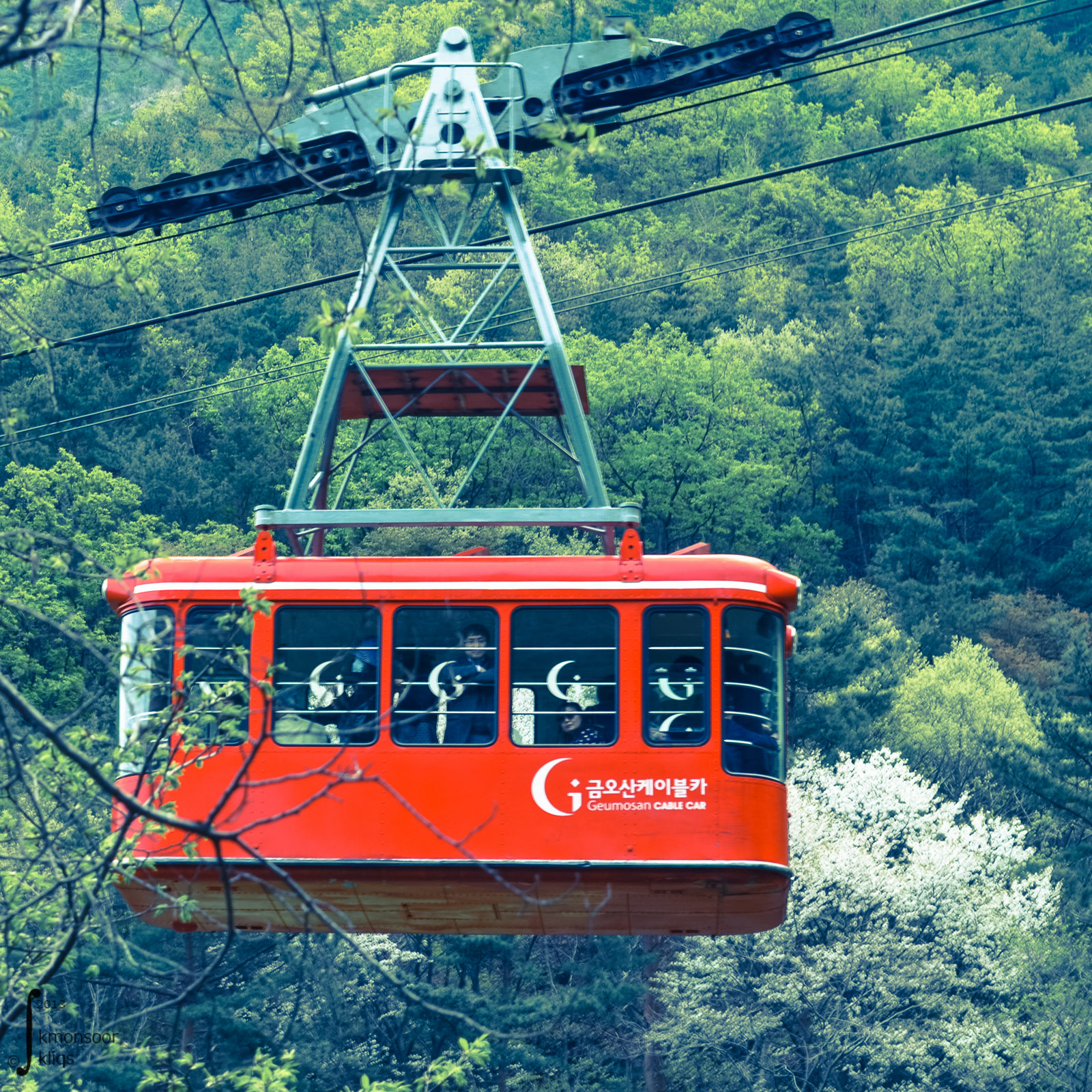
Geumosan dominates any visit to Gumi. The provincial park sits within easy reach of downtown, and its entrance area alone holds a scenic lake, a botanical garden, and a waterfall that freezes in winter and roars in spring and summer, with a small cave nearby. Hiking to the summit takes roughly two hours, and at the top you'll find a temple with panoramic views, a picnic area, and a 700-year-old Buddha stone carving. A tranquil Buddhist temple, Haeunsa, rests on the mountain's slopes, and the family-friendly Gumoland amusement park is nearby. For gentler walking, head to Dongrak Park along the Nakdong River, where a long promenade, a large lawn and sports facilities are especially appealing when the cherry blossoms open in spring, or to the Nakdong River riverside paths, which are peaceful and scenic at sunset and can be explored by rented bike. To dig into local history, the Gumi Municipal Folk Museum displays traditional household items, agricultural tools, clothing and artifacts from the region, and the Gumi Neo-Confucian History Museum covers the area's Confucian heritage and scholars. The birthplace of President Park Chung Hee, a traditional hut expanded into a memorial hall, statue and garden, and the Joseon-era Seonsan Hyanggyo Confucian school on a quiet hillside are both worth a look. Geumosan Market is one of the city's main traditional markets, good for fresh produce, seafood, clothing and street food such as jjim-galbi, makchang and sundae. In the evening, the Gumi Culture & Arts Center hosts concerts, plays, dance performances, musicals and art exhibitions, while a Gumi LIG Greaters volleyball game draws enthusiastic local crowds and plenty of chanting.When to go
Gumi has a temperate monsoon climate with four distinct seasons, so what you pack and plan depends heavily on when you visit. Spring is relatively mild and dry, with blooming flowers and pleasant weather for being outdoors. Yellow dust can affect the area during this season, so it is worth checking air quality before committing to long hours outside.
Summer is hot and humid, with the monsoon concentrated in June and July and most of the year's rain falling in these months. Expect wet conditions and build indoor options into your plans. Autumn is cool and clear, with a large difference between daytime and nighttime temperatures; it is comfortable for outdoor activities, though evenings turn chilly. Winter is cold and dry, with temperatures sometimes dropping below freezing and occasional snowfall. Precipitation is relatively low, and the inland location brings significant temperature variation, so dress in layers.
Festivals & events
Gumi's event calendar has two clear seasonal anchors. In April, the Youth Geumocheon Cherry Blossom Festival takes over the Geumocheon area, when the cherry trees along the water are in bloom and the city turns out to walk beneath them.
- Youth Geumocheon Cherry Blossom Festival — April, along the Geumocheon
- Gumi Ramen Festival — November
If your visit falls in November, the Gumi Ramen Festival is the other date worth planning around, a citywide celebration of the dish.
Three days in Gumi
Day one: Arrive in Gumi, a city in North Gyeongsang Province on the Nakdong River. Settle in and get your bearings, then take a walk along the river, which runs through the city and shapes much of its geography. In the evening, eat at a local restaurant and rest up for the days ahead.
Day two: Head for Geumo Mountain and Geumosanseong Fortress, the hill fort that sits on the mountain. The site reflects the city's long history, from Neolithic and Bronze Age roots through the Silla period, when the area was tied to nearby Gyeongju and the wider Yeongnam region. Spend the afternoon back in the city, where the modern side of Gumi is on show through the presence of Samsung and LG Display.
Day three: Use the day to look outward. Gumi sits between Daegu and Gimcheon, with the Gyeongbu Expressway and the Gyeongbu Line running through, and Gumi Station is served by Mugunghwa and ITX trains. If you are flying, Daegu International Airport is the closest option, with Gimhae International Airport in Busan and Cheongju International Airport as alternatives, and connections onward to Jeju. Plan your departure around one of these, and leave time for a last look at the Nakdong River before you go.