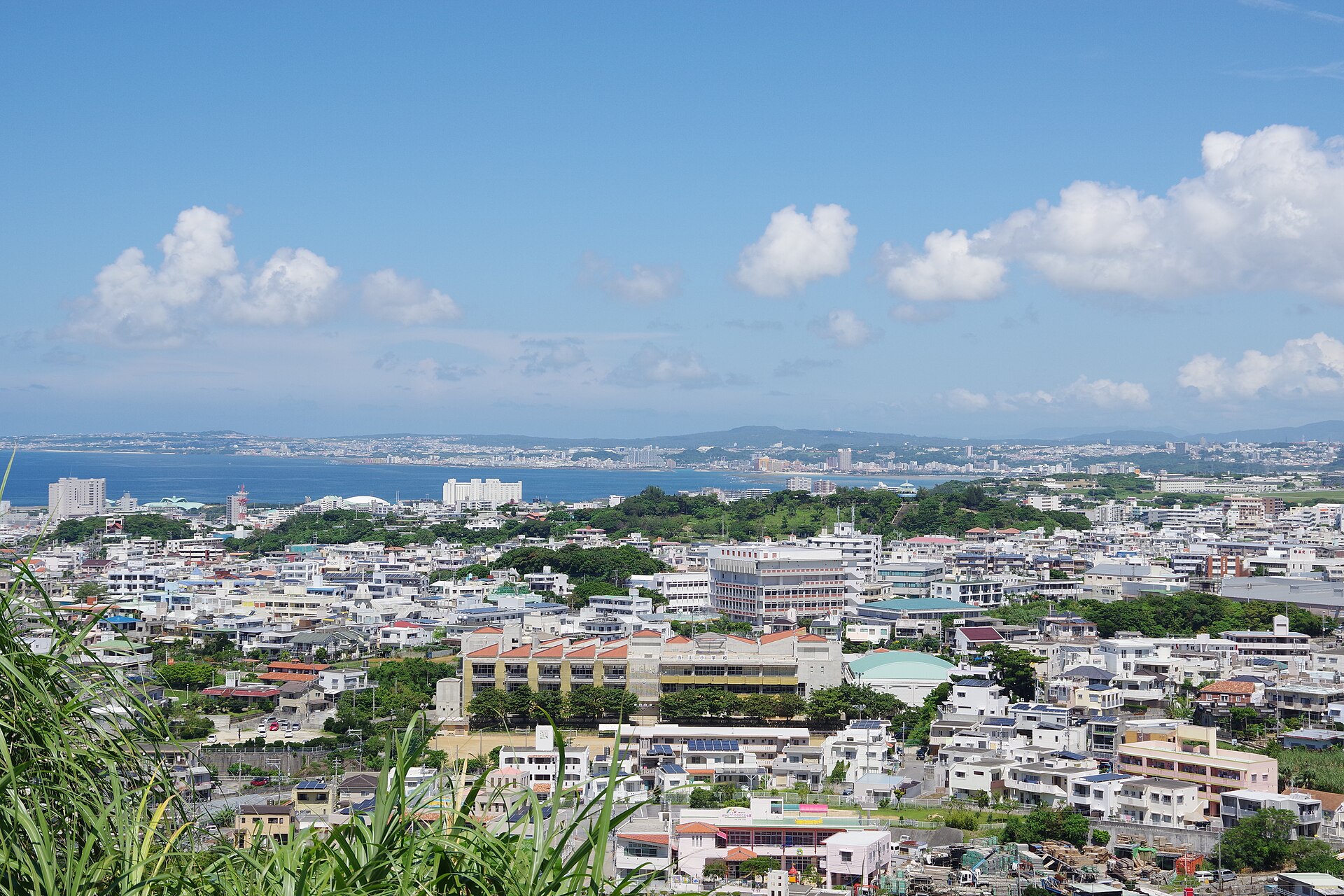
Urasoe
Introduction
Urasoe sits in Okinawa Prefecture, bordered by Naha to the south, Ginowan to the north and Nishihara to the east. Its compact area packs in a dense urban fabric, so you can move between neighbouring districts and into the wider Okinawan capital region without much effort.
Before you go
Central Okinawa is the narrowest part of the island, and the area you'll be travelling through is shaped by two very different coasts. The west coast around Ginowan, Chatan and Kadena is dominated by large US military bases, so expect a strong American presence: the main stretch of Route 58 in front of Camp Foster has three lanes lined with strip malls, English signage and drive-thru fast food. The eastern side is more residential, taking in the cities of Urasoe, Uruma and Okinawa City, formerly known as Koza.
Watch the road signs carefully: if you see highway signs for "Okinawa", they refer to Okinawa City rather than the prefecture as a whole. Before setting out, check the bilingual tourist information sites run by some of the cities in the area, including Chatan Tourism and KOZAWEB for Okinawa City.
Getting there
By road, Highway 58 runs up the western coast from Naha through Ginowan, Chatan, Kadena and Yomitan. Traffic jams at rush hour can be quite bad, so allow extra time if you are driving at peak periods.
To reach the eastern cities, take the highway bus, which goes to Motobu and Nago via Okinawa City. Local buses run from Naha Bus Terminal to Koza via Route 329 and Route 330.
Getting around
Your main car-free link is the Okinawa Urban Monorail, known as Yui Rail, which connects Urasoe with Naha and serves the city at three stations: Kyozuka, Urasoe-Maeda and Tedako-Uranishi. The line runs along the western, more developed side of the city, so it works best as a fast north–south corridor rather than a way to reach every corner. If your destination is in the eastern hills, plan to combine the monorail with a bus, taxi or car. There is no conventional heavy-rail or tram network in Urasoe.
Away from the monorail, local buses are the main way to reach the parts of Urasoe the train does not serve, and Naha Bus Terminal is the hub for longer-distance and regional services. Because the city is a bedroom community for Naha, routes are oriented around commuting into and out of the capital, so plan bus trips around that pattern rather than expecting a dense grid of cross-city routes. Walking is easier in the lower western areas near the coast and more strenuous as you move inland and uphill, since the city is hilly to the east. If you are driving, the Okinawa Expressway serves the city and Highway 58 runs up the western coast from Naha, though rush-hour congestion on that coastal route can be quite bad. The restored section of the Hanta Road, once Okinawa's Tokaido linking the castles of Shuri, Nakagusuku and Katsuren, begins from Nakagusuku Castle rather than in Urasoe itself, making it a day-trip option rather than a local stroll.
Where to stay
For resort-style comfort in the area, the Hilton Okinawa Chatan Resort sits at Mihama in Chatan, within Nakagami District. The hotel has several restaurants and bars, a spa, and both indoor and outdoor pools, and parking is free of charge.
Food & drink
Urasoe and its neighbours give you a spread of dining that runs from Okinawan tradition to the flavours of the American bases. For sushi and sashimi, head to Jirocho Zushi near Araha Beach, recognisable by the Iron Horse out front; it serves sushi, sashimi, tempura and sake alongside excellent Okinawan dishes, often as specials, with an emphasis on fresh, seasonal ingredients in an elegant setting with friendly staff. For a more casual sushi stop, Yoshihachi (known as Yoshi's) is geared towards American tastes and stays open late into the night; try the Yoshi Roll. For traditional Okinawan sushi, Fenutin in the Mihama American Village is an excellent choice, and you can try the sea grapes there while listening to traditional Okinawan music.
- CoCo's on Route 58 near Gate 5 of Camp Foster is a family restaurant popular with Marines stationed on the island.
- Kasthamandap on Kitamae serves authentic Nepalese curry made from scratch by the owner; the small, no-frills shack pairs its curry with ice-cold beer just steps from the East China Sea.
For drinks, the bar strips cluster around the bases. In Kadena, Gate 2 Street outside the back gate of Kadena Airbase has many bars and restaurants, while military officers tend to gather at the bars on "the Seawall" just outside Gate 1. One of the best-known bars on the air force base is Eclipse.
What to see and do
Central Okinawa mixes beach time with a surprising amount of history and family-friendly attractions. In Chatan, Mihama American Village is a shopping and dining complex styled after American beach towns, with a Ferris wheel, clothing and souvenir shops, restaurants of many cuisines, Sunset Beach, and live entertainment most nights. Araha Beach, also in Chatan, has a sandy beach and park along much of the coastline, plus a pirate-ship climbing gym, basketball courts and BBQ pits. Divers based near Chatan can head to Reef Encounters in Miyagi, close to the shore diving at the Sunabe sea wall, where instructors speak English and Japanese and PADI and NAUI courses are offered. Inland, the Southeast Botanical Gardens pair a water garden with a botanical garden of tropical flora and host night illuminations and events through the year, while the Okinawa Zoo and Museum combines a zoo with an interactive science museum for kids.
Three ruined Ryukyuan castles (gusuku) in the area are UNESCO World Heritage Sites, all partly restored: Katsuren Castle near the Sea Road on the eastern side, Nakagusuku Castle in Nakagusuku Village, and Zakimi Castle in Yomitan, built in the early 15th century, with a visitor centre, a museum on its history and architecture, and views. On the western side, Cape Zanpa in Yomitan has a lighthouse and a beach and is where the well-known sweet potato cookies are made. Hamahiga Island, east of the main island and reached by the Sea Road, is known for its rock formations, many shaped like mushrooms. Back in town, Koza Music Town gathers restaurants, music halls, recording studios and shops a short drive from Kadena Air Base.
Three days in Urasoe
Day one: Base yourself in Urasoe and use the Okinawa Urban Monorail, known as Yui Rail, to move between the stations that serve the city, including Kyozuka, Tedako and Uranishi. Ride it south into Naha, where the line connects with the Naha Bus Terminal for onward travel around Okinawa Prefecture. Keep your first day unhurried and let the rail line set the pace.
Day two: Head north along Route 58, the highway that threads through Central Okinawa, to Chatan and Kadena, where English signage and American influences are part of daily life near Camp Foster. Continue to Ginowan, Nishihara and Its, or push further to Uruma and Okinawa City, whose Koza district has its own distinct character. Watch the traffic on the highway, especially where it narrows through the busier stretches.
Day three: Turn to the quieter side of the prefecture. Take the highway north toward Yomitan, Maeda and Motobu, or follow the coast toward Nago, and eat Okinawan food along the way. Before you set out, check local sources such as Chatan Tourism and KOZAWEB for what is happening in the areas you plan to pass through.