Nagahama
Introduction
Nagahama is a city in Shiga Prefecture, Japan, spread across a large area of roughly 680 square kilometres. Its population is concentrated enough to give it a settled, lived-in feel, with tens of thousands of households calling the city home.
Before you go
Before you go, look up the local tourist association's multilingual guide site, which covers Nagahama jointly with the neighbouring city of Maibara. It is the place to check practical details and plan what you want to see ahead of arrival.
Getting there
Nagahama has no airport of its own, and Shiga Prefecture more generally is not well served by air. The nearest is Nagoya-Centrair, but Osaka's two airports, Itami and Kansai, are at least as convenient, if not more so. From Centrair or Kansai, take a train towards Nagoya or Osaka respectively and continue by rail as described below; two morning Haruka trains run direct to Kansai Airport from Maibara, returning in the evening. From Itami, the best option is a bus to either Shin-Osaka or Kyoto station, then train from there.
By rail, Nagahama is served by two trains per hour to Maibara, the nearest Shinkansen station, in about ten minutes; these are in fact Special Rapid services offering fast direct runs to many places in Kansai, including Kyoto, Osaka, Kobe and Himeji. Note that these trains usually run as 12-car trains to Maibara, but only the front 4 (or sometimes 8) cars continue to Nagahama, so make sure you travel in the front part of the train. Shinkansen trains which stop at Maibara usually do not go west of Shin-Osaka. Nagahama is also served by six Shirasagi Limited Expresses a day between Maibara and Kanazawa, of which three continue beyond Maibara to Nagoya; additional trains pass through without stopping, requiring you to change at Maibara or Tsuruga. If avoiding Limited Expresses, trains to Tsuruga run only once an hour during the day and you may have to change at Ōmi-Shiotsu; for Nagoya by Local and Rapid trains you will need to change at Maibara, and sometimes Ōgaki. As an alternative to the Japan Rail Pass, Nagahama is covered by several JR West area passes available to Temporary Visitors with foreign passports, though none of these cover the Tōkaidō Shinkansen east of Shin-Osaka; the Hokuriku Arch Pass allows travel from Tokyo but only the long way round via Kanazawa, a journey of no fewer than 5 hours.
Getting around
Nagahama is compact, and most of its tourist destinations and hotels lie within easy walking distance of the station, so for a typical sightseeing day you can simply go on foot. Buses do run, but they mostly serve locals commuting to the outskirts of the city proper, so you are unlikely to need them if your plans centre on the station area and the main sights. If somewhere is a bit farther away, taxis wait in numbers right outside the station, making one the simplest fallback beyond comfortable walking range.
- Bikes can be rented near the west exit of the station, though the rental is handled in Japanese, so you would need some language ability to arrange it.
- Ferries connect Nagahama to the island of Chikubu in Lake Biwa, giving you a way to reach the island without a car.
Where to stay
Most of Nagahama's accommodation clusters within walking distance of the station or in Hokoen Park along the waterfront. On the park's southern edge, by the yacht harbour, a hotel inspired by Verona (Nagahama's Italian sister city) offers waterfront rooms and in-house restaurants, while the Grand Mercure Lake Biwa Resort & Spa sits between it and the castle, with several restaurants and its own onsen. Near the castle you'll also find a Japanese-style hotel, with station shuttles available by reservation. Closer to the station, two Green Hotel Yes properties serve travellers: one a couple of minutes from the east exit near Kurokabe Square, the other a short walk south from the west exit. East of the station, a national business-hotel chain provides a no-frills option with more amenities than a hostel.
- Kitabiwako Hotel Grazie — waterfront, Verona-inspired, in Hokoen Park
- Grand Mercure Lake Biwa Resort & Spa — in Hokoen between Grazie and the castle, with onsen
- Green Hotel Yes Nagahama Ekimae-kan — near the station's east exit and Kurokabe Square
- Green Hotel Yes Nagahama Minato-kan — a short walk south from the west exit
- Art Hotel Nagahama — national chain business hotel, east of the station
- Hamakogetsu — Japanese-style, north of the castle
For an onsen stay, a Japanese-style hotel in Sugatani-cho is notable for its hot springs, and a Japanese onsen hotel at Onoe, outside Nagahama proper, offers the only Japanese cultural experience nearby with information in English, including lavish meals and onsen access. Further out, a hotel on the far outskirts suits those with a car or shuttle reservation.
Food & drink
Nagahama has a small but varied eating and drinking scene, with several places worth seeking out beyond the central sights. For Thai food in a suburban setting, Yum Thai sits north of the Seiyū in Yawata-nakayama-chō, a short drive or longer walk from Nagahama Station's East Exit; the cooking is well regarded and the staff friendly, with some waiters speaking English (the chef-owner speaks Thai and Japanese). Also in Yawata-nakayama-chō, near the police station, Yakiniku Den is a meat-focused grill house and a good spot for kimchi — expensive, but worth it, and with cheaper pricing for women.
- Nagahama Roman Beer — the city's only brewery, just across the Yone River from the station's East Exit; decent beer and a nice atmosphere, though food is on the pricey side.
- Curry & Bar Sai — a second-floor spot across from the main Kurokabe store, serving curry, omelet rice and cocktails; try the curry or omelet rice with a Heartland beer, and stay as long as customers keep the place open.
- One Coin — a counter bar near North Elementary School that's awkward to reach but rewarding once you arrive; the owner Sumi speaks excellent English with some Portuguese and Spanish, and his elderly mother may interview new faces (taking notes), with all drinks at a flat low price and food costing extra.
What to see and do
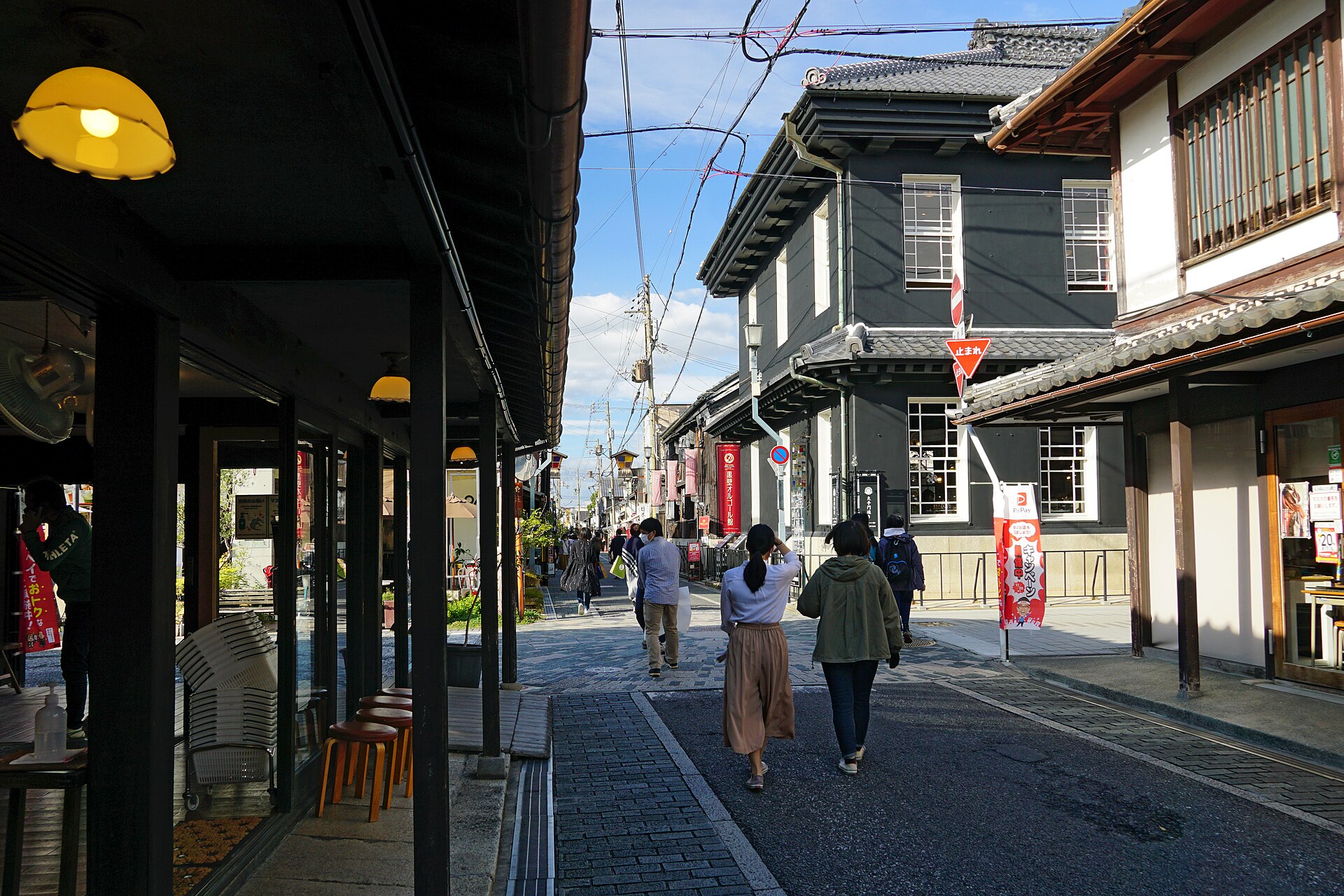
Start at Nagahama Castle, built by Hashiba Hideyoshi in the 1570s and rebuilt in the 1980s as a museum on the city's history (exhibits in Japanese only). It stands in the middle of Hōkōen Park, which offers a sweeping view over Lake Biwa and fills with picnickers under the cherry trees in spring. Nearby, the Hikiyama Museum in Kurokabe Square displays the ornate floats paraded at the Hikiyama Festival and screens footage of the festival, including kabuki performed by boys. Kurokabe Square also holds the Kaiyōdō Figurine Museum, where dinosaurs and anime characters are arranged in dioramas and figures are sold on the ground floor.
At the eastern end of Kurokabe Square, Daitsūji Temple preserves sliding-door paintings by Maruyama Ōkyo and the Kanō school, and its garden is a designated national scenic garden; the street leading to it is lined with traditional machiya merchant houses. Jinshōji is the city's oldest temple, founded in 895, and holds a gold-and-silver carved flower basket that is a national treasure. Hachiman-gū Shrine, with over a thousand years of history, is where the Hikiyama Festival begins each April 15, with boys performing kabuki on floats that wind toward Kurokabe Square. Farther out, Ōmi Kōhō-an sits in quiet mountain greenery and is known for its autumn leaves. The Nagahama Railway Square, a short walk from the station, keeps Japan's oldest existing station house as it once was and exhibits steam locomotives. In winter, the Nagahama Bonbai Exhibition at Keiun-kan shows apricot trees trained in bonsai style, including a very old specimen. In August, fireworks are launched over the harbor of Lake Biwa, and in October the Shusse Festival brings a parade of women in ornate kimono along with an open-air art market in Kurokabe Square.
Three days in Nagahama
Day one: Arrive in Nagahama and get your bearings in Shiga Prefecture. If you are coming from Tokyo, the Tōkaidō Shinkansen brings you west to Maibara, where you change for the local line into Nagahama; from Kyoto, the Special Rapid gets you there directly. From Centrair, the Haruka connects to the Kansai Airport line and onward services; from Itami, head for Shin-Osaka and pick up the Special Rapid toward Nagahama. A Japan Rail Pass or JR West pass for Temporary Visitors covers these journeys, and the Hokuriku Arch Pass is worth considering if you plan to continue toward Kanazawa or Tsuruga. Settle in and spend the evening exploring the streets near the station.
- Tokyo to Maibara by Tōkaidō Shinkansen, then local to Nagahama
- Kyoto to Nagahama by Special Rapid
- Centrair via Haruka; Itami via Shin-Osaka
Day two: Use Nagahama as your base for the wider region. The Shirasagi Limited Expresses and other Limited Expresses link Nagahama with Kanazawa and Tsuruga, while local and rapid services along the line reach Shiotsu. If you want a bigger city for the day, Osaka, Kobe and Himeji are all reachable by rail, and Kyoto is a straightforward run on the Special Rapid. Return to Nagahama in the evening.
- Limited Expresses toward Kanazawa and Tsuruga
- Local and rapid services to Shiotsu
- Day trips to Osaka, Kobe, Himeji or Kyoto
Day three: Take a slower morning in Nagahama before you leave. Check your onward connections: Maibara for the Shinkansen toward Tokyo or Nagoya, Shin-Osaka for Kansai Airport and Itami, and Centrair via the Haruka and connecting services. If your route heads north, the Limited Expresses toward Kanazawa and Tsuruga are the way to go. Confirm your pass covers the final leg before you set off.
- Maibara for Shinkansen to Tokyo or Nagoya
- Shin-Osaka for Kansai Airport and Itami
- Limited Expresses toward Kanazawa or Tsuruga