Siracusa
Introduction
You will find Syracuse located in the autonomous region of Sicily in Southern Italy. This city serves as the capital of the free municipal consortium of the same name.
Before you go
Prepare to explore a city steeped in history, once celebrated by the Roman writer Cicero as the most beautiful and greatest of all Greek cities. You can trace the legacy of the ancient world through its distinct districts: the island of Ortigia, which showcases early modern and baroque architecture, and the Neapolis district, known as the "new town," which dates back significantly further into antiquity. This area was also home to the master mathematician Archimedes.
For assistance with your visit, you can find a Tourist Information Centre located within the Provincial Government building on Ortigia island.
Getting there
You can arrive in Syracuse by plane at Catania-Fontarossa airport, located to the north of the city. From there, you can choose between a direct inter-city bus that takes just over an hour or a bus or taxi to the Catania railway station to catch frequent trains. While Ragusa airport is geographically closer, it offers fewer flights and lacks onward public transport options.
Train travel provides several routes into the city, including coastal lines from Messina via Taormina-Giardini and Catania, as well as connections from Palermo and long-distance trains from Rome. Regional trains also serve nearby destinations like Noto, Modica, and Ragusa. Upon arrival at the Stazione Centrale di Siracusa, you will find a station equipped with a cafe, ticket office, and luggage storage at the bar on the piazza. The inter-city bus hub is located just outside the station, offering connections to various nearby destinations including Palermo, Messina, Naples, and Rome.
Getting around
You can easily explore the city on foot, as both primary areas of interest are located within a short walk from the station. To the southeast lies the island of Ortigia, which contains the oldest part of the city, while the archaeological area of Neapolis sits to the north.
For longer distances or specific routes, you can utilize electric navettes that ply the center and areas of interest. These lines include a blue line circling Ortigia and passing near the stations, a red line serving Neapolis, and a green line running along the coast toward Neapolis. Other bus services are available for travel into the surrounding area. If you choose to travel by car, be aware that the entire island of Ortigia is a limited traffic zone where most vehicles are prohibited at night and on Sundays and holidays.
Where to stay
You can find budget-friendly accommodations primarily clustered around the railway station, the post office, and east of the Apollo temple. These options include simple rooms with a pleasant atmosphere or those located directly adjacent to the train and bus stations. For a more social experience, you might choose a hostel that offers both dormitories and private rooms, featuring a large terrace for meeting other travelers.
For a mid-range stay, you can choose from various styles depending on your preference for location:
- In the heart of Ortigia, you can find accommodations in historic buildings, some featuring Mediterranean-style furnishings or located near the archaeological zone.
- Stay on the waterfront to enjoy sea views and terrace breakfasts.
- Choose a boutique hotel in the historical center just bordering Ortigia for a more refined experience.
For a luxurious experience, you can stay in an imposing quayside building featuring Art Nouveau interiors and a roof garden, or choose a resort located on a scenic headland that offers a private beach and views overlooking the town.
Food & drink
Savor a variety of local flavors ranging from casual bites to refined Sicilian cuisine. You can enjoy pizza and pasta in the heart of the city or find cozy settings for vegan and vegetarian fare. For those seeking seafood, several establishments specialize in fish dishes, while others offer diverse menus featuring risotto and couscous. If you prefer a more indulgent experience, traditional Sicilian dishes are available with wine-cellar options and tasting menus.
Experience the local nightlife along the coastline on the Alfeo Promenade. You can visit various night clubs where some feature dance floors located directly on the beach, allowing you to dance under the moonlight.
What to see and do
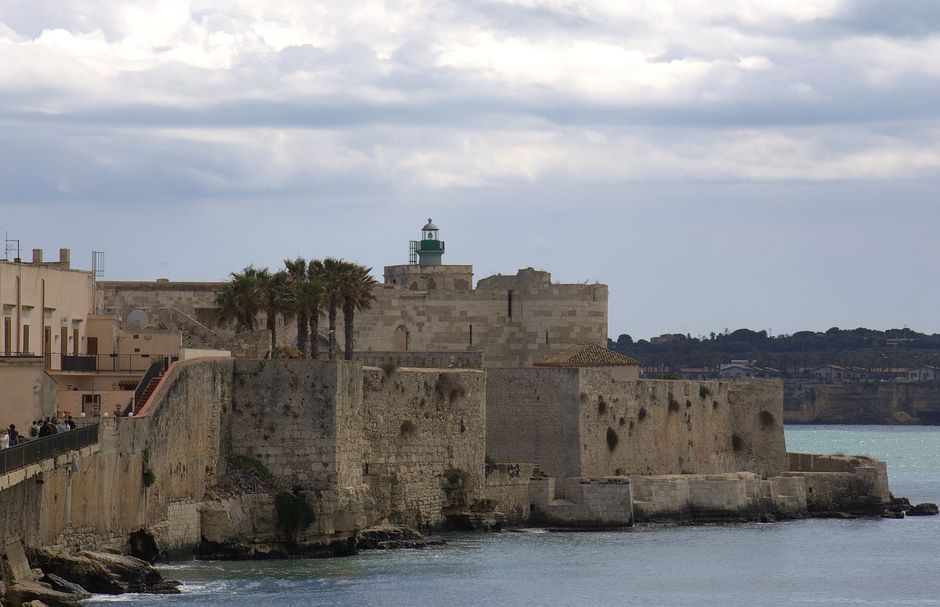
Explore the historic island of Ortigia, the oldest part of Syracuse. As you cross the bridge, you can view the remnants of the Tempio di Apollo before reaching Piazza Duomo. Here, you can visit the Cattedrale della Natività di Maria Santissima, a site that has served as a Greek temple, a mosque, and a church across different centuries. Nearby, find the ornate Fountain of Diana in Piazza Archimedes or visit the Antica Fonte Aretusa, a pond surrounded by papyrus reeds. The southern tip of the island features the Castello Maniace, a medieval fortress with Vauban-style bastions. You can also visit the Chiesa di Santa Lucia al Sepolcro to see its historic portal and apses.
In the Neapolis area, you can explore an extensive archaeological park containing several significant sites:
- Latomia del Paradiso, where you can descend into ancient stone quarries and hear the echoes of the Orecchio di Dionisio.
- The Teatro Greco, a large Greek theatre where performances are held during the summer months.
- The Ara di Ierone II, a massive piece of rock that served as the foundation for one of the largest known altars in the ancient world.
- The Anfiteatro romano, a grassy pit carved into the hillside.
Three days in Siracusa
Day one, you begin your journey in the heart of Sicily by exploring the ancient sites of Syracuse. You can wander through the historic areas to experience the legacy of Greek and Roman history, where figures like Cicero and Archimedes once walked.
Day two, you cross over to Ortigia to immerse yourself in the atmosphere of this island district. You can spend your time taking in the local surroundings and experiencing the unique character of this part of Southern Italy.
Day three, you explore more of the region's heritage. You can visit nearby locations such as Noto or Modica to see the diverse architecture and history that define this area of Sicily.