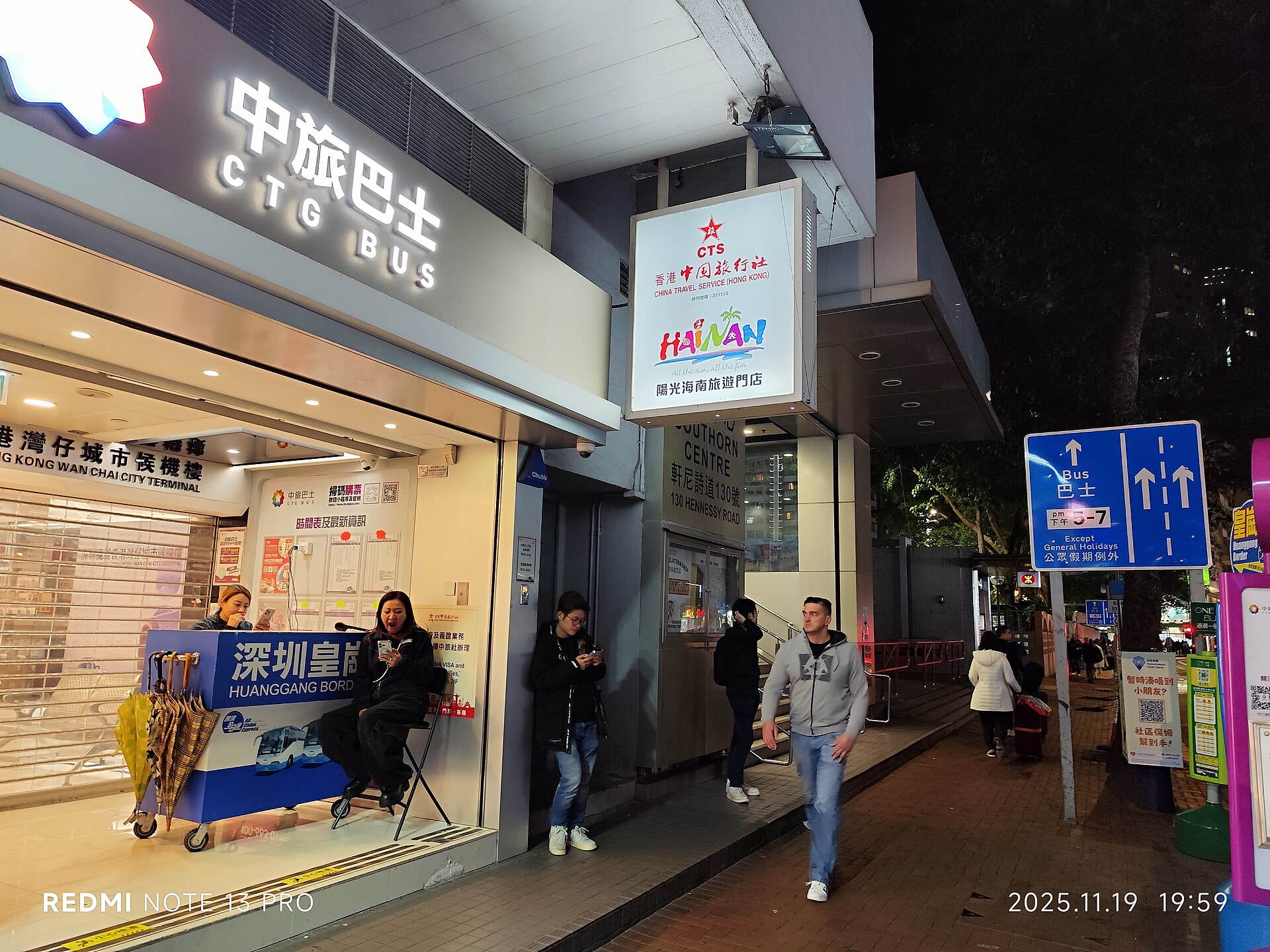
Wan Chai
Introduction
Wan Chai sits on the northern shore of Hong Kong Island, in the western part of Wan Chai District. The area is bounded by Canal Road to the east, Arsenal Street to the west, and Bowen Road to the south, and the section north of Gloucester Road is usually known as Wan Chai North.
Before you go
Wan Chai and Causeway Bay sit along the eastern shore of Hong Kong Island's north coast, with Happy Valley tucked inland behind its racecourse. Wan Chai has an inner-city feel and is an interesting but safe area to walk around at any time, though its reputation still carries echoes of the sleazy nightlife that once made it a favourite hangout for American soldiers on R&R during the Vietnam War. Causeway Bay is a crowded shopping district where you can eat and shop until very late, with some major supermarkets and eateries open around the clock. Plan around the weather rather than fighting it: expect warm, humid conditions for much of the year. If you only have a short time in Hong Kong, the Eastern District further east along the north shore can safely be ignored unless you intend to visit the Museum of Coastal Defence.Getting there
Wan Chai sits on the north coast of Hong Kong Island, within easy walking distance of Central from the main transport hubs — though the summer heat can make that walk less appealing. The Mass Transit Railway's Island Line runs along this coast, from Kennedy Town in the west through Central, Admiralty, Wan Chai, Causeway Bay and beyond. Arriving from Kowloon, take the Tsuen Wan Line to Admiralty and change to the Island Line, or cross the harbour on the Tseung Kwan O Line or the extended East Rail Line.
- By tram: The tram runs from Kennedy Town to Sai Wan Ho, passing through Wan Chai and the Eastern district. It is a low-effort, inexpensive way to see this part of town, but check that your tram follows your route rather than branching off. Trams have no air conditioning, only fans and open windows, and Sundays are uncomfortable due to the sheer volume of fellow travellers.
- By bus: Many buses run from Central eastwards to Wan Chai and beyond, and some cross-harbour buses connect the area to Kowloon. Mastering the bus system means more comfortable journeys, with a seat in a clean, air-conditioned environment instead of running around metro stations.
- By boat: The Star Ferry arrives at Wan Chai Pier from Hung Hom and Tsim Sha Tsui in Kowloon. North Point also has a pier with frequent services to Hung Hom, Kwun Tong and Kowloon City, and there is a ferry pier at Sai Wan Ho.
- By taxi: Taxis are cheap enough if you want to travel in comfort; a ride from Hong Kong Station to Causeway Bay costs a modest fare depending on traffic.
Getting around
Wan Chai sits on the northern shore of Hong Kong Island, bounded by Canal Road to the east, Arsenal Street to the west and Bowen Road to the south, with Wan Chai North — the strip above Gloucester Road — holding the office towers, parks, hotels and the Hong Kong Convention and Exhibition Centre. The district is densely built up, so it pays to know your options before you arrive. The MTR is the simplest way around: the Island Line runs along the north coast through Central, Admiralty, Wan Chai and Causeway Bay, and if you're coming from Kowloon the Tsuen Wan Line stops at Admiralty, where transferring to the Island Line is straightforward. You can also cross the harbour on the Tseung Kwan O Line or the East Rail Line. Almost all MTR stations have step-free access, and those that don't have stair lifts, platform ramps and staff to assist. Because the MTR corporation develops land above its stations, major interchanges tend to sit inside malls and high-rises that double as bus and light rail interchanges — useful when you surface somewhere unexpected.
The tram, nicknamed the "ding ding", runs the length of Hong Kong Island from Kennedy Town to Shau Kei Wan and trundles right through Wan Chai; it's slow, unairconditioned and cramped with steep steps, and it isn't wheelchair accessible, so check you're on one heading your way. Many buses run from Central eastwards through Wan Chai and beyond, with cross-harbour routes to Kowloon; most are double-deckers with low floors, wheelchair ramps and designated wheelchair areas, though airport buses are not accessible — use the Airport Express instead. Minibuses are among the cheapest options: green ones run fixed routes and timetables and can be flagged down at official stops, red ones are owner-operated with driver-chosen routes and stop on request, and neither is wheelchair accessible. Taxis are cheap enough for comfort, with red taxis serving urban areas, green covering the New Territories and blue confined to Lantau; fares are displayed on the dashboard, tipping isn't expected, and drivers prefer cash. An Octopus card is the single most useful thing in your pocket, working across transport, shops, convenience stores and vending machines, with concessionary fares applied automatically on the MTR, buses, ferries and the Light Rail. Wan Chai Pier is served by the Star Ferry from Hung Hom and Tsim Sha Tsui, and ferries are generally wheelchair accessible, though some piers have steep ramps depending on the tide. Walking is easy from Central and the main transport hubs, and Wan Chai North is a particularly walkable pocket near the waterfront — but watch for narrow, uneven pavements and streets that turn out to be long staircases.
Where to stay
Wan Chai and neighbouring Causeway Bay put you in the middle of the action, and the range of places to sleep runs from backpacker dorms to harbour-view luxury. Budget travellers head for the hostels around Paterson Street and King's Road in Causeway Bay, a few minutes from the MTR; expect small, clean rooms, shared kitchens and fridges, and staff who are brusque but helpful. Mid-range options cluster along Hennessy Road, Jaffe Road and Queen's Road East, with several business and leisure hotels offering compact rooms, desk space, tea- and coffee-making facilities and in-room internet. A couple of larger properties sit further east in North Point and near Victoria Park. If you want to splash out, the top end is concentrated in Wan Chai and Causeway Bay. The Grand Hyatt overlooks Victoria Harbour and connects directly to the Hong Kong Convention and Exhibition Centre, and is home to a renowned spa. In Causeway Bay you'll find a small boutique hotel with an old-world European facade on a quieter corner, a Philippe Starck-designed boutique property with complimentary breakfast and evening wine, and a large four-star with views over either the harbour or Victoria Park.Food & drink
Wan Chai and neighbouring Causeway Bay both offer a bewildering range of places to eat to suit all budgets and interests, though you should expect crowds of people doing the same. Causeway Bay tends to be a bit more expensive and draws plenty of young trendies who may be seen eating into the small hours; look out for specialist dessert cafes, and remember to look up, since higher floors hold cafes with balconies that give you a more relaxed view of the crowded streets below. Wan Chai is generally a little easier to find a table in, and good places to eat are spread through all parts of it — part of the fun is looking around. Star Street, close to Pacific Place Three and reachable by subway from Pacific Place, is a street not to miss. Arriving via the MTR station lands you in the middle of the bar and drinking area, where many restaurants are geared to drinkers and tourists; head instead towards the Causeway Bay side of Wan Chai for a more local dining experience. Further afield, Lei King Wan or SOHO East is an interesting place to wine and dine, often ignored by tourists, with plenty of restaurants and pubs where you can sit at the sidewalk over dinner, while Shau Kei Wan Main Street East, at the tram terminal, has many small restaurants mostly serving local food.
On a tight budget, Wan Chai offers a great choice of places with the added bonus of plenty of character and personality. Chiu Yuen is a small, usually packed eatery serving simple fare, with beef brisket noodles and homemade giant fishball soup as the crowd-pullers. Tsui Wah Restaurant is a clean, multilingual cha chaan teng where even a non-Chinese speaker can easily explore; aside from typical cha chaan teng foods such as French toast, curry, baked rice, fried noodles and Hong Kong style milk-tea, try the famous fishball noodle in soup, and expect to share a table at peak hours. Tai Hing Roast Restaurant is a Cantonese BBQ eatery with roast pork, roast piglet, BBQ pork, roast goose and soy sauce chicken hanging in the front display window, to eat in or take out, while 3.6.9. Restaurant Shanghai is an old style dive usually packed with locals and serves excellent, inexpensive xiao long bao. Mid-range options include The Flying Pan, above Mes Amis on the corner of Lockhart Road and Luard Road, open all day every day for breakfast including a full-English, and Kung Tak Lam, a vegetarian restaurant serving Shanghainese cuisine with MSG-free hotpot, dim sum and noodles. Under the Bridge Spicy Crab is a Hong Kong institution famous for its Typhoon Shelter style crab, where people come for the food rather than the basic interior. For a splurge, Fook Lam Moon is an old school Cantonese restaurant famous for luxurious delicacies such as abalone and swallow's nest, with more affordable specialties including roast suckling pig, crispy chicken and steamed lotus leaf rice. Around North Point you will find Duck Shing Ho, Hong Kong's most famous purveyor of egg rolls, which makes a limited quantity every day — join the queue well before opening or miss out, and note that each customer is limited in how much they can buy.
What to see and do
Wan Chai puts several of its landmarks within easy reach. Central Plaza is visible from most of the district, and during business hours you can ride the lift from the ground floor to the sky lobby on the 46th floor for a free view over the harbour and the island; after dark, the changing lights at the top of the building tell the time. The Hopewell Centre on Queen's Road East, one of the city's few round towers, offers another free viewpoint via its glass observation lift, which climbs from the 17th to the 62nd floor in about 90 seconds. Near Causeway Bay, the Noon Day Gun is fired into Victoria Harbour every day at noon, continuing a tradition that dates back to the 1860s. Golden Bauhinia Square, outside the Hong Kong Convention and Exhibition Centre, marks the site of the 1997 handover ceremony and hosts a flag-raising ceremony each morning; come at night for the neon-lit skyline across the water. The Old Wan Chai Post Office on Queen's Road East, the district's only declared monument, now serves as an Environmental Resource Centre.
For indoor time, the Hong Kong Central Library overlooks Victoria Park with exhibitions, newspapers and magazines, while the Hong Kong Convention and Exhibition Centre itself is one of the city's most striking buildings, fronted by a promenade where the handover took place. Military history enthusiasts can head to the Museum of Coastal Defence in Shau Kei Wan or the Hong Kong Police Museum on the Peak, and the Fireboat Alexander Grantham Exhibition Gallery in Quarry Bay Park covers firefighting. The Law Uk Folk Museum in Chai Wan is an 18th-century Hakka village house, and the Hong Kong Film Archive is in Sai Wan Ho. Outdoors, Victoria Park has football fields, a jogging track and a public open-air pool in summer, Quarry Bay Park gives an alternative view of the eastern harbour, and Southorn Playground offers rare open space among the skyscrapers for football, basketball or simply watching. Horse racing has been run at Happy Valley racecourse since 1846, with evening meets particularly impressive against the lit-up skyline, and the Hong Kong Racing Museum sits beside the track. The Hong Kong Academy for Performing Arts on Gloucester Road stages dance, music and drama.
Three days in Wan Chai
Day one: Arrive in Wan Chai on Hong Kong Island and get your bearings. The Mass Transit Railway serves the area on the Island Line, which runs between Kennedy Town and Admiralty, while the Tsuen Kwan Line, Tseung Kwan Line and East Rail Line connect you onward to Kowloon and beyond. Trams also run through the district, and on Sundays many routes are especially busy. Start around Gloucester Road and Wan Chai North, then walk inland to Canal Road and Arsenal Street to see how the commercial waterfront gives way to older streets.
Day two: Give the day to the district's wartime history. The Museum of Coastal Defence sits in the area, and its displays cover the American role in the Vietnam War and the wider Plan for Hong Kong's defence. Afterwards, follow Bowen Road for a quieter stretch above the built-up streets, then drop back down toward Central or over to Causeway Bay and Happy Valley, both within easy reach of Wan Chai District.
Day three: Use the water and the rails to see more of the city. The Star Ferry calls at Wan Chai Pier, and from there you can cross to Kowloon or simply watch the harbour traffic. If you prefer to stay on the island, the Island Line links you to Sai Wan Ho and the Eastern District, while the East Rail Line opens up the New Territories. Mastering the trams and the Mass Transit Railway together makes the rest of Hong Kong Island straightforward to explore.