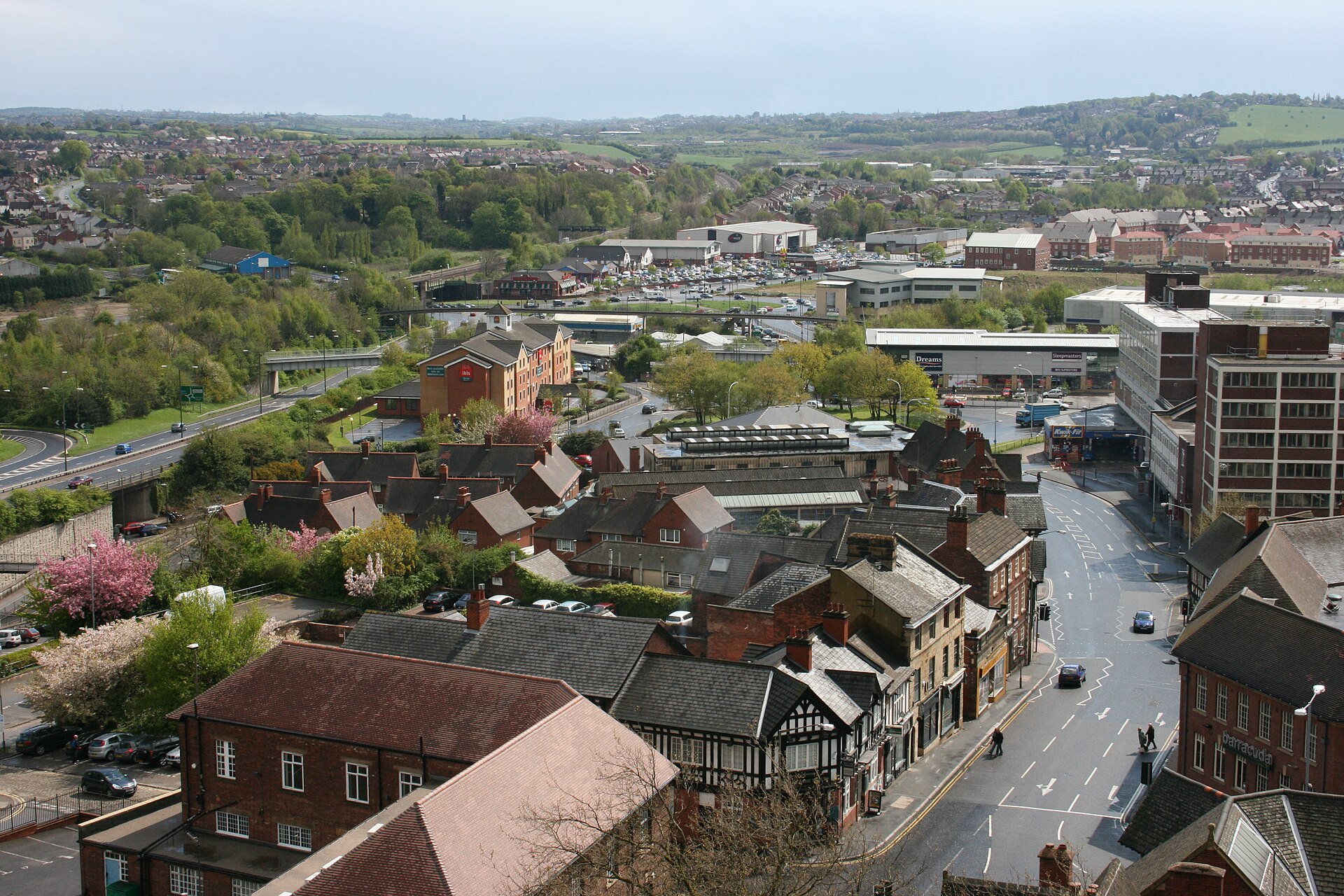
Chesterfield
Before you go
Chesterfield grew from a hamlet within the village of Newbold into the main town of its area as the Industrial Revolution took hold, its fortunes built on coalfields and iron ore, then on the canal and the railway that Stephenson ran through from 1837. Heavy industry collapsed in the late 20th century after the miners' strike, the colliery sites were re-landscaped, and the town shifted to light and service industries. Keep that arc in mind and the place makes more sense: a market town with an industrial past, now best known for one very distinctive landmark.
That landmark is the crooked spire of St Mary's and All Saints Church, twisted and leaning for many hundreds of years and visible from any train passing on the Sheffield to London mainline. Local folklore blames the Devil, startled away by ringing bells with his tail wrapped around the spire, or a virgin bride who surprised the church into craning round to look; more sober explanations point to a lack of skilled craftsmen after the Black Death or to lead tiling that twists in uneven sun. Read up on the stories before you arrive, so you can decide which you believe when you see it.
Getting there
Chesterfield sits on a busy rail corridor, and most travellers arrive by train. East Midlands Rail services from London St Pancras run hourly and take about an hour and three-quarters via Leicester and Derby. From the West Country, trains pass through without stopping, so change at Derby if you're coming from Bristol or Birmingham; from Wakefield, Leeds, York, Newcastle upon Tyne or Edinburgh, change at Sheffield. Hourly trains also run from Stockport via Ilkeston and Alfreton, and any northbound train stops next to Sheffield, so together these services are frequent and the hop from Sheffield is quick. Change at Sheffield for Manchester via the scenic Peak District line through Edale and Hathersage. The station is on the east side of town off Crow Lane, with a staffed ticket office and machines, a waiting room, toilets and step-free access to all platforms.
By road, from the south take the M1 to junction 29 and then the A617. From the north, junction 30 onto the A619 looks shorter, but that road drags through a series of villages, so it's generally quicker to stay on the M1 to junction 29. From Sheffield, follow the A61 south. There's plenty of town-centre parking, including the multi-storey by the bus station. National Express coaches from London Victoria run several times a day and continue to Sheffield, while Stagecoach's X17 links Barnsley with Sheffield and carries on into the Peak District to Matlock, Cromford and Wirksworth. Slower local buses run from Sheffield via Dronfield, Newbold and Old Whittington, and from Worksop via Staveley; there are also direct services from Nottingham via Mansfield and from Derby via Ripley, Alfreton and Clay Cross. The coach station is on Beckinsale Way off the A619 Markham Road.
Getting around
Chesterfield's centre is compact and genuinely walkable, so you can cover most of it on foot. To explore the surroundings and reach the Peak District, though, you'll need wheels — a bus, a train or a car. The railway station sits on the east side of town off Crow Lane, with step-free access to all platforms, and it's the main rail gateway for the area. Sheffield is a useful interchange for Manchester and the scenic Peak District line through Edale and Hathersage.
There's no metro or tram network; buses and trains do the heavy lifting. Stagecoach Bus X17 runs from Barnsley via Meadowhall and Sheffield and continues to Matlock, Cromford and Wirksworth in the Peak District, while buses 43 and 44 take a slower route from Sheffield via Dronfield, Newbold and Old Whittington. Pronto Bus runs from Nottingham via Mansfield, and Trentbarton Comet runs from Derby via Ripley, Alfreton and Clay Cross. Buy tickets and passes directly from the operator or the driver — services are run by a mix of companies, so a single operator's day ticket won't cover every route. For short hops, especially between the station and the town centre or out to surrounding villages, local taxi firms include Central Cars, A-Line and Door2Door; ride-hailing apps aren't documented here, so booking a local firm by phone is safest. If you're heading to Hardwick Hall, note that the Pronto Bus to Mansfield drops you about two miles north of it, so plan the final stretch.
Where to stay
Chesterfield's accommodation is mostly reliable chain hotels, with a few distinctive options on the edges. In the town centre, you'll find a value-for-money Accor hotel on Lordsmill Street and a smart budget Premier Inn on Elder Way — note that the latter has no on-site parking. A second Premier Inn sits a mile north of the centre behind the Tesco Superstore, described as friendly and efficient, and the Casa Hotel on Lockoford Lane is a clean, welcoming place in the same northern area.
- Ibis Chesterfield Centre — reliable, good-value chain hotel in the centre
- Premier Inn Chesterfield Town Centre — smart budget option, no on-site parking
- Premier Inn Chesterfield North — friendly and efficient, a mile north of the centre
- Casa Hotel — clean and welcoming, a mile north of the centre
- Travelodge, Old Whittington — simple but worth what you pay, near the A61/B6050 junction
- Premier Inn Chesterfield West, Eastmoor — cosy chain hotel in a quiet spot
- Lambs Glamping, Moorhay Farm — three glamping pods sleeping four, each with a private hot tub, open all year
- Ringwood Hall Hotel, Brimington — pleasant spa hotel built in the early 1900s by coal and iron tycoons
If you'd rather stay outside town, the Travelodge at Old Whittington suits drivers, the Premier Inn West offers a quiet setting at Eastmoor, and Lambs Glamping provides pods with private hot tubs year-round. For something grander, the spa hotel at Brimington has period character from its industrial heyday origins.
Food & drink
For a sit-down meal, the cluster of streets just west of the Crooked Spire is the place to start. Odyssey on Knifesmithgate is a cheerful, authentic Greek taverna, and Bottle and Thyme on the same street serves modern English cuisine. O-Tokuda, a block west of the spire, has a good Japanese menu with small portions and an all-you-can-eat buffet, while Blaze Bar & Grill by the spire describes itself as East Med but mostly turns out standard burgers and grills. For something more traditional, Filippelli's Bistro on Glumangate behind the Odyssey does filling grub. Among the Indian options, Ashoka on Holywell Street gets better reviews than Indian Blues by the spire. The Old Post on Holywell Street offers relaxed dining in a charming old building, and Northern Tea Merchants on Chatsworth Road is a café within a tea and coffee shop serving sandwiches, panini and cakes.
For a drink, the Market Pub on New Square is a great traditional pub with good grub, ales and a huge selection of gin, and The Hidden Knight just north of it also has good food. The Rose & Crown in Brampton is a buzzing pub with live music. Burlington, just south of the Crooked Spire, gets rotten reviews, so you may want to look elsewhere.
What to see and do
Start with the town's defining landmark, St Mary's and All Saints Church, known for its crooked spire. The spire was added in the 14th century and has leaned since at least the 18th; the tip sits well off-centre, most likely because of green timber shrinking, the weight of the roof, missing cross-bracing and rot, while the church below stands true. The interior is mostly Victorian, and guided tower tours run most days from April to December. Opposite, the Chesterfield Museum is closed for rebuilding. Just north of the bus station, the Shambles are medieval alleyways whose name recalls the butchers' benches of a historic slaughterhouse area. Holy Trinity Church, completed in the 1830s, holds the plain slab grave of railway engineer George Stephenson, and Christ Church, finished in 1870, is a chapel-sized building on Sheffield Road. The late-Saxon Eyre Chapel, once a Roman Catholic family chapel sacked by a Protestant mob in the 1680s, now serves as the village hall.
For green space, Queen's Park sits on the south bank of the River Hipper, reached by a footbridge from the town centre, and its cricket ground occasionally hosts Derbyshire games. Tapton House, Stephenson's last residence and now a business centre, has park and gardens open at all hours. The Chesterfield Canal, restored locally as far as Staveley, has a footpath running its full length. Barrow Hill Roundhouse, the last functioning locomotive roundhouse in Britain, displays heritage steam and diesel engines. Further out, Hardwick Hall is a grand Elizabethan prodigy house with a Great Hall, staircase, staterooms and long gallery, and Stainsby Mill on the same estate is a restored water mill. In Old Whittington, the Revolution House museum recalls the 1688 plot against King James II. For entertainment, the Pomegranate Theatre is a traditional Victorian hall opposite the church, the Winding Wheel offers a larger performance space nearby, and Cineworld sits on Alma Leisure Park. Chesterfield FC, the Spireites, play soccer at their stadium north of the railway station, and several golf courses lie around town.
Three days in Chesterfield
Day one begins in the centre of Chesterfield, where you can trace the town's story from its market origins through the Industrial Revolution. Visit All Saints Church, known for its crooked spire, and look for the local legend of the Devil. Wander the streets around the church and take in the town's character before heading out to Newbold to see a different side of the area. Round off the day with a walk along Crow Lane.
Day two is for the rail enthusiast. Chesterfield sits on a busy line with hourly services, and you can watch heavy freight and passenger trains pass through. The town's railway heritage links back to Stephenson, and the station connects directly to Sheffield, London St Pancras, Leicester, Derby, Bristol, Birmingham, Wakefield, Leeds, York, Newcastle, Edinburgh, Stockport, Ilkeston and Alfreton, with a change needed for Manchester. Spend the afternoon exploring the town centre at an easy pace.
Day three takes you into the Peak District. From Chesterfield you can reach Edale and Hathersage, both good starting points for walks in the national park. Keep the day flexible depending on the weather, which can turn cool and changeable on the hills. Return to Chesterfield in the evening for a final look around the town before you leave.