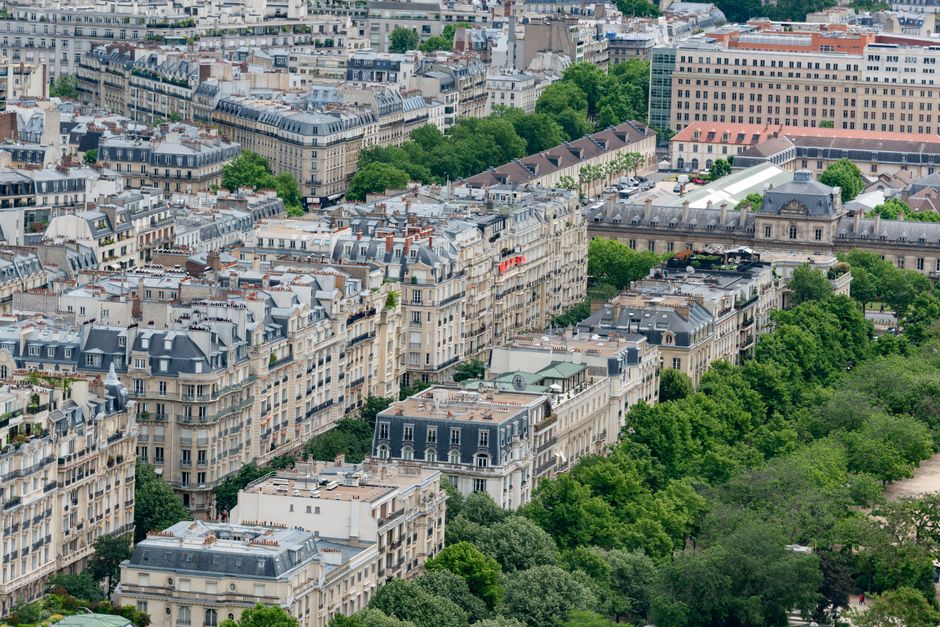
Paris, in Full Light
Paris has drawn the world to its riverbanks since the Age of Enlightenment, and it hasn't stopped since. Along the Seine, in the heart of the Île-de-France region, 2.04 million Parisians live inside a compact 105.4 square kilometres — a metropolitan orbit of 13.2 million people radiating out from it. This is the "City of Light," a working capital of finance, diplomacy, fashion, and food that has held that title for over three centuries. Give it five or six days and you'll only scratch the surface; give it a month and you'll start to understand why people never quite leave.
The Landmarks Worth Queuing For
- The Eiffel Tower — 1,063 feet, 81 stories, three levels open for dining and views. Skip the base crush and see it properly from Trocadéro, Pont d'Iéna, the Champ de Mars, or the Bir Hakeim Bridge.
- The Louvre — a museum on the scale of a small nation, entered through its glass pyramid. Book morning tickets in advance or spend your visit in a queue instead of a gallery.
- Arc de Triomphe — anchoring the far end of the Champs-Élysées at Place Charles de Gaulle. Climb 284 steps or take the lift to the rooftop for one of the best sightlines in the city.
- Notre Dame — the medieval cathedral of rose windows and twin bell towers, still the emotional center of the Île de la Cité.
- Palais Garnier — the Paris Opera House, where the Grand Staircase and gold-and-red auditorium make the building itself the performance.
- Palais de Versailles — the former royal residence, about 12 miles outside the city, worth the half-day trip on its own.
Neighborhoods That Reward Wandering
Paris is carved into 20 arrondissements, each with its own temperament — some built for romance, some for family days, some for pure luxury. A few worth knowing by name:
- Montmartre — the hilltop village of cobbled lanes and vintage newsstands, crowned by the Sacré-Cœur Basilica at the city's highest point.
- The Latin Quarter — Paris's oldest district, on the Left Bank, its narrow streets thick with cafés, bistros, and cabarets.
- Le Marais (4th arrondissement) — high-end shopping, bars, and restaurants, and a favorite base for visitors who want to be near everything.
- Saint-Germain-des-Prés — home turf of the traditional corner bistro, in the 6th arrondissement behind the Luxembourg Gardens.
When to Go
- Spring — comfortable temperatures, blooming flowers, and crowds that are still manageable.
- Summer — the city at full volume: outdoor café culture, and major events like the World Cup and Pride filling the calendar.
- Fall — the mellow stretch, once the summer crowds thin out by late September.
- Winter — cold, but lit up with holiday decorations and festive music that make the "City of Light" nickname feel literal.
Where to Rest and Eat
Near the Louvre, Madame Rêve occupies the former Louvre Post Office, with 82 rooms and a rooftop for morning yoga — walk a few minutes to Stohrer, a pastry shop that has been baking since 1730. In the 16th arrondissement, the Peninsula Paris sits at 19 Avenue Kléber in a building once owned by Queen Isabella II of Spain, where George Gershwin wrote *An American in Paris*; nearby, Saint James Paris houses the Michelin-starred restaurant Bellefeuille. For old-world Paris in full costume, the Ritz Paris keeps its Louis XV furnishings, the Salon Proust for afternoon tea, and the Bar Hemingway for something stronger. In Le Marais, Cheval Blanc Paris — owned by LVMH — runs four restaurants and a Dior spa, while in Pigalle, Soho House occupies a 19th-century building once home to the artist Jean Cocteau.
Start with the Metro map and a loose itinerary, and let the arrondissements do the rest — Paris rewards the traveler who wanders off the direct route between landmarks as much as the one who checks them all off.