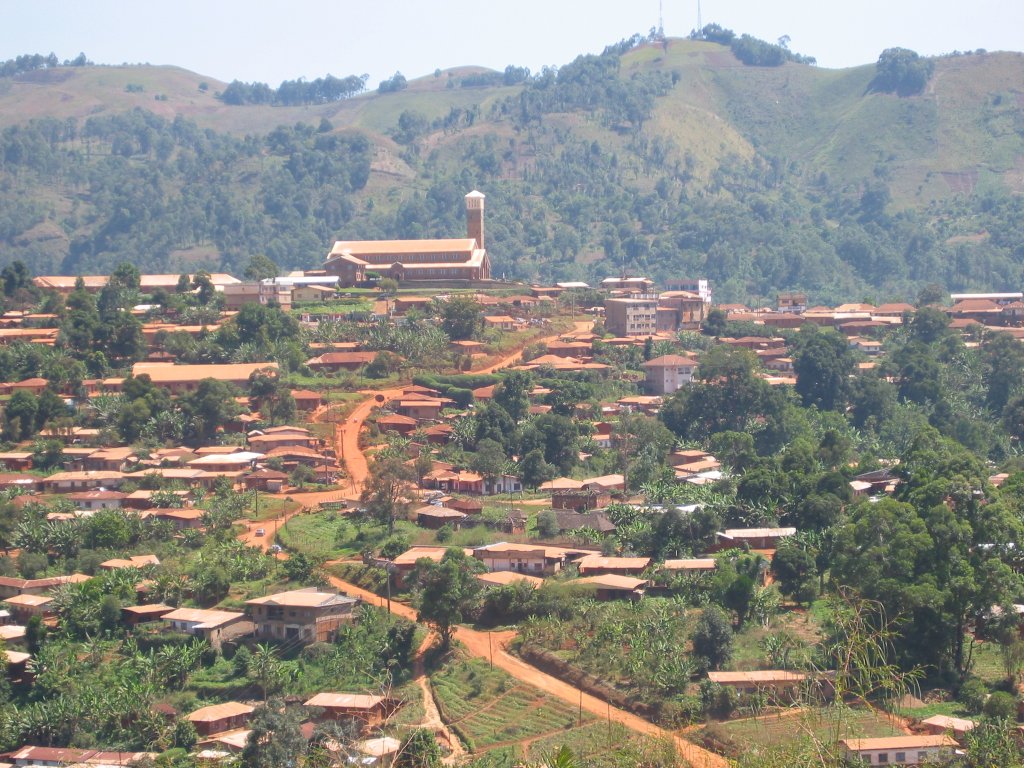
Kumbo
Introduction
Kumbo, also called Kimbo, sits high in the Bamenda Highlands of Cameroon's North West Province, roughly 110 km from Bamenda along the Bamenda Highlands Ring Road. At about 2000 m above sea level, the air here is cool, and the town spreads across three distinct hilly settlements: Tobin, Mbveh and Squares. As the capital of the Nso Kingdom, Kumbo is the seat of the Nso people and their palace, and it is known for horse racing and traditional medicine as well as for its market and two hospitals.
Lamnso is the lingua franca, but you will also hear Pidgin, English, Oku, Djottin, Fulfulde, French and Hausa spoken around town, so visitors can generally get by in more than one language.
Before you go
Kumbo, also called Kimbo, sits in Cameroon's North West Province and serves as the capital of Bui Département. It is also the capital of the Nso Kingdom, the seat of the Nso people, so your visit brings you into a living royal and cultural centre rather than a purely administrative town.
- Expect to hear both names, Kumbo and Kimbo, used for the same place.
- Plan around the town's role as a departmental and royal capital, which shapes its character.
Getting there
Since the source material for Kumbo contains no information on how to reach the city, there is nothing to include in this section.Getting around
Kumbo spreads across three hilly settlements — Tobin, Mbveh and Squares — so plan each trip around which one your destination sits in before you set out. There is no rail, metro or tram network and no train station, so all movement is by road. Walking works well between nearby points, but the gradients mean you should allow more time and effort than the map distance suggests; the Cathedral at the top of the square hill gives you a sense of the climbs involved. The Mbve market, the main market in Kumbo, is a useful orientation point within the Mbve settlement.
No scheduled urban bus service or app-based taxi network is documented for the city, so arrange local transport on the ground — ask at your accommodation, at Shisong Hospital or Banso Baptist Hospital, or around the Mbve market. For arriving and leaving, the practical route is the Bamenda Highlands Ring Road, roughly 110 km from Bamenda, and you should confirm onward connections with your carrier or accommodation rather than assuming a direct airport transfer. English and Pidgin are among the languages spoken alongside Lamnso, Oku, Djottin, Fulfulde, French and Hausa, so asking directions and negotiating transport in English is generally straightforward. Kumbo has been affected by the ongoing Anglophone Crisis, so check current travel advice and local conditions before and during your stay.
Where to stay
Kumbo has limited accommodation, with Capitol Residence standing out as the main option for visitors needing a place to stay.
Food & drink
The source material for Kumbo contains no information on where or what to eat, so there is nothing to describe here.What to see and do
Kumbo's cultural life centres on the Fon's Palace, the seat of the paramount chief of the Nso people and the heart of the town's social and cultural life. The palace is made up of several traditional buildings decorated with wood carvings, arranged around two courtyards where the Fon sits to receive his people and his advisers; in the middle of the first courtyard stands a statue of Ngonso, the legendary first queen of the Nso people. Nearby traditional buildings, also carved in wood, house the sacred societies that assist the Fon in his duties, and a mosque was built alongside them. Elsewhere in town, the Musa Heritage Gallery, also known as the Grassfields Museum, was created in memory of the Cameroonian artists Daniel Kanjo Musa and his elder son John to preserve their wood sculptures. Its collection has since broadened to include carved masks, wood statues, traditional musical instruments, hunting gadgets, metal works, bamboo objects and pottery gathered from the grassfields, and temporary exhibitions are sometimes held.
Kumbo Cathedral, built in the 1950s entirely from stone, sits at the top of the square hill and dominates the town's landscape. If your visit coincides with it, the annual horse race at the Tobin Municipal Stadium, organised by the Ministry of Youths and Sports, is a well-known local event.
Three days in Kumbo
Day one: Start in Kumbo itself, the main town of the Nso Kingdom in Cameroon's North West Province. Walking is the best way to get your bearings, and the Cathedral is the obvious first stop. Expect to hear Lamnso spoken around you, along with Pidgin and English; Fulfulde, French and Hausa are also part of the town's linguistic mix. Plan your day around the central squares, where much of Kumbo's daily life plays out.
- Kumbo town centre and its squares
- The Cathedral
Day two: Head out into the Bamenda Highlands, the highland country around Kumbo that gives the region its character. The settlements of Mbveh and Tobin lie within reach, and the Bamenda Highlands Ring Road links the area's towns and villages. Since the highlands sit high above sea level, expect cooler, mistier conditions than the lowlands. Oku and Djottin are other names you may hear as you travel through the highlands.
- Bamenda Highlands
- Mbveh and Tobin
- The Bamenda Highlands Ring Road
Day three: Give your last day to the wider Nso Kingdom and its institutions. The Fon is the central figure of Nso traditional authority, and the palace quarter is where that authority is centred. Shisong Hospital and Banso Baptist Hospital are the town's best-known landmarks beyond the centre. For context on how the region has changed, the Anglophone Crisis has shaped daily life across the North West Province, so plan flexibly and take local advice before travelling onward toward Bamenda or Bui Département.
- Nso Kingdom and the Fon's palace quarter
- Shisong Hospital and Banso Baptist Hospital