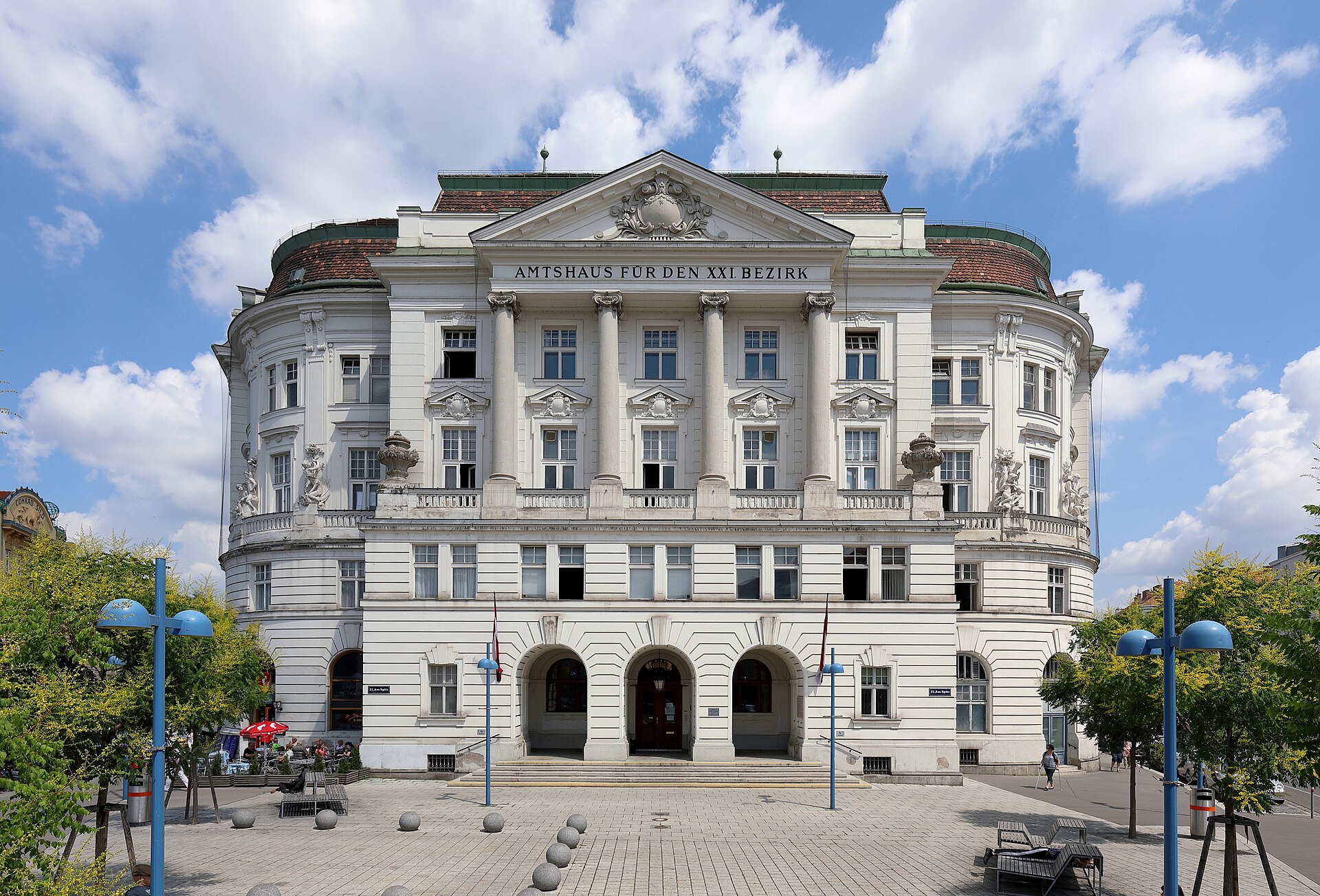
Floridsdorf
Introduction
Floridsdorf lies north of the Danube as Vienna's 21st district, a part of the city that grew out of former villages including Floridsdorf itself, Donaufeld, Jedlesee, Leopoldau, Stammersdorf, Strebersdorf and Groß-Jedlersdorf. It is one of Vienna's fastest-growing districts, and its character comes from the mix of urban infrastructure with green space: vineyards, parks and historical architecture sit alongside the everyday fabric of the city.
For a visitor, that blend is the draw. You can move between built-up areas and open, planted ground without leaving the district, and the village origins of its neighbourhoods still shape how each part feels.
Getting around
Floridsdorf sits on the left bank of the Danube in Vienna's northeast, and its mix of busy urban nodes and village-like quarters is easiest to explore on Vienna's integrated public transport network, run mainly by Wiener Linien. A single ticket covers the U-Bahn, S-Bahn, trams and buses within the city zones, so you don't buy separate tickets for each mode — but you must validate your ticket before boarding. Everything centres on the Floridsdorf station complex, which combines U-Bahn, S-Bahn and bus services in one place. It's the northern terminus of the U6, which runs directly toward the city centre with interchanges at Spittelau (for the U4) and Westbahnhof (for the U3); as a rough guide, the journey to the centre takes around twenty to twenty-five minutes. The same complex is served by S-Bahn lines S1, S2, S3, S4, S7 and S8 plus regional trains into Lower Austria, and Tram 31 stops nearby for surface-level local trips. The U6 also serves other parts of the district, and the U1 reaches into neighbouring areas, so you can connect onward without a car.
Buses fill in the gaps away from the metro and tram corridors, with routes including the 20A, 25A, 26A, 28A, 29A, 30A and 31A, plus the 29B. Late at night, trains give way to night buses — the N29 serves the station area. For short trips, Nextbike/Citybike sharing is available around the station, and there's bicycle parking too; parking at the station itself is limited and paid. Ticket options include single tickets, 24-, 48- and 72-hour passes, weekly and monthly passes, and the Vienna City Card, which adds museum and attraction discounts. Buy from the accessible machines at the station, which accept cash and card, or ask at the Wiener Linien service centre there; real-time departure displays show when the next service is due. Note that the airport lies outside the standard city zones, so reaching it needs a separate ticket or a zone extension — one routing is the U6 to Spittelau, then the City Airport Train. There's a taxi stand at the station, and ride-hailing apps work in Vienna. Walking suits local exploring rather than crossing the whole district: around Am Spitz you'll find shops and services, the Floridsdorf Center mall, the Brünner Straße shopping street, a weekly farmers' market and cafés, while the Danube Island, the Japanese Cherry Tree Park near the Jedleseer Brücke footbridge, the Old Danube's shores, the Bisamberg slopes and the Marchfeldkanal banks reward a stroll or a ride. For anything beyond a neighbourhood wander, combine walking with the metro, tram or bus.
Three days in Floridsdorf
Day one: Start at Am Spitz, the heart of Floridsdorf, and get your bearings in the district centre. From there, walk or take a tram along Brünner Straße, the long spine of the neighbourhood, and dip into Floridsdorf Center for supplies. In the afternoon, head for the Danube and cross to Danube Island for a flat walk or cycle with the river on both sides. If you want to go further, follow the water to the Old Danube and the Japanese Cherry Tree Park, and cross at Jedleseer Brücke into Jedlesee, a quiet quarter with a village feel.
Day two: Turn north towards the vineyards and hills. Take a tram or bus to Stammersdorf, where the streets give way to wine-growing country, and walk on towards Strebersdorf and the slopes of the Bisamberg. This is the greenest edge of Vienna, with Lower Austria just beyond. Come back through Leopoldau, a district of old village cores and newer housing, and finish the day around Donaufeld, where the church and the low houses keep a small-town atmosphere.
Day three: Use the day to link Floridsdorf with the rest of Vienna. Wiener Linien trams, buses and the Bahn from Floridsdorf station make it easy to reach Spittelau and Westbahnhof, and the City Airport Train is handy if you are leaving. Buy a Vienna City Card or a ticket for the day, and note that Nextbike and Citybike stands let you cycle instead. Late in the day, return to the Danube for a last look at the water before heading back to Am Spitz.